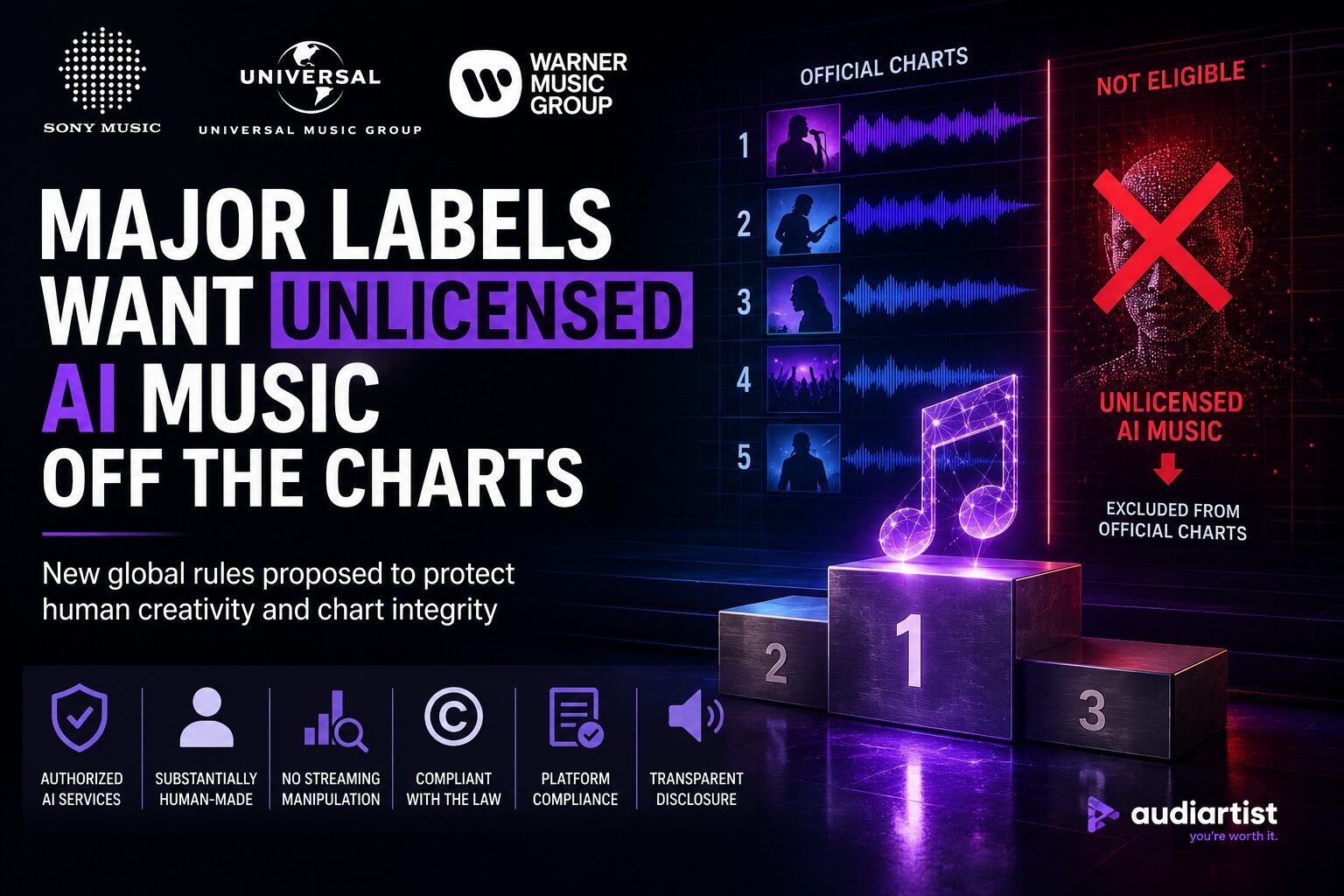

The world’s largest record companies have joined leading independent music groups to propose new global rules governing whether recordings created with generative artificial intelligence should be eligible for official music charts.
The coalition includes Sony Music Entertainment, Universal Music Group, Warner Music Group, Believe, BMG, Concord, Dirty Hit, Glassnote Records, HYBE, Mom+Pop Music and Partisan Records.
Under the proposed framework, AI-assisted music could remain eligible for chart recognition, but only when the recording is substantially human-made, created with authorized technology, legally compliant, transparently labelled and free from suspected streaming manipulation.
Fully synthetic recordings and music generated through unauthorized AI models would effectively be excluded.
The initiative marks an important change in the music industry’s response to artificial intelligence. Record companies are no longer discussing only how AI music should be labelled on streaming services. They are now asking whether certain synthetic recordings should be officially celebrated as commercial hits at all.
A Proposed Framework, Not Yet a Global Rule
The principles were announced on July 29, 2026, as a roadmap for official chart compilers, trade organizations and other music industry stakeholders around the world.
They have not yet been formally adopted by Billboard, the UK’s Official Charts Company or every national chart organization.
The proposal therefore does not immediately remove any particular recording from a chart. Each chart compiler would still need to decide whether to introduce the framework and how to apply it.
Nevertheless, the companies supporting the initiative control and distribute a substantial share of the world’s recorded music. Their collective influence means the proposal is likely to receive serious consideration from chart organizations, distributors and streaming platforms.
The coalition says the objective is to preserve official charts as a celebration of human artistry while still allowing responsible uses of artificial intelligence during the creative process.
The Six Requirements for Chart Eligibility
According to the proposed principles, a recording developed with generative AI should not be included in an official chart when there is reason to believe that it fails to satisfy any of six central conditions.
- Authorized technology: Any generative AI service used to create the recording must be properly authorized and lawful.
- Human-led creation: The recording must remain substantially human-made.
- Chart integrity: The release must not raise concerns about artificial streaming or chart manipulation.
- Legal compliance: The recording must respect copyright, related rights, personality rights and other applicable laws.
- Platform compliance: Releasing the recording must not violate the terms of the AI service used to create it.
- Consumer transparency: The use of generative AI must be appropriately disclosed to listeners through streaming services and industry metadata.
The rules attempt to address several different problems at the same time: unauthorized training, synthetic impersonation, mass-generated content, fraudulent streams and the absence of clear information for listeners.
They also create a distinction between AI used as a production tool and AI used as the primary creator of a recording.
AI-Assisted Music Could Still Enter the Charts
The proposal is not a complete rejection of artificial intelligence in music production.
A human artist using AI for sound restoration, vocal processing, stem separation, mastering, arrangement or limited creative assistance could still qualify for chart inclusion.
The decisive condition is that the recording must remain substantially human-made.
This reflects the music industry’s wider attempt to separate two categories.
AI-assisted music describes recordings in which human creators remain responsible for the essential artistic decisions while using artificial intelligence for specific elements.
AI-generated music describes recordings in which a generative system produces most of the important creative content, such as the lead vocal, composition, lyrics or principal instrumentation.
The distinction appears reasonable in theory. Applying it consistently may prove far more complicated.
What Does “Substantially Human-Made” Actually Mean?
The most important phrase in the proposed framework is also its most ambiguous.
The companies do not provide a numerical threshold defining how much human involvement is required for a recording to be considered substantially human-made.
A producer may write the lyrics and structure of a song before asking an AI platform to generate the vocal and instrumental performance. Another artist may generate an initial composition, replace several parts, record new vocals and completely remix the result.
Both projects involve human decisions and artificial generation, but the balance of creative responsibility is different.
Modern production workflows make the distinction even more difficult. Artificial intelligence can contribute to songwriting, arrangement, synthesis, voice transformation, sound design, mixing, mastering and visual content.
A simple binary label may not accurately describe every stage of that process.
Chart organizations will therefore need more detailed criteria if they want to avoid inconsistent decisions or disputes between artists, labels and distributors.
Only Authorized AI Services Would Qualify
The requirement that artists use properly authorized and lawful AI services may become one of the most controversial parts of the proposal.
Many of the best-known generative music platforms have faced allegations that their models were trained on copyrighted recordings without permission.
The proposed chart rules would make the legal and licensing status of the technology part of a recording’s eligibility.
An artist could create a popular song without directly copying an existing track and still be excluded if the underlying generative service was considered unauthorized.
This gives record labels another way to encourage the use of licensed AI platforms developed through agreements with rights holders.
Universal Music Group, Warner Music Group and other music companies have already entered licensing partnerships with selected AI developers. Those services could gain a significant commercial advantage if their users remain eligible for charts while recordings created through unlicensed competitors do not.
The rule therefore concerns more than copyright protection. It could help determine which AI companies are accepted as legitimate participants in the professional music economy.
Artists May Need to Identify Every AI Tool They Used
Enforcement would require more detailed information than many artists and distributors currently provide.
Declaring that a recording contains AI may not be sufficient. Rights holders and chart compilers may also need to know which platform generated the material, what parts of the recording were affected and whether the artist complied with that platform’s terms.
This could create a new layer of metadata within the distribution process.
Artists may eventually need to specify whether AI was used for vocals, instrumentation, composition, lyrics, mixing or other creative elements.
Distributors would then be responsible for transmitting that information to streaming services and chart organizations.
The music industry recently proposed standardized labels for AI-generated and AI-assisted recordings. The new chart principles could make those supposedly voluntary labels practically essential for anyone seeking official chart recognition.
Streaming Fraud Is a Central Part of the Proposal
The framework also states that recordings should be excluded when they raise concerns about streaming or chart manipulation.
This condition applies to human and synthetic music alike, but industrial AI production creates additional risks.
Generative systems can create thousands of tracks at extremely low cost. The same operators can then use automated accounts, manipulated playlists or paid streaming networks to inflate their consumption.
The result is a system in which both production and listening can be automated.
Artificial streams may redirect royalty money away from legitimate artists while creating the appearance of commercial popularity.
Allowing manipulated recordings to enter official charts would give those campaigns additional credibility, media exposure and promotional value.
The coalition argues that music with fraudulently inflated consumption should not be publicly recognized as a genuine hit.
Deezer’s Data Shows Why the Industry Is Acting
The proposal arrives as streaming services receive an unprecedented volume of synthetic music.
Deezer reported that it was receiving close to 90,000 fully AI-generated tracks per day in June 2026. On peak days, synthetic recordings represented more than half of all newly delivered music.
Yet fully generated music still accounted for only 1% to 3% of listening activity on the platform.
Deezer also said that up to 85% of streams associated with fully AI-generated recordings during 2025 were considered fraudulent and excluded from royalty payments.
These figures reveal a significant gap between the quantity of synthetic music uploaded and genuine audience demand.
AI is already transforming the supply side of streaming, but much of that activity does not represent real cultural popularity.
Chart rules based only on raw stream totals may therefore become increasingly vulnerable to automated production and artificial consumption.
Disclosure Would Become Essential
The proposed framework requires generative AI use to be appropriately signalled to listeners.
This connects chart eligibility to the wider industry campaign for standardized AI metadata and visible labels on streaming services.
Transparency would allow listeners to understand whether a recording was human-led, AI-assisted or largely generated by a machine.
It would also help chart organizations evaluate whether a recording satisfies the human-made requirement.
However, disclosure systems currently depend heavily on information supplied by artists, labels and distributors. Not every streaming platform performs its own technical detection.
A creator determined to conceal the use of AI could simply provide incomplete metadata unless additional verification systems are introduced.
Chart compilers may therefore need to combine declarations with audio analysis, distribution records and investigations into suspicious release patterns.
False Positives Could Harm Human Artists
Detection systems are improving, but they are not infallible.
Highly processed vocals, synthetic instruments, aggressive mastering and experimental sound design may sometimes resemble the characteristics of fully generated audio.
A human artist could be incorrectly identified as using unauthorized generative technology and lose chart eligibility as a result.
The opposite problem is equally possible. AI-generated music can be edited, re-recorded or mastered in ways that make detection more difficult.
Any chart organization adopting the principles will need a transparent review process and a meaningful right of appeal.
AI detection should provide evidence for investigation rather than function as an automatic verdict.
Charts Still Carry Commercial Value
Music charts may no longer dominate popular culture in the same way they did during the physical sales era, but they remain commercially important.
A chart position can support marketing campaigns, media coverage, festival bookings, radio promotion and negotiations with labels or distributors.
Chart success also contributes to gold, platinum and other industry certifications in many markets.
Excluding a recording from official rankings would therefore have consequences beyond removing its name from a weekly list.
It could limit the commercial legitimacy of fully synthetic projects even when they accumulate millions of streams.
The proposal creates the possibility that a song may be popular on a streaming platform while remaining ineligible for official recognition.
The Industry Is Not Rejecting AI, but Defining Acceptable AI
The participation of Universal, Warner and other companies that have signed licensing agreements with AI developers reveals an important contradiction.
The record industry is not trying to remove generative technology from music entirely.
It wants to establish conditions under which that technology can participate in the market.
Those conditions include authorization, compensation, human involvement, disclosure and protection against fraud.
An AI-assisted track created through a licensed platform could be accepted. A fully synthetic recording produced through an unlicensed model could be excluded, even if listeners stream it in large numbers.
The debate is therefore shifting from whether AI should exist in music to who controls it, who receives payment and which uses deserve industry recognition.
Independent Artists Could Face Additional Administrative Pressure
Large labels have legal departments, metadata teams and direct relationships with chart compilers. Independent musicians may find the new requirements more difficult to navigate.
An artist using several production tools may not know whether each service is considered properly authorized in every territory.
Some AI platforms also provide limited information about their training data or licensing arrangements.
Independent distributors will need clear and accessible guidance rather than expecting individual artists to interpret complex copyright disputes.
Without consistent procedures, the framework could create uncertainty for legitimate creators while sophisticated high-volume operators find new ways to avoid detection.
The coalition will therefore need to work with distributors and chart organizations to make compliance practical, not merely principled.
Who Decides Which AI Platforms Are Legitimate?
The proposal also creates a larger governance question.
Chart compilers would need a reliable method for deciding whether a generative service is authorized and lawful.
A platform may hold licences from some labels but not others. Its legal status may differ between countries, and ongoing lawsuits may remain unresolved for years.
A service could also combine licensed training material with public-domain recordings, user uploads or other datasets whose ownership is disputed.
There is currently no universal register of approved AI music tools.
If record companies effectively decide which platforms are legitimate, critics may argue that the rules favour services with major-label partnerships while excluding smaller competitors.
If every chart organization performs its own evaluation, decisions could vary dramatically between markets.
A transparent independent standard will be necessary if the framework is to earn confidence from artists and listeners.
Official Charts Are Becoming Cultural Gatekeepers Again
Streaming services largely replaced traditional gatekeepers by allowing almost any artist to distribute music globally.
The rise of generative AI is now encouraging the industry to reintroduce boundaries at the level of recognition rather than distribution.
A synthetic track may remain available to stream. It may even become viral. Yet it could still be excluded from the systems that officially classify commercial success.
This approach avoids a complete ban while reserving charts for recordings that meet specific creative, legal and ethical standards.
Supporters will see it as protection for human artists.
Critics may describe it as an attempt by established rights holders to control a new form of production and determine which AI companies can compete.
Both interpretations contain part of the truth.
The Next Battle Is Over Recognition
The music industry’s first conflict with generative AI concerned training data and copyright.
The second concerned labelling and transparency.
The next conflict may concern cultural legitimacy.
If the proposed principles are adopted, official charts would no longer measure consumption alone. They would also judge how a recording was created, which tools were used and whether the work contains enough human authorship to deserve recognition.
That would represent a major change in the meaning of a hit.
A track could accumulate millions of plays and still fail to qualify as an official chart success because its creation was considered too synthetic, insufficiently transparent or legally questionable.
The proposal has not yet rewritten the world’s chart rules. It has, however, established the direction in which many of the industry’s most powerful companies want them to move.
Artificial intelligence may be allowed to assist the artist. The industry is far less willing to let the machine stand alone on the podium.