Free Compressor Plugin
Multi-Comp: Eight Free Compressors Inside One Powerful Plugin
Optical leveling, aggressive FET compression, console-style glue, transparent control and four-band processing in one open-source dynamics tool.
Multi-Comp is a free multi-mode compressor developed by Dusk Audio for mixing, recording, mastering and creative dynamics processing.
Instead of recreating only one compressor design, the plugin provides eight distinct modes. Producers can move from smooth optical leveling to aggressive FET limiting, punchy VCA compression, transparent digital control or detailed four-band processing without loading a different plugin for every task.
The current version is Multi-Comp 1.3.4. It is completely free, open source and available for Windows, macOS and Linux. There is no account, subscription, activation manager or reduced commercial edition hiding the useful controls behind a payment screen.
| Developer | Dusk Audio |
|---|---|
| Plugin type | Multi-mode dynamics compressor |
| Current version | 1.3.4 |
| Platforms | Windows, macOS and Linux |
| Plugin formats | VST3, AU and LV2, depending on the platform |
| Compression modes | Eight, including Opto, FET, VCA, Bus, Digital and Multiband |
| Multiband processing | Four bands with adjustable Linkwitz-Riley crossovers |
| Additional tools | Sidechain, lookahead, parallel mix, saturation and oversampling |
| Price | Free and open source |
Eight Compression Modes
Multi-Comp changes its processing architecture and controls according to the selected mode. This is more useful than applying a different visual skin to the same generic compression algorithm.
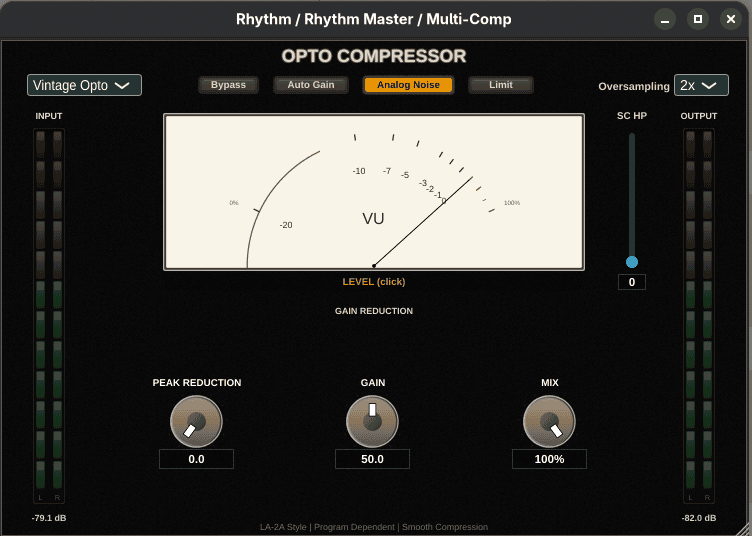
Vintage Opto recreates the slower, program-dependent behavior associated with optical leveling amplifiers. It includes a T4-style optical response, tube-stage modeling and separate Compress and Limit modes. This setting is particularly effective for vocals, bass guitar and sources that need smooth level control.
Vintage FET offers much faster attack times, four classic ratios and an All-Buttons mode for aggressive compression and harmonic distortion. It works well on drum rooms, vocals, basses and parallel processing.
Classic VCA provides punchy compression with an optional soft knee. It is a practical choice for drums, percussion and other transient-heavy material.
Bus Compressor follows the workflow of a British console compressor, with stepped attack and release settings, automatic release and ratios of 2:1, 4:1 and 10:1. It is designed for drum buses, instrument groups and mix-bus glue.
Studio FET and Studio VCA offer cleaner alternatives to the vintage modes. They retain fast or musical compression behavior while generating less coloration.
Digital provides precise dynamics control without analog saturation. It is suitable for corrective work, dialogue, mastering and situations where the original tone should remain unchanged.
Four-Band Multiband Compression
The Multiband mode divides the signal into Low, Low-Mid, High-Mid and High sections using Linkwitz-Riley crossovers.
Each band provides individual threshold, ratio, attack, release and makeup-gain controls. Bands can also be soloed, bypassed or disabled while adjusting the crossover structure.
This mode can control uneven low frequencies, reduce harsh upper mids, stabilize vocal presence or manage a full mix without applying the same amount of compression to every frequency.
Multiband compression should still be used carefully. Four bands do not automatically make a mix four times more professional, although the interface may briefly suggest otherwise.
Analog Modeling and Transformer Colour
The vintage modes include different harmonic and frequency-response characteristics rather than sharing one saturation stage.
Vintage Opto models an optical cell and tube output stage. Vintage FET adds Class A transistor-style saturation, while Bus mode introduces the coloration associated with console VCA processing.
Input and output transformer responses also vary between selected modes. A dedicated Analog Noise control adds a subtle noise floor when a more hardware-like result is desired. It can remain disabled for completely silent digital operation.
The saturation amount depends on the selected mode and how hard the signal enters the processor. Producers can therefore use Multi-Comp as a clean dynamics tool or deliberately drive it for additional harmonic density.
Sidechain, Lookahead and Parallel Compression
Multi-Comp includes an internal sidechain high-pass filter adjustable from 20 to 500 Hz. Removing low frequencies from the detector can prevent kicks and bass notes from triggering excessive gain reduction.
External sidechain input is also supported. This allows a kick to duck a bass, a vocal to control background instruments or another track to trigger rhythmic pumping.
Global lookahead can be adjusted from 0 to 10 milliseconds. Higher values help the compressor anticipate fast transients, although they also introduce latency.
A Mix control provides parallel compression directly inside the plugin. The compressed signal can be blended with the original source without creating a separate auxiliary channel.
Oversampling and Output Distortion
Oversampling can be disabled or set to 2x or 4x. Higher settings reduce aliasing generated by nonlinear saturation but require more processor resources.
Producers can work with oversampling disabled while arranging, then select 2x or 4x before rendering when the additional quality is useful.
The output section also provides Soft, Hard and Clip distortion options. These can add subtle density, control peaks or push the compressor into more obvious creative processing.
Thirteen Factory Presets
Multi-Comp includes 13 presets designed for vocals, drums, bass, guitars, mix buses and creative pumping.
Examples include Smooth Opto Vocal, Vocal Presence, Classic Drum Glue, Room Nuke, Snare Snap, Vintage Pinned Bass, Gentle Master and EDM Pump.
The presets provide useful starting points, but threshold and input levels should always be adjusted for the source. Compression depends on the incoming signal, so the same preset can react very differently to a quiet vocal and a heavily limited drum loop.
Best Uses
- Smooth vocal and bass leveling
- Aggressive FET drum compression
- Drum-bus and mix-bus glue
- Transparent corrective dynamics control
- Four-band mixing and mastering
- Parallel compression
- Sidechain pumping for House and EDM
- Adding analog-style saturation and density
Compatibility and Installation
Windows users need Windows 10 or later and receive the plugin in VST3 format.
On macOS, Multi-Comp requires macOS 10.13 or later and is available as VST3 and Audio Unit. Linux builds are supplied in VST3 and LV2 formats for compatible 64-bit distributions.
The plugin supports sample rates from 44.1 kHz to 192 kHz. A compatible 64-bit DAW is required.
No account, license key, installer manager or online activation is necessary. The files can be copied into the appropriate plugin directory before rescanning the DAW.
Main Limitations
- No official AAX version for Pro Tools
- No confirmed VST2 edition
- Different modes use different controls and require some learning
- Lookahead and oversampling introduce additional latency or CPU use
- Analog modes can colour the signal when transparency is required
- Multiband compression can produce unnatural results when overused
Final Verdict
Multi-Comp is an unusually complete free compressor for producers who want several dynamics-processing styles inside one plugin.
The eight modes cover smooth leveling, fast transient control, bus compression, transparent digital processing and detailed multiband work. Sidechain filtering, external triggering, lookahead, parallel mixing, saturation and oversampling add the controls expected from a serious modern compressor.
Its broad feature set makes it useful for vocals, drums, basses, instrument buses and complete mixes. Beginners can start with the factory presets, while experienced engineers can adjust each mode according to the source.
For Windows, macOS and Linux users looking for a free open-source compressor that can remain useful beyond the first project, Multi-Comp is a strong addition to a mixing toolkit.