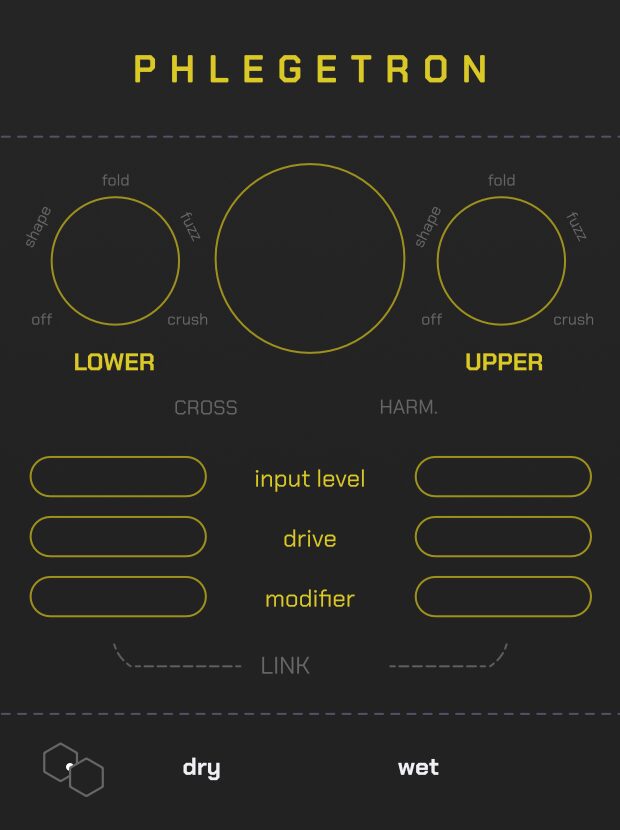

Phlegetron by Igorski is a free dual-band distortion plugin released in 2026 for Windows and macOS.
The effect separates incoming audio into two independently processed sections, allowing producers to apply different types and amounts of distortion across selected parts of the frequency spectrum. Its crossover and harmonic splitting modes make Phlegetron particularly useful for synthesizers, basses, drums and experimental electronic sound design.
What Is Phlegetron?
Phlegetron is a free audio effect developed by Igor Zinken under the Igorski name.
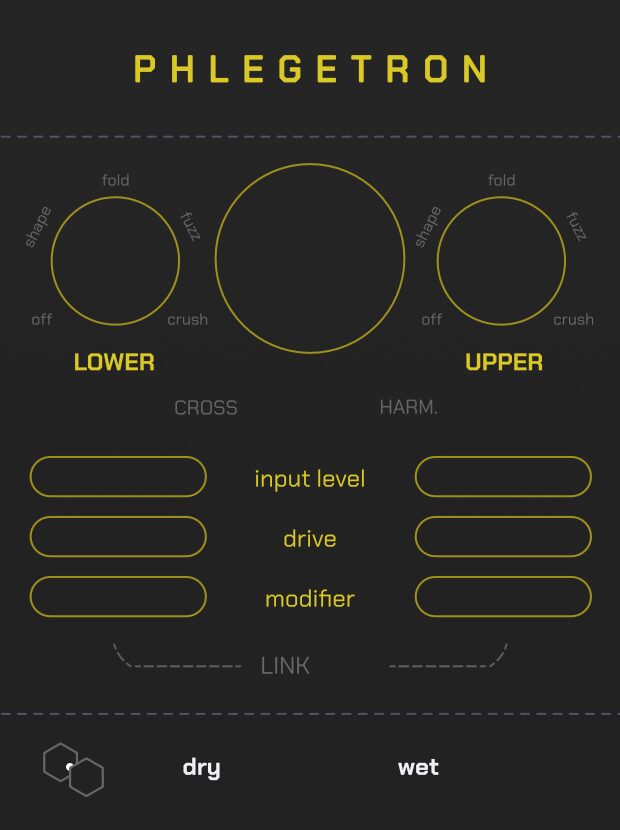
Instead of applying one distortion algorithm to the complete signal, the plugin divides the audio into two bands named Lower and Upper. Each section can use its own distortion mode, input level, drive amount and modifier setting.
This structure makes it possible to preserve one part of a sound while applying more aggressive processing to another.
Crossover and Harmonic Splitting
Phlegetron provides two methods for dividing the incoming signal.
Cross mode works like a conventional frequency crossover. The large central control sets the frequency separating the lower and upper bands.
A producer could keep the low frequencies of a bass relatively controlled while adding wavefolding, fuzz or digital crushing to its upper harmonics.
Harmonic mode uses a less conventional separation based on harmonic frequency components. Its response changes according to the tonal content of the source, making it useful for animated and less predictable distortion effects.
Four Distortion Algorithms
Each band offers four distortion modes plus an off position.
- Shape: Waveshaping distortion for harmonic coloration and stronger nonlinear processing
- Fold: Wavefolding that reflects the waveform and generates additional harmonics
- Fuzz: Harder clipping combined with a gated and spluttering character
- Crush: Digital degradation based on downsampling and bit reduction
The Lower and Upper bands can use different algorithms simultaneously. A warm waveshaper can therefore process one frequency area while a digital crusher transforms another.
Input Level, Drive and Modifier
Each processing band includes three central controls.
Input Level determines how strongly the signal enters the distortion stage. Drive controls the overall intensity of the selected algorithm.
The Modifier parameter changes its function according to the active distortion mode. It adjusts the curve in Shape mode, the folding threshold in Fold mode, the gate threshold in Fuzz mode and the amount of bit reduction in Crush mode.
This keeps the interface compact while still providing meaningful control over each distortion character.
Link and Parallel Processing
The Link function mirrors the Lower settings to the Upper section.
This is useful when both bands should use the same distortion character while still being separated through the crossover or harmonic engine.
Independent Dry and Wet controls allow the distorted signal to be blended with the original audio. Phlegetron can therefore be used for parallel saturation as well as completely processed sound design.
Best Uses for Phlegetron
- Adding upper-frequency aggression to bass sounds
- Creating distorted Techno and Industrial drums
- Processing harmonically rich synthesizers
- Generating digital percussion textures
- Adding controlled fuzz to guitars
- Creating parallel distortion on buses
- Transforming loops for experimental production
- Building aggressive effects for cinematic sound design
Phlegetron responds particularly well to sources containing strong harmonic detail. Saw waves, complex synth patches, basses and complete drum loops provide plenty of material for its two-band engine.
Automation and Sound Design
All parameters can be automated inside a compatible DAW.
Automating the crossover frequency can move the distortion through different areas of the spectrum. Switching algorithms or changing the Modifier parameter can create transitions, fills and continuously evolving textures.
More restrained settings can add harmonic density, while stronger drive and crushing values can reduce the source to something considerably less civilized.
Plugin Formats and Compatibility
- Windows: VST3, Windows 10 or later
- macOS: VST3 and Audio Unit, macOS Catalina or later
- Mac architecture: Intel and Apple Silicon
- Plugin type: Audio effect
A compatible plugin host supporting VST3 or Audio Unit is required.
Official Linux binaries are not currently supplied. Linux users can compile the open-source project from the official GitHub repository.
Free and Open Source
Phlegetron is completely free and released under the GPL-3.0 open-source license.
No account, subscription, license key or online authorization is required. The official product page provides separate downloadable archives for Windows and macOS.
Download Phlegetron from the official Igorski website
View the official Phlegetron source code on GitHub
Important Limitations
Phlegetron is a focused distortion processor rather than a complete multi-effects suite.
It does not include modulation, oversampling controls, a preset browser or a large collection of additional effects. Its creative identity comes from the interaction between the two splitting methods and four distortion algorithms.
The harmonic mode can also respond very differently depending on the source material. This unpredictability is part of its character, but producers looking for completely repeatable frequency-band processing may prefer the conventional crossover mode.
Final Verdict
Phlegetron is a distinctive free distortion plugin for producers who want more control than a conventional full-range waveshaper or bitcrusher.
Its dual-band architecture allows different processing to be applied to the lower and upper parts of a sound, while the harmonic splitting mode introduces a more experimental alternative to standard multiband distortion.
For Techno, Industrial music, electronic bass design, drums and creative resampling, Phlegetron is a focused open-source VST3 effect that can move from controlled harmonic enhancement to unapologetic digital damage.