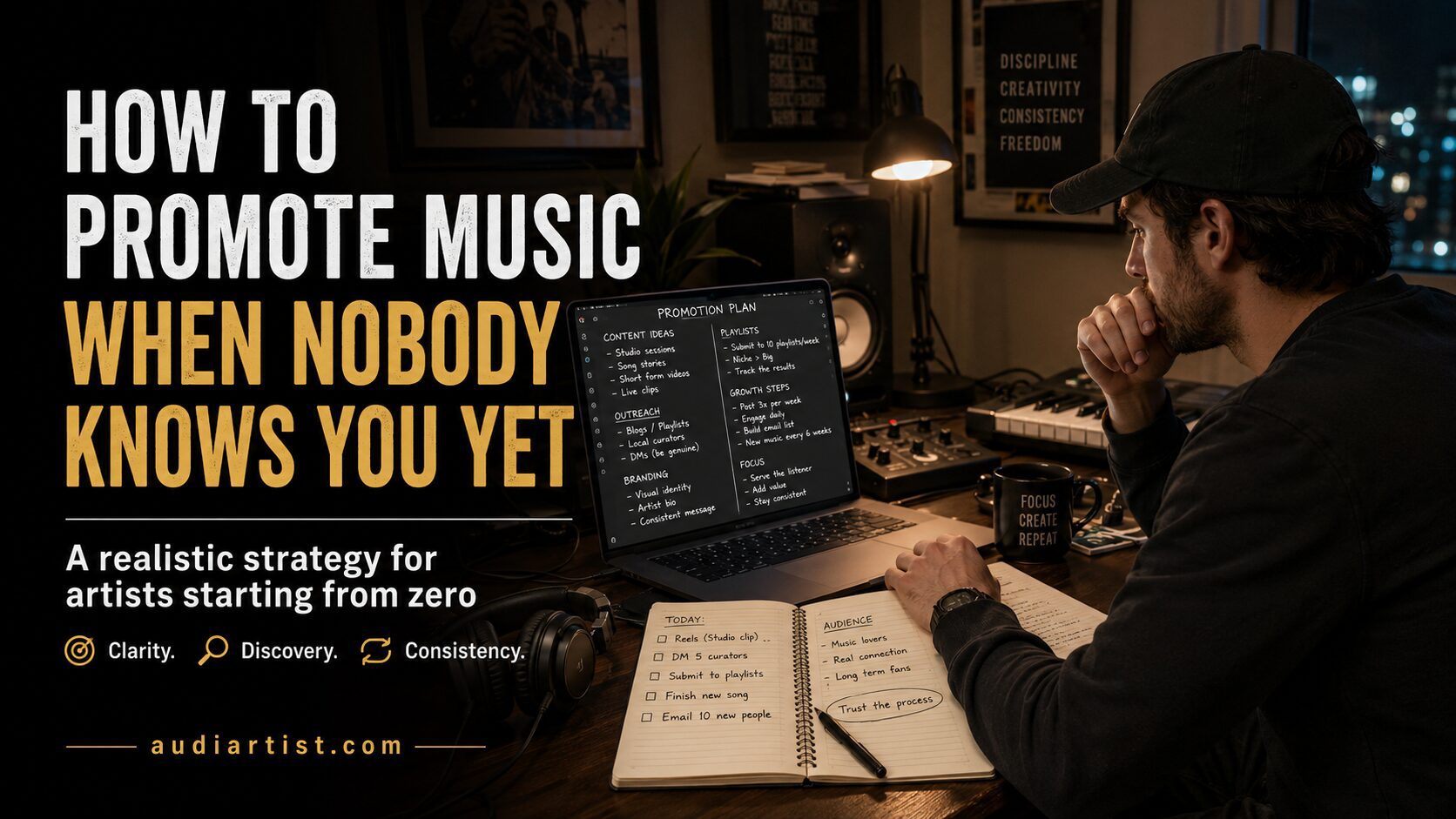

How to Promote Music When Nobody Knows You Yet
An unknown artist cannot promote music the same way as an artist with an audience. A famous artist can post a cover and generate attention because people already care. A new artist has to create the reason to care before the link is even clicked. That changes everything. The strategy has to be more patient, more precise, and more human. It cannot depend on hype that does not exist yet.
The first phase of independent music promotion is not about looking big. It is about becoming understandable, discoverable, and worth returning to. It is about turning strangers into first listeners, first listeners into repeat listeners, and repeat listeners into people who recognize the artist’s name the next time it appears.
There is no glamorous shortcut here. But there is a smarter way to begin.
The First Truth: Nobody Is Waiting, and That Is Normal
One of the most painful realities for new artists is also the most liberating: nobody is waiting for the first release. That does not mean the music has no value. It means the audience has not been built yet. Discovery has to be earned before loyalty can exist.
Many artists interpret silence as rejection. A post gets little engagement, a track receives a few streams, a playlist pitch goes unanswered, and the artist assumes the song has failed. In reality, most people simply did not see it, did not understand it, or did not have enough context to stop what they were doing and listen.
This is why early music promotion should not be built around emotional expectations. It should be built around controlled exposure. The goal is not to become known overnight. The goal is to create enough small contact points for the right people to discover the artist repeatedly.
At the beginning, a listener usually needs more than one signal. They might see a short clip, ignore it, see another post days later, notice the artwork, hear a hook in a reel, read a line about the song, visit the profile, then finally listen. First discovery is rarely clean. It is messy, gradual, and built through repetition with purpose.
The artist who accepts this reality stops panicking after one quiet post. They begin building recognition instead.
Stop Promoting Like People Already Care
The most common mistake unknown artists make is promoting as if they already have fans. They post “new single out now,” “available on all platforms,” “go stream it,” or “link in bio,” then wonder why strangers do not react. The message assumes that the audience already has a reason to care. But at this stage, they do not.
For an emerging artist, the campaign must answer a different question: why should someone who has never heard your name give this song thirty seconds?
That answer cannot be vague. “This song means a lot to me” may be true, but it does not automatically create curiosity. “My new track is out everywhere” gives information, but not desire. A stronger message frames the experience. It tells the listener what the song feels like, when it should be heard, who it is for, and what emotional world it opens.
A lo-fi track should not be introduced like a festival anthem. A dark techno single should not be sold with generic lifestyle language. A cinematic pop song needs a different doorway than a raw rap track. The more precise the promise, the easier it becomes for the right listener to understand the invitation.
Unknown artists do not need louder announcements. They need sharper entry points.
Build a Clear Artist Identity Before Chasing Attention
When nobody knows you yet, clarity is more powerful than scale. A stranger landing on your profile should quickly understand the sound, the mood, the visual world, and the reason your project exists. If the profile feels scattered, conversion becomes harder.
This does not mean creating a fake persona or reducing the music to one narrow label. It means giving people enough structure to remember you. A clear artist identity helps listeners place the music in their mind. It also helps curators, bloggers, playlist owners, and collaborators understand where the project belongs.
An artist with no audience cannot afford confusion. If the artwork says one thing, the bio says another, the posts feel random, and the music is presented with generic captions, the listener has no anchor. They might enjoy one song and still forget the artist immediately.
A strong identity starts with simple decisions. What musical world are you building? What emotions return across your songs? What scenes, images, colors, and moods fit your sound? What type of listener would genuinely understand this music? What sentence could describe the project without sounding empty?
Promotion becomes easier when the artist stops asking people to decode everything alone.
Your First Audience Is Usually Smaller Than You Think
Many new artists imagine their potential audience as huge, but their first real audience is usually very specific. It may be fans of a niche sound, a local scene, a playlist mood, a micro-community, a genre corner, a visual aesthetic, or a certain emotional state. This is not a weakness. It is where momentum begins.
Trying to reach everyone too early often produces weak results. Broad promotion creates broad indifference. A song described as “for everyone who loves good music” does not speak directly to anyone. A track positioned for late-night house listeners, cinematic synthwave fans, underground rap heads, intimate acoustic audiences, or nostalgic lo-fi listeners has a clearer chance of connecting.
At the beginning, the artist needs a beachhead audience. This is the first group most likely to care before the wider world does. They may be small, but if they respond, they provide the first meaningful signals: saves, comments, shares, playlist adds, profile visits, and repeat listening.
The first audience is not the final audience. It is the first fire. Once it burns, the artist can expand.
Use Content to Create Context, Not Just Visibility
Posting often is not enough. An unknown artist needs content that explains the music without turning every post into an advertisement. The audience needs to hear the sound, understand the feeling, and see the person or world behind the track.
This is where context becomes essential. A studio clip can show the process. A short lyric explanation can reveal meaning. A performance video can create trust. A mood-based visual can place the song in a specific moment. A behind-the-scenes post can make the artist more human. A production breakdown can attract musicians and serious listeners. A story about why the song exists can create emotional entry before the stream.
The goal is not to flood social media with random clips. The goal is to build a sequence of reasons to listen. Each piece of content should answer one hidden question: what is this song, why does it matter, and why should I care now?
For unknown artists, content is not decoration around the release. It is the bridge between silence and discovery.
Do Not Wait for a Viral Moment
Viral success is seductive because it looks like a shortcut. One clip catches fire, the streams rise, followers arrive, and the artist seems to leap over the hard early phase. But building a music promotion strategy around virality is like building a house on weather. It might happen. It cannot be controlled.
Unknown artists need systems more than miracles. A system means posting with consistency, testing hooks, refining the message, pitching to relevant curators, improving visuals, tracking what converts, building a small direct audience, and learning from each release. This may sound less exciting than going viral, but it is far more reliable.
A viral clip without a clear artist identity can disappear quickly. A smaller campaign with strong saves, profile visits, and repeat listeners can become the foundation of a real career. The difference is durability.
The smartest early promotion strategy is not “how do I explode?” It is “how do I make every new listener more likely to remember me?”
Pitch Smaller, Better, and More Personally
When an artist is unknown, playlist pitching and media outreach require precision. Sending the same message to hundreds of curators rarely works. It wastes energy, creates frustration, and often lands in the wrong places.
A better strategy is to pitch smaller and sharper. Look for playlists, blogs, channels, radios, and curators that genuinely match the track’s genre, mood, tempo, language, and audience. A small curator with real listeners can be more useful than a large playlist with no fit. A niche blog that understands the sound can be more valuable than a broad outlet that ignores the pitch.
The pitch should be concise, human, and specific. It should explain the sound clearly, mention why the track fits the curator’s selection, and provide an easy listening link. It should not beg, oversell, or inflate the artist’s story. Curators do not need a novel. They need context and quality.
At the beginning, outreach is not only about immediate placement. It is also about building recognition. A curator who does not add the first track may remember the artist on the second or third submission if the music, message, and professionalism are consistent.
Make Your Profile Ready Before You Send People There
Promotion often fails because the artist sends people to a profile that is not ready to convert. The song may be strong, but the surrounding presentation feels unfinished. A weak bio, inconsistent visuals, missing links, unclear genre identity, poor profile photo, or empty social page can make listeners hesitate.
Before pushing a release, the artist should make sure every important profile answers the basic questions. Who is this artist? What kind of music do they make? What is the latest release? Where can I listen? Where can I follow? What is the visual identity? Does this look serious enough for me to pay attention?
This applies to Spotify, Apple Music, YouTube, Instagram, TikTok, SoundCloud, Bandcamp, the artist website, and any platform used in the campaign. If a listener discovers the song and becomes curious, the profile must be ready to receive that curiosity.
An unknown artist cannot rely on reputation. Presentation has to create trust quickly.
Use One Song to Open Several Doors
Many artists promote a song once, usually on release day, then stop when the reaction is modest. That approach wastes the material. A single song can create many pieces of promotion if the artist breaks it into angles.
One post can introduce the mood. Another can highlight the strongest hook. Another can explain the story. Another can show the production. Another can focus on the lyrics. Another can use the track in a visual scene. Another can invite listeners into a playlist. Another can thank early supporters. Another can show where the song is being heard. Another can connect the track to the next release.
This is not repetition if every post adds a new reason to listen. The mistake is posting the same link with the same caption over and over. The opportunity is to let the song reveal itself through different doors.
Unknown artists need multiple touchpoints because one announcement rarely creates enough recognition. The audience may need to meet the song several times before it feels familiar enough to click.
Turn Early Listeners Into Real Signals
At the beginning, every real listener matters. Not because each stream changes the numbers dramatically, but because each listener can leave a signal. A save, comment, share, playlist add, message, or follow can help the artist understand what is working.
Instead of chasing anonymous numbers only, unknown artists should pay attention to the first people who respond. What did they mention? Did they connect with the hook, lyrics, beat, mood, voice, production, or visual? Did they discover the song through a post, playlist, message, video, or recommendation? Did they come back?
These early reactions are valuable because they show how the music is landing in real life. They can help shape future captions, visuals, pitches, and even the next song. If listeners repeatedly describe the track as cinematic, hypnotic, raw, nostalgic, sensual, dark, peaceful, or energetic, those words can become part of the artist’s promotional language.
When nobody knows you yet, the first listeners are not just statistics. They are the first clues.
Collaborate With Purpose, Not Panic
Collaboration can help unknown artists reach new audiences, but only when it makes sense. A random collaboration with no artistic fit rarely produces lasting growth. A smart collaboration connects two worlds that can genuinely understand each other.
This could be another artist in the same genre, a producer with a complementary sound, a vocalist who brings a new emotional layer, a visual creator who can translate the music into strong content, a dancer, a DJ, a playlist curator, a local videographer, or a small media page focused on the right scene.
The key is alignment. The collaboration should make the music clearer, not more confusing. It should introduce the artist to people who are likely to care, not simply increase exposure for the sake of exposure.
At the early stage, quality of connection beats size of audience. A small collaboration that produces real listener engagement is more valuable than a bigger one that creates noise and no memory.
Build Direct Contact as Soon as Possible
Social platforms are useful, but they are unstable. Algorithms change, reach fluctuates, accounts get restricted, trends move quickly, and followers do not always see posts. Unknown artists should begin building direct contact with listeners as early as possible.
This can be done through an email list, a private community, a website, Bandcamp followers, YouTube subscribers, SMS, Discord, or any channel where the artist can reach people without depending entirely on a feed. The goal is not to build a massive list immediately. The goal is to start owning the relationship.
Even a small direct audience can be powerful. Fifty people who actually open messages, listen to songs, and respond are more valuable than thousands of passive impressions. Direct contact creates continuity between releases. It helps the artist avoid starting from zero every time.
The earlier this habit begins, the stronger the long-term foundation becomes.
Use Local and Micro-Scene Promotion
Many artists think digital promotion means ignoring the local world. That is a mistake. Local scenes, small events, independent radios, student media, regional blogs, DJ communities, open mics, record shops, studios, collectives, and cultural pages can create the first layer of recognition.
Local promotion works because it adds human proximity. A stranger on the internet may ignore an unknown artist. A local listener may give the song a chance because it comes from their city, scene, language, or cultural environment. That first connection can matter.
Micro-scenes are equally important online. A niche Discord group, a small YouTube channel, a genre-specific subreddit, a producer community, a playlist community, or an independent music newsletter can provide more meaningful discovery than a broad social post seen by the wrong people.
Early music promotion is about finding rooms where the artist is not invisible. Sometimes those rooms are smaller than expected. That is exactly why they work.
Measure Progress Differently at the Beginning
New artists often judge themselves with the wrong scoreboard. They expect large stream numbers, strong playlist support, active comments, and fast follower growth before the audience exists. This creates discouragement and can lead to bad decisions.
At the beginning, progress may look smaller but still matter. More saves than the previous release. Better completion rates. A few personal playlist adds. One curator reply. A stronger visual identity. More profile visits. A handful of repeat listeners. A better-performing reel. A clearer pitch. A small increase in followers from the right audience.
These are not glamorous wins, but they are real. They show that the artist is learning how to move people. Early promotion is less about instant scale and more about improving the conversion path.
The question should not be, “Did this make me famous?” The better question is, “Did this create more meaningful movement than the last campaign?”
Create a Simple 90-Day Visibility Plan
When nobody knows you yet, consistency matters more than intensity. A chaotic week of heavy promotion followed by silence rarely builds recognition. A simple 90-day plan can create a stronger foundation.
The first month can focus on clarity: profile updates, artist positioning, visual identity, content testing, and a clean release presentation. The second month can focus on targeted outreach: playlists, blogs, local media, small communities, collaborations, and short-form content variations. The third month can focus on retention: direct contact, follow-up content, catalog promotion, listener feedback, and preparing the next release with better data.
This structure helps the artist avoid the release-day trap. Promotion becomes a rhythm rather than a panic reaction. The artist is no longer trying to force one song to change everything in one weekend.
Momentum grows when activity becomes repeatable.
The First Fans Are Built Through Recognition
Before people become fans, they need to recognize you. Recognition usually comes before loyalty. A listener sees the name once, hears a clip later, notices the artwork again, reads a story, hears the track in a playlist, then finally remembers the artist. That memory is the beginning of a relationship.
This is why unknown artists should not disappear between releases. The campaign does not need to be loud every day, but the artist should remain present with purpose. Small, consistent signals are more effective than rare bursts of desperate promotion.
The goal is to make the artist feel familiar to the right people. Familiarity reduces resistance. When the next song arrives, the listener is not starting from zero. They already have a trace of recognition.
That trace is where an audience begins.
Promotion Starts Before People Care
Promoting music when nobody knows you yet is not easy, but it is not hopeless. It requires a different mindset. The artist cannot rely on hype, reputation, or automatic attention. They have to build the path from silence to curiosity, from curiosity to listening, from listening to recognition, and from recognition to loyalty.
That path begins with clarity. A clear identity. A clear audience. A clear promise. A clear profile. A clear reason to listen. A clear next step. Without those pieces, promotion becomes noise. With them, even a small campaign can start to create movement.
Unknown artists do not need to pretend they are bigger than they are. They need to become easier to discover, easier to understand, and easier to remember.
The first stage of a music career is not about proving that everyone cares. It is about finding the first people who might.
Once they are found, everything changes.
Discover more independent music promotion strategies, artist resources, and playlist insights on Audiartist.
Submit your music for free on https://www.audiartist.com.
“`