QDelay by Tilr is a free dual delay VST3 plugin designed for producers who want more control than a basic echo effect without turning every session into a routing experiment.
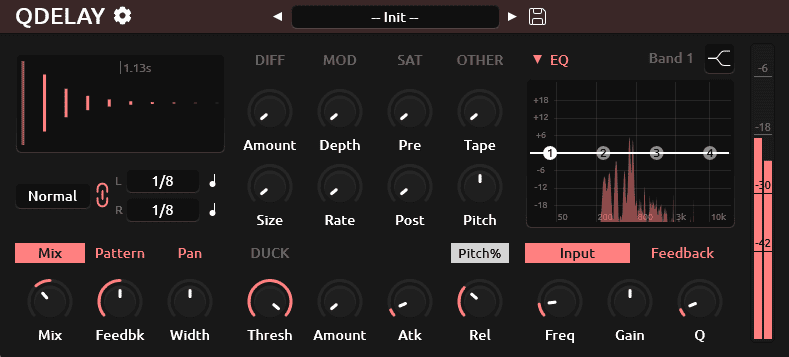
The plugin combines independent stereo delays with ping-pong processing, reverse playback, pitch shifting, diffusion, saturation, ducking and tape-style modulation. It can create clean rhythmic echoes, wide stereo patterns, ambient textures and heavily processed feedback effects from one compact interface.
What Is QDelay?
QDelay is a free and open-source stereo delay effect developed by Tiago Lourenço, also known as Tilr.
It was created as a complete alternative to restricted free delay editions. There are no premium features locked behind an upgrade, no subscription and no online activation.
The plugin provides independent delay times for the left and right channels, multiple routing modes and several built-in processors for shaping the delayed signal.
Multiple Stereo Delay Modes
QDelay includes normal stereo delay, ping-pong and tap-based processing.
Ping-pong mode sends repeats between the left and right channels, while the Width control changes the stereo movement. The Tap mode separates the initial offset from the main delay time, making it useful for rhythmic patterns and more complex echo structures.
Swing, Feel and odd or even accent controls can change the timing and level of individual repetitions.
Reverse, Pitch Shift and Diffusion
The Reverse function transforms conventional echoes into backward-moving textures and transitions.
A built-in pitch shifter can process either the feedback path or the post-delay signal. This allows each repetition to move higher or lower in pitch, creating melodic echoes, rising feedback effects and unusual sound design layers.
The Diffusion section can be positioned before or after the delay. Lower settings soften individual repetitions, while stronger processing can move the effect toward reverb-like spaces and ambient textures.
Saturation and Tape-Style Movement
QDelay includes saturation controls for the pre-delay, post-delay and feedback stages.
The Color, Bias and Dynamics parameters adjust the harmonic character and response of the saturation. Applying saturation inside the feedback loop can make each repetition progressively more colored and distorted.
Wow and Flutter introduce pitch movement inspired by analog tape instability. These controls are useful for lo-fi echoes, worn tape textures and less predictable modulation.
Built-In EQ and Ducking
A parametric EQ can process the input signal and the delay feedback path.
This makes it possible to remove low frequencies from the repeats, darken the feedback or emphasize a specific frequency area without loading another EQ plugin.
The ducking section reduces the delayed signal while new audio is present. When the input becomes quieter, the echoes return. This helps vocals, leads and other important sounds remain clear while still using a noticeable delay effect.
Best Uses for QDelay
- Tempo-synchronized vocal echoes
- Ping-pong synth delays
- Dub and techno feedback effects
- Pitch-shifted ambient textures
- Reverse transitions
- Lo-fi tape delay
- Rhythmic drum processing
- Creative resampling
QDelay can be used as a straightforward mixing delay, but its deeper controls make it particularly useful for electronic music and experimental sound design.
Plugin Formats and Compatibility
- Windows: VST3
- macOS: VST3 and AU
- Linux: VST3 and LV2
A compatible 64-bit DAW or plugin host is required.
The macOS builds are unsigned, so users may need to remove the quarantine attribute if the operating system blocks the plugin after installation.
Free and Open Source
QDelay is released under the GPL-3.0 open-source license.
No account, license manager or online authorization is required. The latest builds can be downloaded directly from the developer’s official GitHub Releases page.
Visit the official QDelay GitHub repository
Important Limitations
QDelay contains many processing options, but it is not intended to reproduce every detail of premium tape delay hardware or expensive commercial plugins.
Saturation inside the feedback path can also increase energy rapidly. Producers should monitor output levels carefully when using high feedback and distortion settings together.
Final Verdict
QDelay is an impressive free delay VST3 plugin for producers who want rhythmic echoes, stereo movement and creative sound design in one effect.
Its combination of pitch shifting, reverse delay, diffusion, saturation, ducking, EQ and tape modulation provides considerably more flexibility than a basic free delay.
For vocals, synthesizers, drums, ambient textures, dub effects and electronic music production, QDelay is a powerful open-source plugin worth downloading.