
Resonarium: A Free Waveguide Synth for Physical Modeling and MPE
Coupled string waveguides, expressive MPE control and semi-modular physical modeling inside a free open-source VST3 instrument.
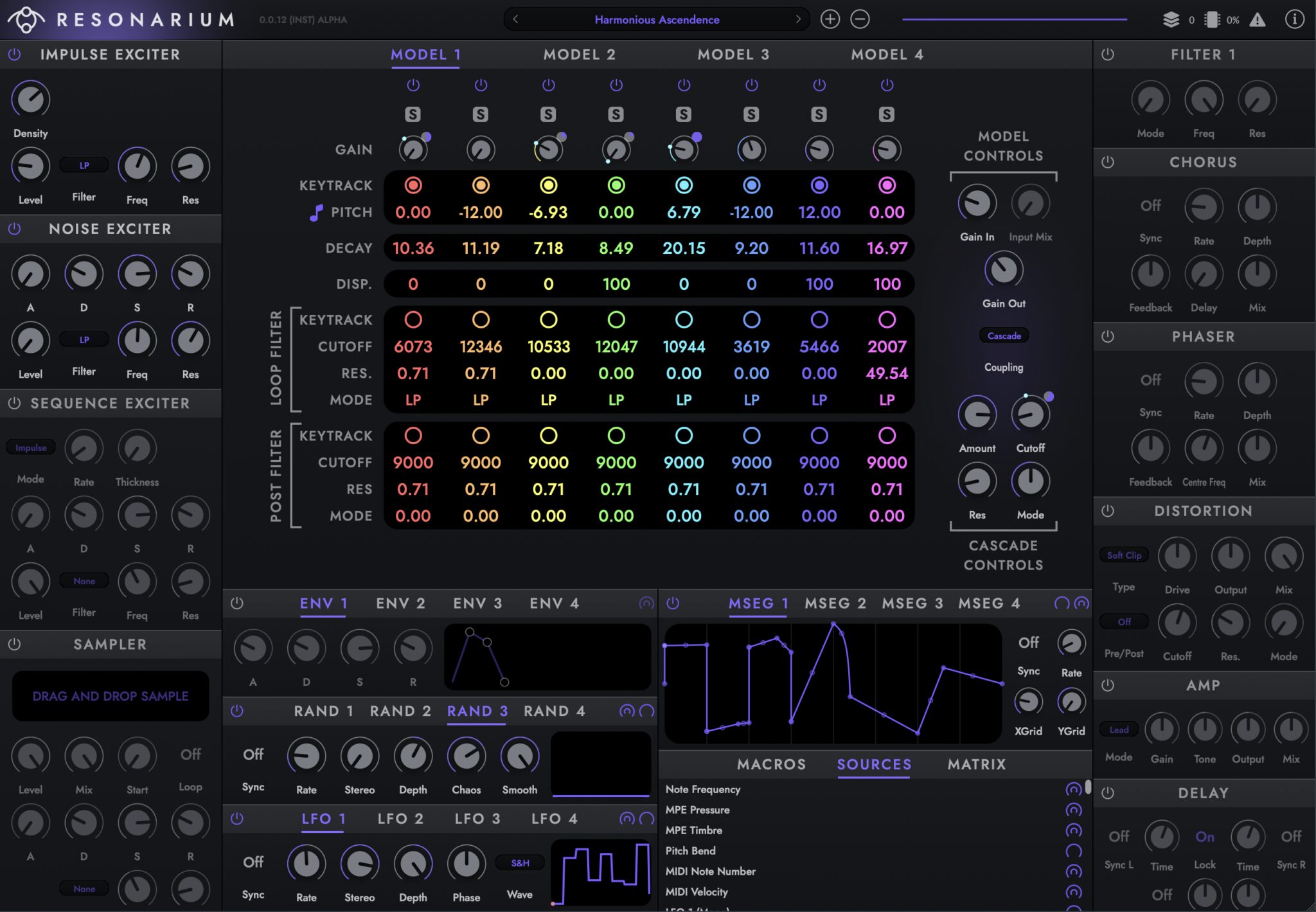
Resonarium by Gabriel Soule is a free, open-source physical-modeling synthesizer centered on coupled string waveguides. Rather than starting from sampled instruments or standard subtractive oscillators, it generates tone by simulating interacting resonant structures. The result is especially suited to plucked, struck, metallic and evolving acoustic-like sounds that can remain recognizably synthetic.
Coupled Waveguides Create Living Resonances
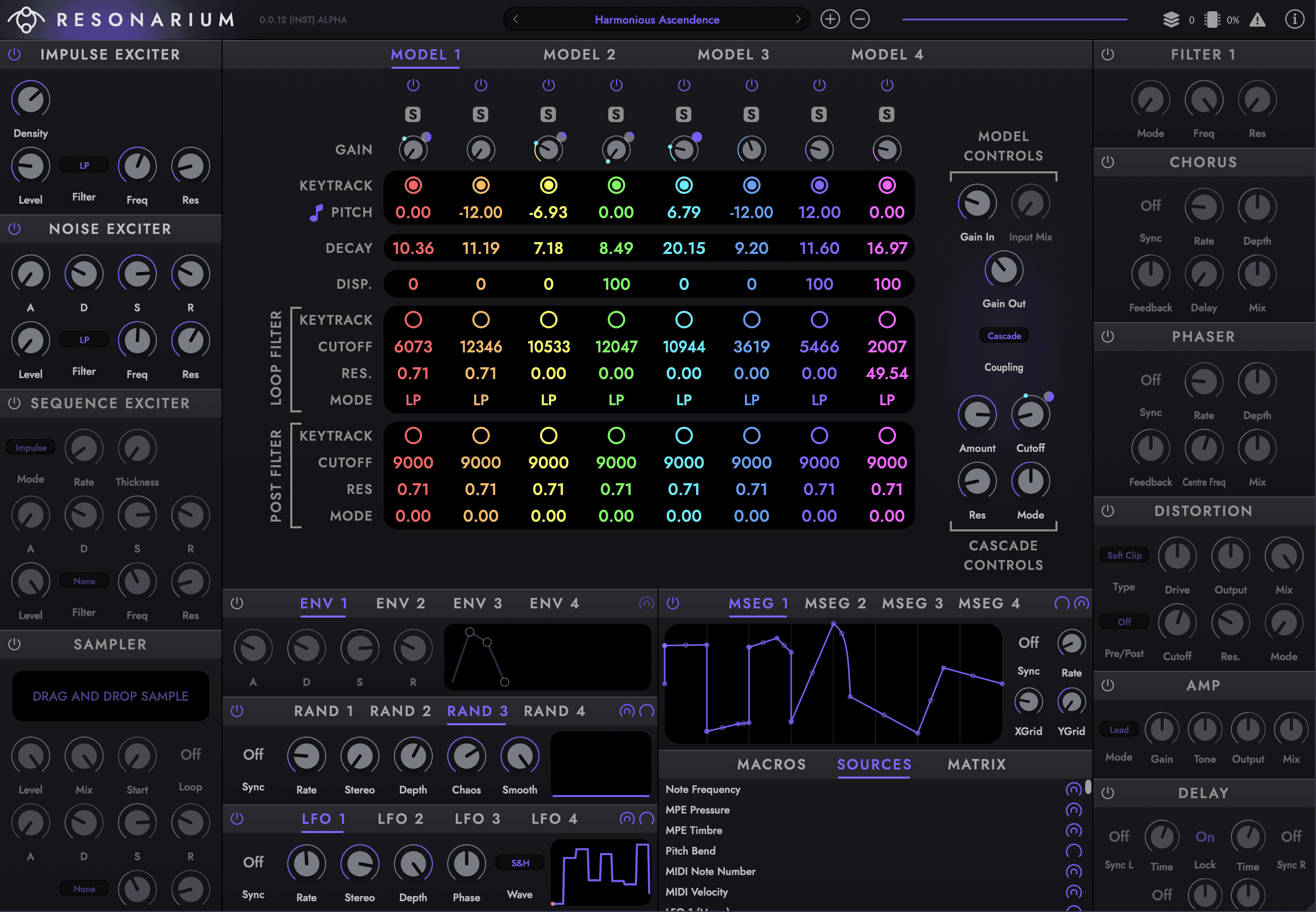
At the heart of Resonarium are multiple string waveguide models that can interact with one another. This allows the instrument to create complex resonant behavior that is difficult to reproduce with a conventional oscillator and filter signal path.
The model can produce clean plucks, buzzing strings, metallic resonances and unstable hybrid textures depending on excitation, damping and coupling choices.
Designed Around Expressive MPE Performance
Resonarium supports MPE, allowing compatible controllers to use per-note pressure, pitch and timbre information. The included preset system can respond to these dimensions, making a patch feel more like an expressive instrument than a static synthesizer preset.
Even without an MPE controller, the synthesis engine remains useful for programmed MIDI and automation.
Semi-Modular Physical Modeling
The project is intentionally open-ended. Resonators, excitation and modulation can be combined in ways that move beyond attempts to imitate a single real acoustic instrument.
This semi-modular direction makes Resonarium particularly useful for experimental sound design, where believable physical behavior matters more than reproducing a specific guitar, string or mallet instrument.
Use It as an Instrument or Processing Environment
The project supports instrument-oriented and effect-oriented builds, so its physical-modeling system can be approached both as a generator and as a resonant processor.
That opens interesting possibilities for transforming external sounds through modeled resonances rather than simply adding reverb or conventional filtering.
Open Source and Actively Developed
Resonarium is distributed under an open-source license with its source code and releases available from the official repository. The developer has continued to refine the project and has also documented performance considerations around the relatively CPU-intensive modeling engine.
Because the synth is ambitious and still evolving, compatibility can vary between hosts, so testing it in your own DAW is worthwhile before building an important project around a specific version.
Where Resonarium Makes the Most Sense
This is a specialist instrument rather than a general-purpose preset machine. It shines when the production needs an organic attack, resonant decay or physical quality that ordinary subtractive synthesis cannot provide.
- Plucked and struck textures
- Metallic percussion
- Expressive MPE leads
- Cinematic resonances
- Ambient drones
- Experimental acoustic hybrids
At a Glance
Developer: Gabriel Soule
Type: Physical-modeling / waveguide synthesizer
Core engine: Coupled string waveguide models
Expression: MPE compatible
Workflow: Semi-modular and open-ended
Formats: VST3 and standalone builds are part of the project
License: Open source
Price: Free
Download Resonarium for Free
Get the current free version directly from the official developer page.
Final Thoughts
Resonarium is one of the more adventurous free instruments available to producers interested in physical modeling. Its coupled waveguides and MPE support make it capable of sounds that are expressive, resonant and difficult to fake with sample libraries or standard virtual analog synthesis. It asks for more experimentation than a preset-driven synth, but that is precisely where its value lies.