
The Retrohandz Afro House Projects pack is a free production resource created for producers who want to study, build and refine Afro House ideas inside a real DAW workflow. Presented as a free download by Retrohandz, the pack is especially interesting because it is not positioned as a simple folder of isolated samples. Its identity is built around projects, which makes it useful for producers who want to understand arrangement, groove structure, sound selection and production direction.
Afro House is a genre where the details matter. A strong kick and bass relationship is essential, but the real character often comes from percussion movement, melodic restraint, atmospheric layers and subtle transitions. For producers who want to move beyond loop stacking, a project-based pack can be more educational than a standard sample kit. It gives a clearer view of how sounds interact inside a session, not only how they sound alone in a browser preview.
Visit the official Retrohandz Afro House Projects download page
A Free Afro House Project Pack Made for Learning and Inspiration
The strongest value of Retrohandz Afro House Projects is its project-focused concept. A normal sample pack gives producers individual sounds. A project pack can show how those sounds are arranged, balanced and developed into a musical idea. For Afro House, that difference matters because the genre depends heavily on space, repetition, tension and gradual evolution.
Opening a project can help producers understand the invisible work behind a track. Where does the percussion enter? How much low end is left for the kick? How are melodic ideas repeated without becoming boring? How do transitions create movement without overcrowding the arrangement? These are the questions that separate a basic loop from a convincing Afro House production.
This makes the pack useful for beginners, but not only for beginners. Experienced producers can also use project files as references, arrangement studies, resampling material or creative starting points. A project can be studied, stripped down, rearranged, rebuilt or used as inspiration for a completely new track.
Why Project Files Can Be More Useful Than Random Loops
Free sample packs are everywhere, but not all of them are useful. Many give producers a large folder of loops with no context. That can be fun for ten minutes, then the session often becomes a museum of unfinished ideas. A project-based resource has a different role. It can help producers learn how to finish tracks, not only how to start them.
For Afro House, this is particularly valuable. The genre often works through gradual arrangement. Elements appear, disappear, return, filter, breathe and evolve. A project file can show how a simple groove becomes a full structure. It can also reveal how few elements are sometimes needed to create strong movement when the production is well organized.
Retrohandz Afro House Projects is therefore best approached as a production study tool as much as a creative pack. Producers can open the project, analyze the structure, identify the strongest elements, then rebuild the idea with their own sounds. That is where the real value appears.
Designed for Afro House Workflow
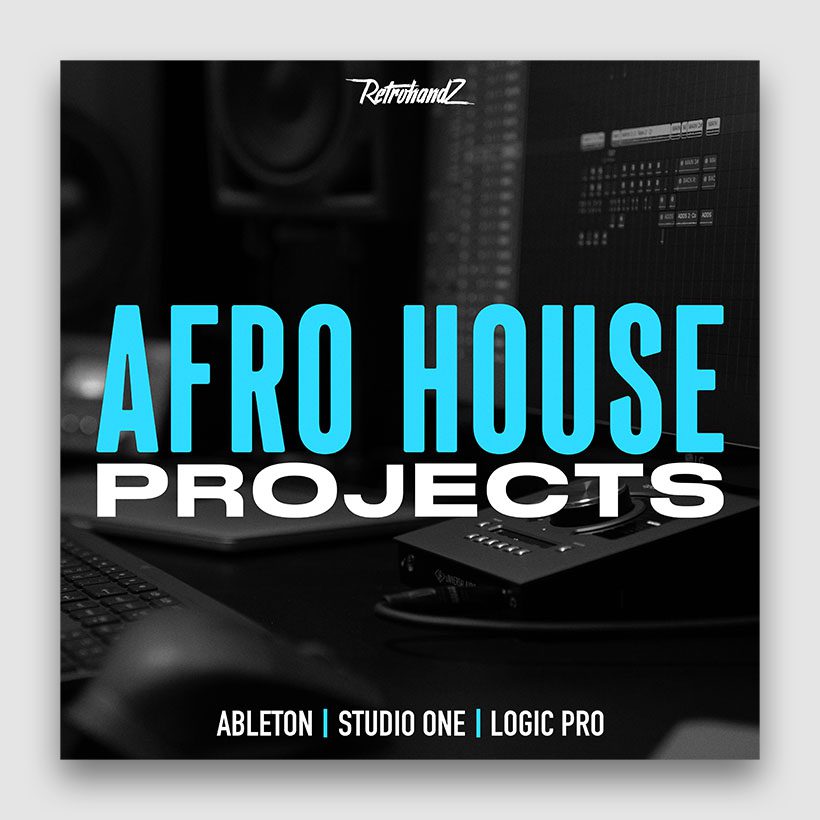
The official artwork highlights compatibility with Ableton, Studio One and Logic Pro, three major DAWs used by electronic music producers. This is important because workflow changes from one DAW to another. A pack that acknowledges multiple production environments becomes more accessible to producers who do not all work inside the same software.
For Studio One users, a project-based Afro House pack can be useful for studying arrangement and mixing choices directly inside a familiar workflow. Ableton users can explore clips, automation and session structure. Logic Pro users can focus on musical arrangement, sound design and mix balance. The core idea remains the same: use the project as a map, not as a finished destination.
The best approach is to open the project and listen before touching anything. Then mute tracks one by one. Study what happens when the percussion disappears, when the bass is removed, or when the melodic layer is muted. This simple process can teach more about arrangement than adding ten more loops to a track and hoping the groove signs a peace treaty.
How to Use Retrohandz Afro House Projects Creatively
Start by identifying the central groove. In Afro House, the rhythm is often the heart of the production. Listen to the kick, bass and percussion relationship, then study how the groove creates motion. If the project includes melodic elements, analyze how they support the rhythm rather than overpower it.
Next, use the project as a reference for your own track. You can rebuild the structure with your own drums, replace the sounds, change the tempo, rewrite the melodies or keep only the arrangement concept. This is often more valuable than using the original material directly because it helps develop your own production identity.
Another creative method is to resample small parts. A percussion phrase, FX transition, groove section or melodic idea can be bounced, chopped and transformed into something new. Add filters, delays, distortion, reverb or pitch changes to make the material personal. The goal is not to copy the project, but to extract inspiration from it.
Production Tips for Afro House Projects
When working from a project file, avoid replacing everything too quickly. First, understand why the arrangement works. Then change one element at a time. Replace the kick and listen. Change the bass and listen. Add a new percussion layer and listen again. This slower method helps producers make better decisions instead of turning the session into an audio supermarket at closing time.
Keep the low end clean. Afro House relies on a strong relationship between kick and bass, but that relationship must stay controlled. If the bass is too wide, too loud or too busy, the groove can lose impact. Use EQ, sidechain compression and careful note placement to keep the low end powerful but readable.
Use automation to create movement. Filter sweeps, delay sends, reverb changes, volume rides and percussion mutes can transform a simple pattern into a full arrangement. Afro House is hypnotic, but it should still evolve. Repetition becomes powerful when the producer controls tension and release.
Royalty-Free Use for Producers
Retrohandz presents its sounds as 100% royalty-free, which makes the Afro House Projects pack useful for producers who want to develop tracks, demos, remixes or commercial releases with clear usage rights. This is especially important for independent artists releasing music on streaming platforms or producing content for online promotion.
As always, the smartest approach is to personalize the material. Royalty-free does not mean the final track should sound like a template. Change sounds, rewrite parts, edit arrangements and build something that reflects your own musical direction.
Who Should Download Retrohandz Afro House Projects?
The Retrohandz Afro House Projects pack is ideal for producers who want to study Afro House from the inside. Beginners can use it to understand structure, arrangement and groove design. Intermediate producers can use it to improve workflow and learn how to move from a loop to a full track. More advanced producers can treat it as a reference, remix foundation or resampling source.
It is especially relevant for artists working in Afro House, Afro Tech, Organic House, Melodic House and rhythm-driven electronic music. Producers who often struggle to finish tracks may find project-based material particularly helpful because it shows how ideas can be developed across a complete arrangement.
Download Retrohandz Afro House Projects
The Retrohandz Afro House Projects pack is available through the official Retrohandz website. The download page asks users to enter an email address to receive the download link, and the pack is listed in the Retrohandz free downloads section at €0,00.
Official Retrohandz Afro House Projects download page
Browse all Retrohandz free downloads
Final Verdict
Retrohandz Afro House Projects is a smart free resource for producers who want more than isolated samples. Its project-based format makes it useful for learning arrangement, studying groove structure and developing stronger Afro House ideas inside a real production workflow.
For producers working with Ableton, Studio One or Logic Pro, this free pack can provide a practical reference point for building more complete Afro House tracks. It is not just about downloading sounds. It is about understanding how those sounds can become a finished production.