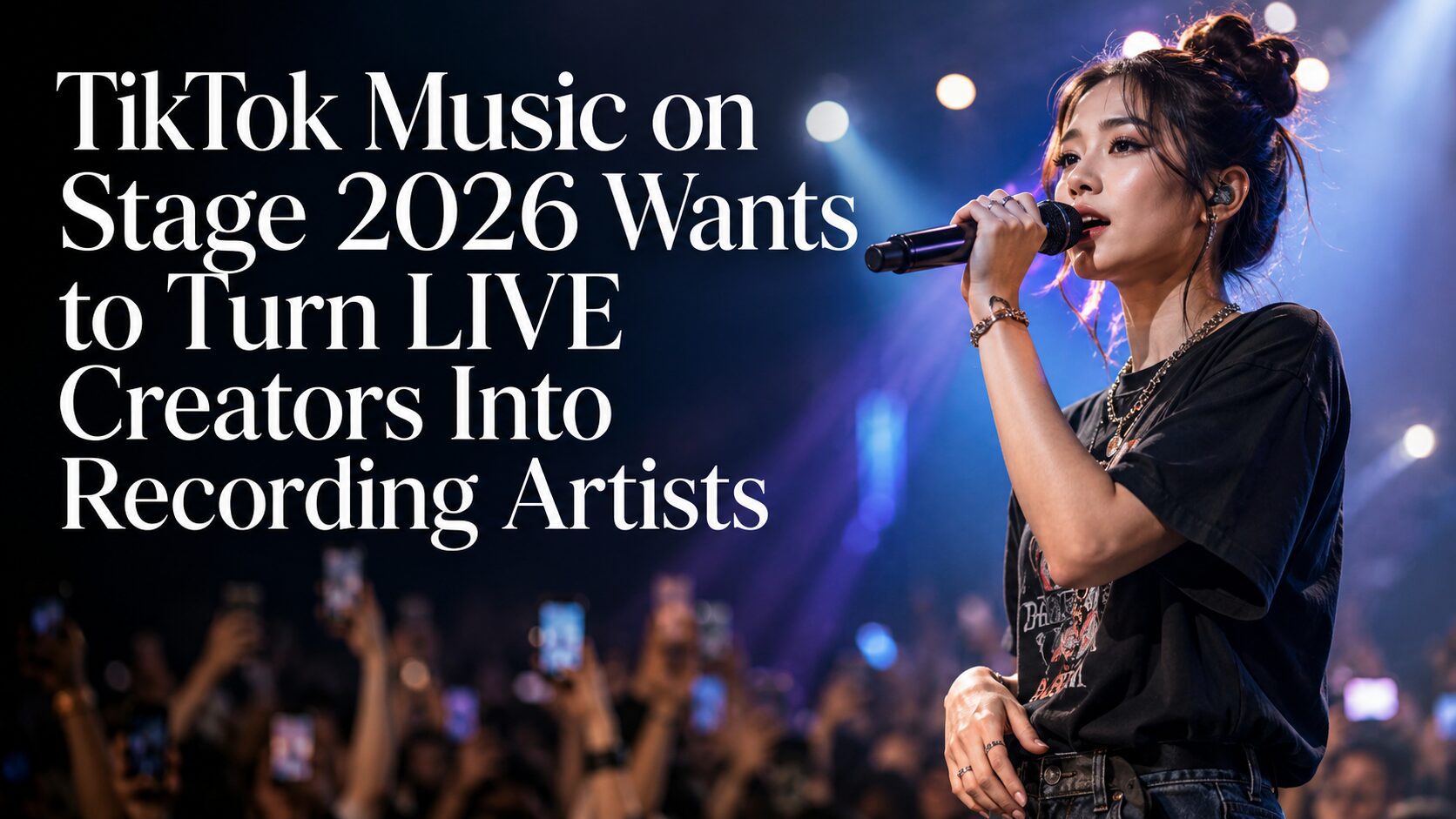

TikTok is bringing back Music on Stage with a bigger ambition: identify emerging musicians through LIVE performances, then help selected creators move from livestreams to professionally released songs and major festival stages.
TikTok is once again trying to turn digital discovery into a real music career. The platform has launched the 2026 edition of TikTok LIVE Music on Stage, its global programme for emerging singers, songwriters and music creators.
Auditions officially begin on August 15, following a registration period that closed on August 14. This year’s programme brings together creators from more than 20 regions and combines livestream performances, international competition, professional music production and real-world festival opportunities.
The ambition goes significantly beyond discovering a viral clip. TikTok wants selected creators to progress from performing on LIVE to recording original music with professional support through SoundOn, TikTok’s distribution and artist-services platform. Winners may also receive opportunities to perform at major events and festivals.
Key Facts
- Auditions begin August 15, 2026.
- Artists from more than 20 regions are participating.
- Cat Burns will host the EMEA and Americas Global Finals.
- Songkarn will host the APAC Finals.
- Top creators can access professional recording, distribution and promotion through SoundOn.
- Selected winners may perform at TikTok LIVE Fest and major music festivals.

Photo: Ezkol Arnak / Pexels
From TikTok LIVE to a Professional Release
Music on Stage is designed around a familiar TikTok phenomenon: an unknown artist can suddenly reach a large audience through a phone screen.
The difference is that TikTok is now attempting to create a more structured path after that first moment of discovery.
Top-performing creators will have access to professional development opportunities in partnership with SoundOn. TikTok says this can include the chance to record and release original music with full production, distribution and promotional support.
That matters because visibility alone does not necessarily create a sustainable career. A musician can accumulate millions of video views while still lacking production support, distribution expertise, marketing infrastructure or opportunities to perform outside social media.
Music on Stage is therefore attempting to bridge two worlds: the immediate discovery power of TikTok and the slower, more traditional process of developing a recording artist.
Audiartist Analysis
The most interesting part of Music on Stage is not the competition itself. It is TikTok’s attempt to build a complete artist-development pipeline around its own audience: discovery on LIVE, fan growth on TikTok, distribution through SoundOn and eventually performances on physical stages.
A Global Audition Starts Today
The 2026 auditions officially start on August 15 with a special global relay concert featuring musicians from different parts of the world. TikTok says the opening programme will showcase original songwriting, live musicianship and emerging performers over a three-day period.
The competition will then progress toward Global Finals in September.
British singer-songwriter Cat Burns will host the finals covering EMEA and the Americas, while Thai singer-songwriter Songkarn will host the APAC competition. TikTok says an additional guest judge will also be announced.
Cat Burns has an obvious connection to the programme’s philosophy. TikTok has played an important role in her own career, and the artist described Music on Stage as an opportunity for singers, songwriters and creators to share their music globally. In TikTok’s announcement, she said the winner will receive support to record and release an original song.
The Prize Is More Than Exposure
Music competitions built around social platforms can easily become little more than engagement campaigns. TikTok is trying to offer something more tangible.
Alongside recording and distribution support, winning artists may receive opportunities to perform at TikTok LIVE Fest and selected music festivals around the world.
TikTok specifically mentions possible appearances at the Breakaway Carolina Festival and All Things Go NYC Festival in September.
For an emerging artist, the combination can be powerful. A performer who begins in front of a smartphone camera could potentially end the programme with an officially distributed release and a festival appearance.
That is a much more concrete proposition than simply promising followers or visibility.

Photo: Anna Pou / Pexels
TikTok Has Evidence That the Model Can Work
The company is using the results of its first edition to demonstrate that the programme can generate measurable career growth.
According to TikTok, the 2025 campaign generated more than 8.2 billion impressions, inspired over 230,000 posts using the #MusicOnStage hashtag and attracted more than 1.4 million viewers to its Global Finals.
The platform also highlights the progress of 2025 winner Angelyque Solorio. After the competition, she released her debut EP through SoundOn. TikTok says the project subsequently generated more than 350,000 creator videos, while her Spotify monthly listener count increased tenfold and her music accumulated more than 450,000 streams.
Those figures come from TikTok itself, so they should be understood as the company’s own measurement of the programme’s performance. Even so, they illustrate why TikTok is investing further in Music on Stage.
TikTok Is Becoming More Than a Discovery Platform
TikTok has spent years proving that it can influence which songs become popular.
What is changing is the company’s role after discovery.
Through SoundOn, LIVE programmes and direct artist initiatives, TikTok increasingly participates in stages that traditionally belonged to labels, distributors, promoters and artist-development teams.
An artist can potentially be discovered through a viral post, develop a fanbase through LIVE broadcasts, distribute music through a TikTok-owned service and then receive access to events promoted through the same ecosystem.
That vertical integration is strategically important.
TikTok no longer needs to be only the place where a song becomes famous before listeners move to Spotify or Apple Music. It can increasingly participate in the artist’s career before, during and after that discovery moment.
There Are Still Limitations
The programme is attractive, but independent artists should not confuse a competition with a guaranteed career path.
Only a small number of participants will reach the final stages. TikTok’s enormous audience also means the competition for attention is intense.
Success on a livestream additionally requires skills that are not identical to songwriting or studio production. Artists must often be comfortable talking directly to audiences, maintaining regular interaction and turning passive viewers into an active community.
That creates an interesting new definition of what an emerging artist is expected to do.
Musical ability remains essential, but digital performance, personal communication and audience-building are increasingly part of the same job.
What Emerging Artists Can Learn From Music on Stage
- Live interaction is becoming an important part of music discovery.
- Original songwriting still matters even in a short-form-video environment.
- Platforms increasingly reward artists who can build communities, not just generate views.
- Distribution and promotion are becoming integrated directly into social platforms.
- Online visibility can now lead directly to physical festival opportunities.
Why LIVE Matters to TikTok’s Music Strategy
Short videos remain at the heart of TikTok, but LIVE offers something that a 20-second clip cannot easily reproduce: a direct relationship between artist and audience.
Fans can communicate with musicians in real time, follow the development of songs and feel involved before a release reaches traditional streaming services.
That relationship is especially valuable for emerging artists who do not yet have the marketing budgets of major-label acts.
TikTok says Music on Stage is designed to help artists build genuine communities and sustainable careers rather than simply generate temporary viral attention.
Whether the programme can consistently achieve that goal will depend on what happens to participants after the competition ends.

Photo: Caleb Oquendo / Pexels
From Smartphone Screen to Festival Stage
Music on Stage represents an interesting evolution in the relationship between social media and the music business.
A decade ago, artists typically tried to build a career first and then used social networks to promote it.
Today, the order can be reversed.
An artist can start with an audience on TikTok and build the traditional elements of a music career afterwards.
TikTok is now attempting to institutionalize that process.
The platform identifies talent through LIVE, measures audience reaction in real time, provides selected creators with production and distribution infrastructure, and then potentially places them in front of physical festival audiences.
That makes Music on Stage less like a conventional talent competition and more like a digital artist-development programme.
Conclusion
TikTok LIVE Music on Stage 2026 arrives at a moment when the boundaries between social media, streaming, distribution and artist development are becoming increasingly blurred.
The programme offers emerging musicians something more valuable than a viral moment: the possibility of turning digital attention into a professionally produced release, wider distribution and real-world performance opportunities.
There is no guarantee that every participant will build a sustainable career, and only a small percentage will reach the final stages.
But TikTok’s strategy is increasingly clear.
The platform does not simply want to discover the next music star. It wants to become part of the infrastructure that creates one.