
A Billboard-charting rap track has become the centre of an unusual AI music controversy after Treblo, the company behind a generative music platform, classified the song as highly likely to have been created with its own technology.
“Rubberz” by Fenix Flexin has attracted growing attention following allegations that artificial intelligence may have been involved in its production. The artist and the credited producer have both denied using AI.
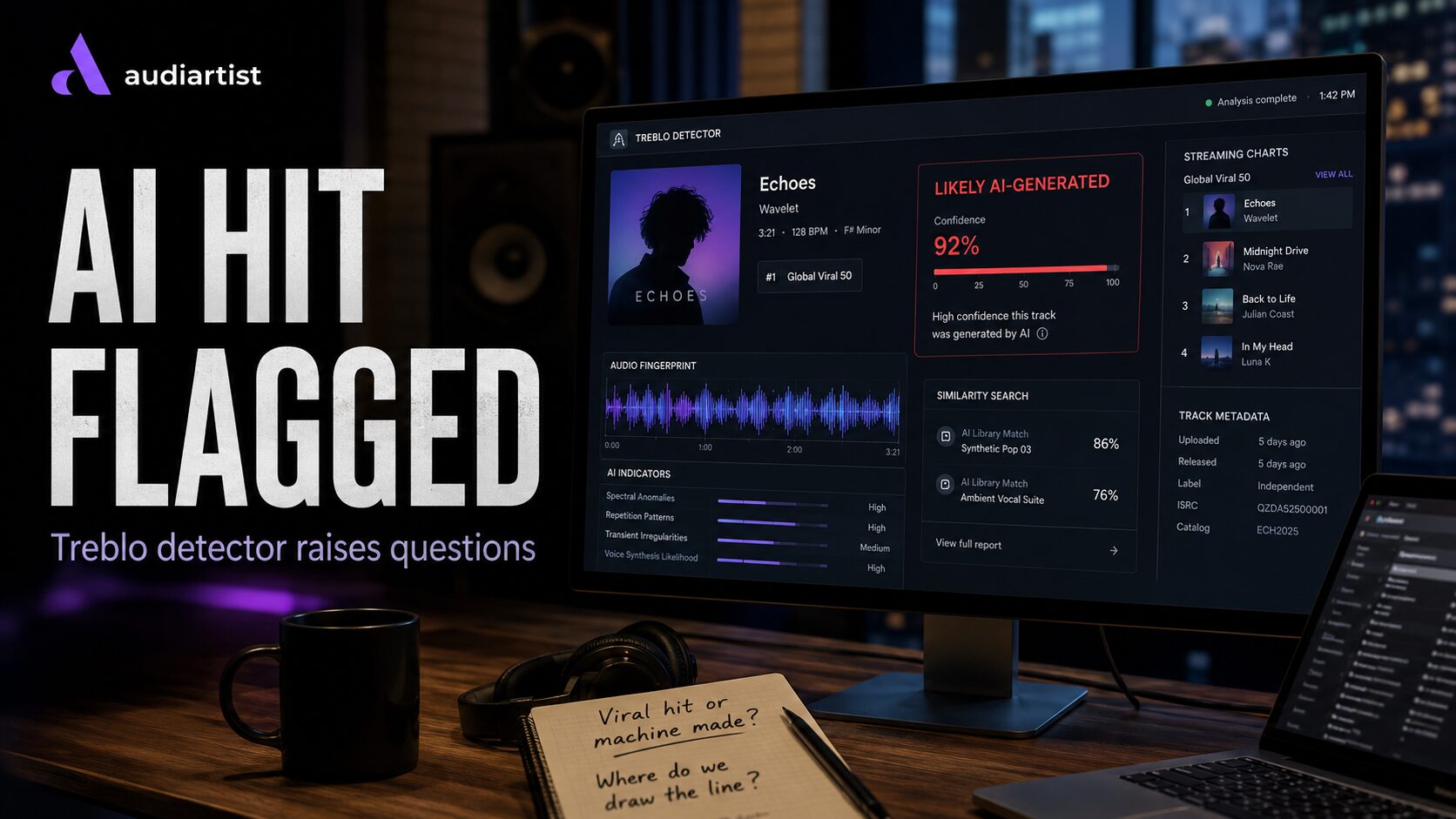
The debate intensified when Treblo, formerly known as Sonauto, launched a detection tool capable of identifying audio that may have originated from its generative model. The company’s system classified “Rubberz” as “Very likely Treblo”.
A recent track associated with Tyga was also classified as “Likely Treblo”.
Treblo claims that its detector produces fewer than one false positive for every 10,000 recordings analysed. That performance, however, has not yet been independently verified.
Key Facts
| Track | “Rubberz” |
|---|---|
| Artist | Fenix Flexin |
| AI platform involved | Treblo, formerly Sonauto |
| Detection result | “Very likely Treblo” |
| Artist response | AI use denied |
| Independent verification | Not currently available |

A Viral Hit Surrounded by Questions
The controversy surrounding “Rubberz” reflects a growing problem for the music industry: commercially successful songs can now reach large audiences before listeners clearly understand how they were created.
Suspicions about the track had already circulated online before Treblo released its detection system. Once the company’s own technology identified the recording as highly likely to have originated from its model, the story moved beyond social media speculation.
The classification does not prove conclusively that the finished track was entirely generated by artificial intelligence. It may indicate that some musical material, vocals, instrumentation or an earlier version of the recording passed through Treblo’s technology.
The artist and producer involved have denied using AI, creating a direct conflict between the people credited for the release and the company operating the detection system.
The central question is no longer simply whether the song sounds artificial. It is whether a technology company can reliably identify the fingerprints of its own generative model inside a commercial release.
When the Generator Becomes the Investigator
What makes this case particularly unusual is the source of the detection claim.
The accusation is not coming only from fans, competing artists or an independent research laboratory. It is coming from the company that developed the model potentially used to generate the music.
Treblo may have access to technical information unavailable to ordinary detection services. Its system could analyse model-specific audio characteristics, production artefacts or hidden statistical patterns created during generation.
This could make a developer-operated detector more accurate than a general tool trained to recognise synthetic music from multiple platforms.
It also creates an obvious conflict of interest.
The same company is promoting a music generator and a detection system capable of identifying material created with that generator. Without independent testing, listeners and artists must rely largely on the company’s own claims regarding accuracy.

Can Treblo’s Detection Claim Be Trusted?
Treblo says its technology has a false positive rate below one case in 10,000.
If accurate, that would represent an exceptionally high level of reliability. A system with that performance could become valuable to streaming platforms, distributors, record labels and chart organizations attempting to identify undisclosed AI-generated music.
However, the figure has not yet been validated through independent academic research or transparent public testing.
Several questions remain unanswered:
- How large was the dataset used to test the detector?
- Which genres and production styles were included?
- Can mastering, compression or vocal processing affect the result?
- Can the detector distinguish fully generated music from partially AI-assisted production?
- Can artists challenge a classification and request a technical review?
These questions matter because an incorrect classification could damage an artist’s reputation, affect chart eligibility or influence how streaming services handle the release.
Detection Is Not the Same as Proof
An AI detection result should be treated as evidence requiring further investigation, not as an automatic verdict.
Music production frequently involves extensive processing. Vocals may be tuned, transformed, layered or reconstructed. Instruments can be synthesized, sampled or generated from complex digital systems.
These techniques can create characteristics that resemble synthetic audio even when the core performance remains human.
The opposite problem also exists. AI-generated material can be edited, re-recorded or mixed with human performances until the original synthetic fingerprints become difficult to identify.
A reliable investigation may therefore require more than audio analysis. It could include session files, project history, stems, metadata, distribution records and statements from the creators.
A detector can identify a probability. It cannot automatically reconstruct the complete creative process behind a finished recording.
The Transparency Problem Is Bigger Than One Song
The debate surrounding “Rubberz” is not only about whether artificial intelligence was used.
It is also about whether listeners should be informed when generative systems contribute meaningfully to a commercial release.
Some fans appear unconcerned by the possibility that AI played a role in the track. For these listeners, the final sound matters more than the production method.
Others object less to the technology itself than to the absence of transparency. They want artists, labels and distributors to disclose whether vocals, lyrics, compositions or instrumentals were generated by a model.
This distinction is becoming increasingly important as the music industry develops separate categories for AI-generated and AI-assisted recordings.
A song produced by a human artist using an intelligent mastering tool is not equivalent to a complete recording created from a text prompt. Treating both cases identically would make meaningful disclosure almost impossible.
A Billboard Hit Can Now Carry Creative Uncertainty
“Rubberz” is not an anonymous upload hidden inside an enormous streaming catalogue. It is a commercially visible track associated with the Billboard Hot 100.
That visibility changes the significance of the controversy.
AI music debates previously focused largely on experimental releases, fictional artists, streaming fraud and high-volume catalogue uploads. The current case involves a recognizable performer and a track with mainstream chart activity.
A song can now accumulate streams, receive playlist exposure and appear in a major chart while listeners remain uncertain about its authorship and production process.
This creates a new challenge for chart organizations. Should consumption alone determine eligibility, or should a track also satisfy requirements concerning human involvement, authorized technology and transparent metadata?
Recent industry initiatives suggest that the second approach is gaining support.
Potential Consequences for Artists and Platforms
Cases like this could accelerate the adoption of stricter AI disclosure rules.
Streaming platforms and distributors may eventually require creators to declare:
- whether generative AI was used;
- which service or model was involved;
- whether the lead vocal was synthetic;
- whether the composition or lyrics were generated;
- whether the final recording remains primarily human-made.
Such metadata could influence editorial playlist eligibility, royalty distribution, chart recognition and recommendation systems.
Developers may also be asked to provide tools capable of verifying whether their models contributed to a recording.
Treblo’s detector offers an early example of that possibility. A generative platform may no longer be responsible only for creating music. It may also be expected to help identify and disclose where its technology has been used.

Public Trust Is Becoming a Commercial Issue
Transparency is not only an ethical concern. It is increasingly connected to the commercial value of an artist.
Music audiences often develop relationships with performers through their voices, stories, skills and creative identities. A revelation that central elements were generated or replaced by AI may alter that relationship.
The reaction will not be identical for every listener. Some audiences may accept fictional performers and synthetic vocals without hesitation. Others may feel deceived when AI involvement is concealed.
Artists therefore face a strategic choice.
Disclosing AI assistance may create criticism, but hiding it can produce a larger backlash when detection tools or leaked production information contradict the public narrative.
As the technology becomes more common, honest disclosure may become a form of brand protection.
The Industry Still Lacks a Universal Standard
No global system currently provides consistent AI labels across Spotify, Apple Music, YouTube Music, Amazon Music and other platforms.
Some services are developing detection technologies. Industry organizations have proposed metadata standards, while certain chart bodies are introducing eligibility rules for AI-assisted and fully generated recordings.
Implementation remains uneven.
An artist can distribute the same song to multiple services and encounter different policies, labels and levels of scrutiny.
Third-party detectors may also produce conflicting results. One system may classify a track as synthetic while another identifies it as human-made.
Without consistent definitions and transparent appeal procedures, artists risk being judged by tools they cannot examine or challenge.
Why the “Rubberz” Case Matters
The controversy illustrates four important developments:
- AI detection is moving from research laboratories into mainstream music disputes.
- Generative platforms may be able to identify material created with their own models.
- Commercial success does not guarantee clarity about authorship.
- Transparency may become essential for maintaining audience trust.
Whether Treblo’s detector is ultimately proven correct or incorrect, the wider problem will remain.
Music can now move through streaming platforms and charts faster than the industry can establish how it was created.
A Hit Song With a Digital Fingerprint
“Rubberz” remains commercially successful, and the people credited for the release continue to deny using artificial intelligence.
Treblo’s detector presents a conflicting technical assessment, but its claimed accuracy has not yet been independently confirmed.
The case therefore remains unresolved.
Its importance lies in what it reveals about the future of recorded music. Generative systems may leave identifiable fingerprints, and the companies operating those systems may increasingly become participants in copyright, authorship and transparency disputes.
A hit song can now arrive with streams, chart positions and a technical probability attached to its creative origin.
In the AI era, the question is no longer only whether a song is popular. It is whether audiences know who, or what, actually made it.