
neo::synth: A Free Modular VST Instrument for Sound Design
Combine analog-style oscillators, 24 filters, spectral morphing, granular sampling and deep modulation inside one flexible synthesizer.
neo::synth is a free modular polyphonic synthesizer designed for electronic music production, experimental composition and detailed sound design.
The instrument provides 58 independent modules that can be combined inside a flexible signal architecture. Producers can build traditional subtractive synthesizers, FM patches, granular textures, vector sounds and more experimental configurations without being restricted to one fixed synthesis method.
neo::synth is currently available free of charge for Windows and macOS. It includes 16-voice polyphony, 48 factory presets and a modulation matrix containing up to 100 routing slots.
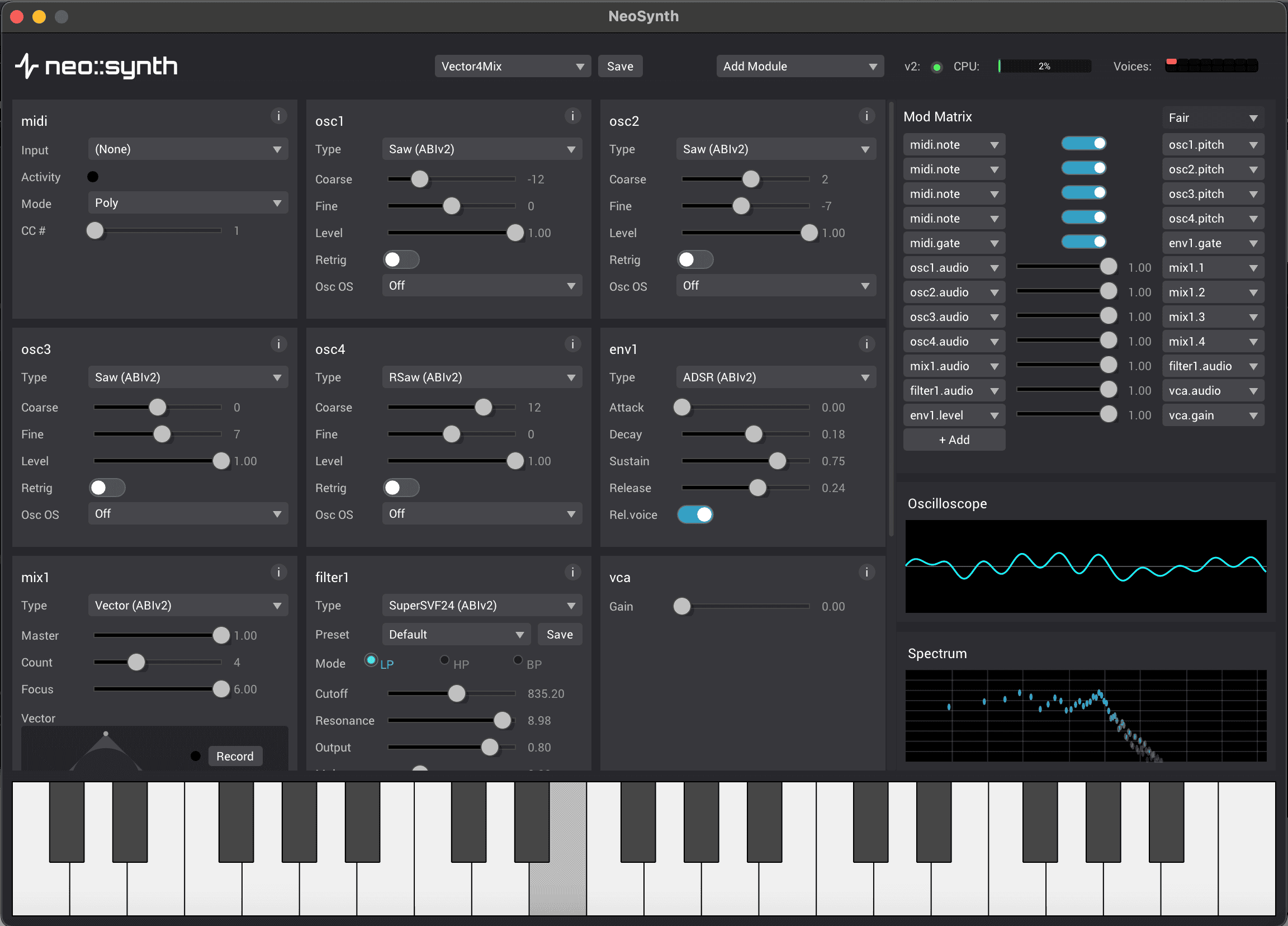
What Is neo::synth?
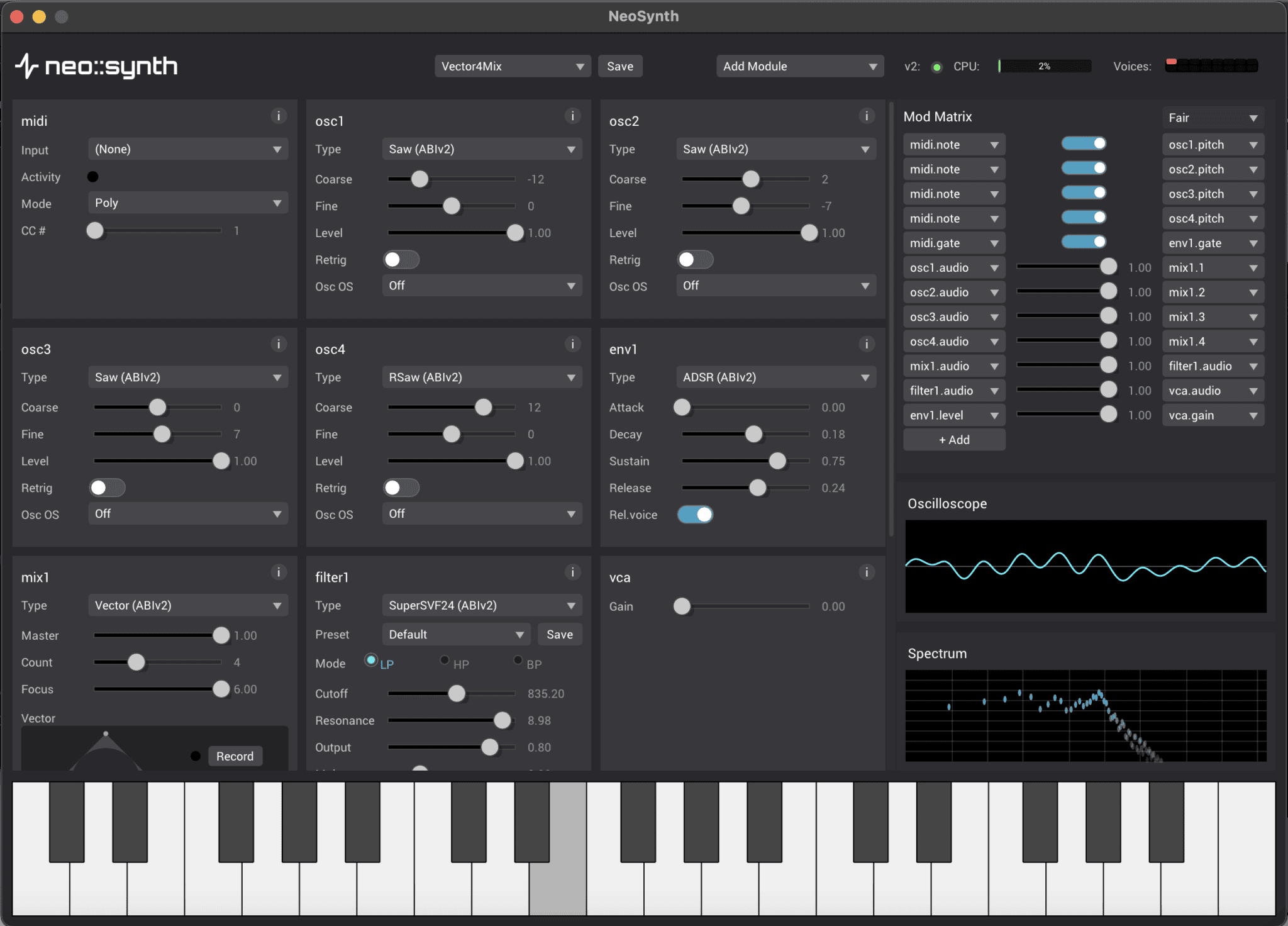
neo::synth is built from independent modules that can be added and arranged according to the requirements of each sound.
A simple patch may contain one oscillator, an envelope, a filter and an amplifier. More complex presets can combine several oscillators, vector mixing, frequency modulation, granular processing, multiple filters and numerous modulation sources.
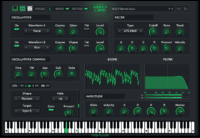
The signal path remains visible inside the main interface, while an oscilloscope and spectrum analyser provide real-time visual feedback.
This modular approach allows the instrument to cover basses, leads, pads, plucks, drones, atmospheric textures and experimental effects without forcing every preset through the same architecture.
Oscillators, FM and Hard Sync
The primary oscillator modules provide saw, reverse saw, sine, triangle and square waveforms. Pulse-width modulation is available for square waves, allowing producers to create animated analog-style tones.
Every oscillator supports audio-rate frequency modulation and hard synchronization. These features extend the instrument beyond basic subtractive synthesis.
Frequency modulation can introduce metallic harmonics, sharp bass textures and digital movement. Hard sync is useful for aggressive leads, swept harmonics and classic electronic sound-design effects.
Several oscillator modules can be combined through the modulation matrix, making it possible to build layered patches and more complex modulation relationships.
24 Filter Models
neo::synth includes 24 filter models inspired by several recognisable analog synthesizer designs.
The available selection includes Moog Ladder, TB-303, MS-20, Juno-106, Jupiter-8, Prophet-5, SSM2040, CEM3320 and diode-ladder style filters.
These models provide different resonance, drive and frequency-response characteristics. A TB-303-inspired filter can produce sharp acid sequences, while ladder and polyphonic synth-style filters are better suited to warm basses, pads and leads.
Most filter modules also support filter-frequency modulation. Audio-rate modulation can create complex harmonics and aggressive textures that would not be possible with a conventional slowly moving cutoff control.
The developer recommends caution with extreme resonance settings because some configurations can generate powerful level peaks.
Spectral Morphing
One of the most distinctive sections of neo::synth is its spectral morphing system.
The instrument includes four processing approaches:
- Additive morphing
- McAulay-Quatieri analysis
- SMS sinusoidal and residual processing
- STFT phase-vocoder processing
These algorithms can transform and interpolate spectral material in different ways. They are particularly useful for evolving pads, synthetic voices, drones and cinematic textures.
Slow modulation can create smooth tonal movement, while more extreme settings can produce unstable, digital and highly experimental results.
Eight-Input Vector Mixer
The Vector Mixer provides eight audio inputs controlled through an XY surface. Its design takes inspiration from vector synthesizers such as the Prophet VS and Korg Wavestation.
Several oscillators or sound sources can be placed around the vector field. Moving the position then changes the balance between those sources.
This movement can be used to transform a sound gradually instead of switching abruptly between layers. A patch can begin with a warm analog waveform, move toward a brighter digital source and finish with a granular or noise-based texture.
Vector movement is particularly effective for long pads, cinematic sounds and evolving electronic arrangements.
Granular Sampler
neo::synth includes a granular sampling module with controls for grain size, density, spray, pitch spread and window shape.
Granular synthesis divides audio into small fragments before reorganising and layering them. Depending on the settings, the result can remain recognisable or become a completely new atmospheric texture.
Short grain sizes and wider pitch variation can produce glitch effects and digital clouds. Longer grains and moderate density settings are more suitable for smooth pads and evolving backgrounds.
The granular sampler can be combined with the filters, vector mixer and spectral processors, providing several stages of transformation inside one instrument.
Deep Modulation System
The modulation matrix contains up to 100 routing slots. This gives producers enough space to create complex patches without repeatedly replacing existing assignments.
Available modulation modules include ADSR, AHDSR and DADSR envelopes, an envelope follower and an LFO with five waveforms, including sample and hold.
The envelope follower can react to the level of an internal or external signal. It can be used to control filters, amplitude, spectral movement and other parameters dynamically.
Noise generators provide white, pink and brown noise, along with a sample-and-hold mode. A lag and slew processor can create portamento or smooth abrupt modulation changes.
Built-In Effects
neo::synth includes several modules for processing the sound without opening additional plugins.
- Ring Modulator: Creates metallic and inharmonic textures.
- Decimator and Bitcrusher: Reduces resolution for Lo-Fi and digital distortion effects.
- Panner: Adds stereo positioning and movement.
- Juno-60 BBD Chorus: Produces wide vintage-style modulation.
- Spring Reverb: Two different spring-inspired reverb models are available.
The effects can be placed inside more complex module configurations rather than functioning only as a fixed final processing chain.
Best Uses
Electronic music: Create basses, leads, plucks and animated synthesizer sequences.
Ambient production: Combine granular sampling, vector movement and long modulation envelopes.
Cinematic sound design: Build evolving drones, tension layers and abstract textures.
Synthwave: Use analog-style oscillators, vintage filter models and the Juno-inspired chorus.
Techno: Design resonant sequences, metallic percussion and modulated bass patches.
Experimental music: Combine spectral processing, FM and unusual module routings before resampling the results.
Production Tips
Begin with a simple signal path before adding more modules. One oscillator, one envelope, one filter and one amplifier provide a clearer starting point than immediately filling the interface.
Use the factory presets to understand how modules are connected. Disable individual sections temporarily to hear their contribution to the complete sound.
Modulate only a small number of parameters at first. Complex movement remains easier to control when each routing has a clear musical purpose.
Monitor the output level when experimenting with filter FM, oscillator synchronization and high resonance. These processes can generate sudden frequency and volume peaks.
Save useful configurations as new presets before making extreme changes. Modular experiments have a mysterious ability to become perfect immediately before the producer clicks the wrong control.
Compatibility
- Windows: Windows 10 or later
- Windows formats: VST3 and standalone application
- macOS: macOS 10 or later
- macOS formats: VST3, Audio Unit and standalone application
- Mac installer: Universal package
- Polyphony: 16 voices
- Modulation matrix: 100 routing slots
- Factory presets: 48
- Current version: 0.6.0
- Price: Free
neo::synth remains under active development, with additional modules and presets expected as the project evolves.
Final Verdict
neo::synth is an ambitious free instrument for producers who enjoy building sounds rather than browsing through thousands of nearly identical presets.
Its 58-module architecture covers subtractive synthesis, frequency modulation, spectral processing, vector mixing and granular sampling. The 24 filter models and 100-slot modulation matrix provide considerable room for detailed programming.
The instrument remains in active development, but version 0.6.0 already offers a substantial collection of synthesis and sound-design tools for Windows and macOS.
neo::synth is particularly well suited to electronic music, Ambient, Techno, Synthwave and cinematic production. Beginners can start with the included presets, while experienced sound designers can construct much deeper configurations.
It contains enough modules to build almost any synthesizer architecture. Whether the producer remembers why seventeen of them are modulating the filter is a separate technical question.