Unravel by ZQ SFX is a free spectral separation VST3 plugin that divides audio into tonal and noise components in real time.
Producers can isolate harmonic content, reduce noisy textures or rebalance both layers through an intuitive XY pad. The plugin is useful for sound design, dialogue editing, audio restoration, creative sampling and reshaping complex recordings inside a DAW.
What Is Unravel?
Unravel is a free open-source audio effect that analyzes incoming sound and separates it into two streams.
- Tonal: sustained, pitched and harmonic content
- Noise: non-tonal, stochastic and textural content
Both components can be adjusted independently without exporting stems or processing the audio offline.
The current tagged stable release is version 1.1.0. It focuses on tonal and noise separation rather than the additional features currently being explored in development builds.
Control Both Layers With an XY Pad
The main XY pad controls the tonal and noise levels simultaneously.
Horizontal movement adjusts the tonal stream, while vertical movement changes the noise component. The pad can be zoomed for more precise adjustments, and keyboard controls are available for smaller movements.
This makes it easy to move between the complete signal, isolated tonal material, isolated noise or more subtle combinations.
Separation, Focus and Spectral Floor
The Separation control determines how strongly Unravel divides the two components.
Focus biases the analysis toward tonal or noisy material, helping the plugin adapt to different sources. A Spectral Floor control provides more extreme isolation by reducing quieter spectral information.
The Brightness control adds a high-frequency shelf to the output for final tonal adjustment.
Solo, Mute and Spectrum Visualization
Dedicated Solo and Mute controls allow each stream to be auditioned independently.
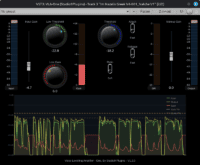
The real-time spectrum display shows how the audio is being divided across the frequency range. Producers can switch between logarithmic and linear frequency views depending on the material being analyzed.
Several presets are included as starting points for tonal extraction, noise isolation, dialogue editing and creative sound design.
Best Uses for Unravel
- Extracting melodic content from mixed recordings
- Reducing noise while preserving tonal information
- Isolating textures from field recordings
- Softening noisy percussion and cymbals
- Creating ambient layers from sustained sounds
- Processing dialogue and room tone
- Preparing material for resampling
- Experimental spectral sound design
For example, a drum loop can be pushed toward its noisy percussion layer, while a musical sample can be reduced to a smoother harmonic texture.
Useful for Creative Resampling
Unravel becomes particularly interesting when its output is recorded to another audio track.
The isolated tonal layer can become a pad, drone or melodic texture. The noise stream can be edited into percussion, atmospheric layers or transition effects.
Both results can then be stretched, pitched, reversed or processed through granular effects to create new production material.
Plugin Formats and Compatibility
- Windows: VST3, Windows 10 or later
- macOS: VST3 Universal Binary, macOS 10.13 or later
- Linux: VST3
- Channel layouts: Mono and stereo
- Sample rates: 44.1 kHz to 192 kHz
A compatible VST3 host is required.
Latency and Quality Modes
Unravel uses spectral analysis, so it introduces processing latency.
The official documentation indicates approximately 15 to 32 milliseconds depending on the selected quality mode. A compatible DAW should compensate for this latency automatically during normal playback.
The high-quality mode can improve separation but requires more processing time.
Free and Open Source
Unravel is released as free open-source software under the GPL-3.0 license.
No account, subscription or license manager is required. Installers can be downloaded directly from the official GitHub release page.
Visit the official Unravel GitHub repository
Important Limitations
Unravel is a spectral separation tool rather than a complete source-separation application. It cannot perfectly recover individual instruments from every finished mix.
Results depend on the spectral characteristics of the source, and stronger separation settings may introduce audible processing artifacts.
The tagged stable version 1.1.0 separates tonal and noise components. Features shown only in newer development documentation should not be assumed to exist in the current stable download.
Final Verdict
Unravel is a distinctive free VST3 plugin for producers who want to separate harmonic content from noise and texture directly inside their DAW.
Its XY workflow, real-time spectrum display, presets and independent Solo and Mute controls make spectral processing accessible without reducing the plugin to a one-knob effect.
For sound design, dialogue editing, ambient production, audio restoration and creative resampling, Unravel is a useful open-source tool worth exploring.