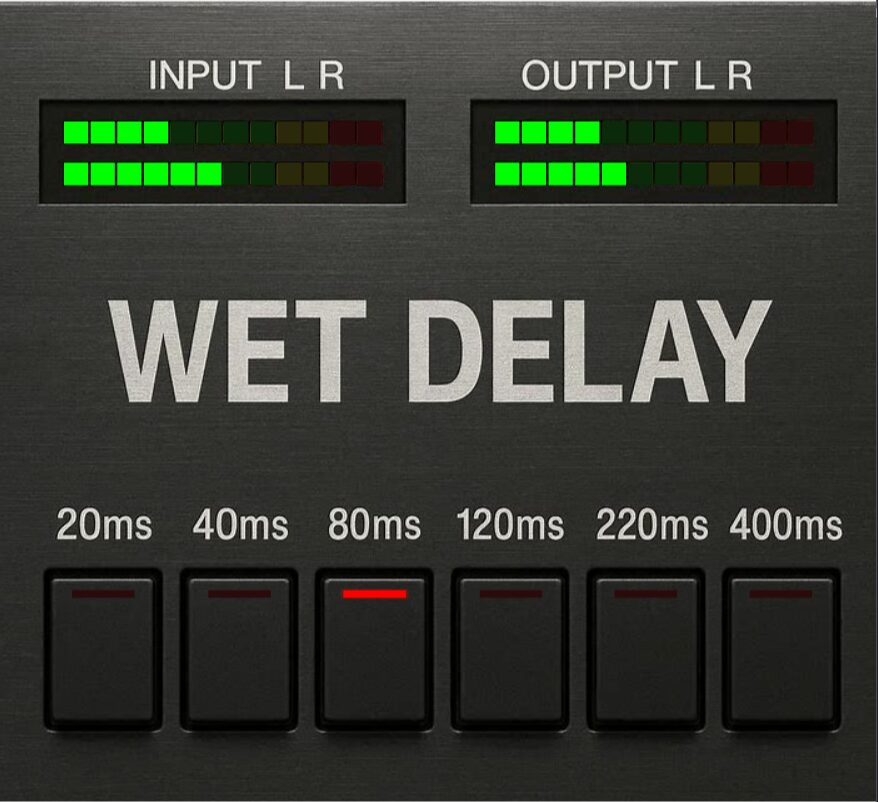

WET Delay by Yonie is a free VST plugin designed to recreate the restricted bandwidth, low-resolution processing and subtle stereo imperfections of an early digital rack delay.
Instead of offering dozens of modulation pages, feedback networks and polished modern algorithms, the plugin focuses on a deliberately limited signal path. It processes audio at an internal sample rate of 24 kHz, reduces it to 12-bit resolution and applies fixed vintage-style filtering.
The result is a delay effect with darker echoes, audible digital texture and the slightly imperfect stereo behavior associated with older studio hardware.
WET Delay is free, open source and available in VST3 format for Windows, macOS and Linux. It is particularly useful for producers who want a simple parallel delay with more character than a clean stock plugin.
What Is WET Delay?
WET Delay is a stereo audio effect developed by Ronald Klarenbeek, also known as Yonie.
The plugin is inspired by the sound of digital rack effects from the 1980s. These units often operated at lower sample rates and bit depths than modern audio software, resulting in reduced high-frequency response, audible quantization and a recognizable gritty character.
Rather than attempting to remove those limitations, WET Delay uses them as part of its sound.
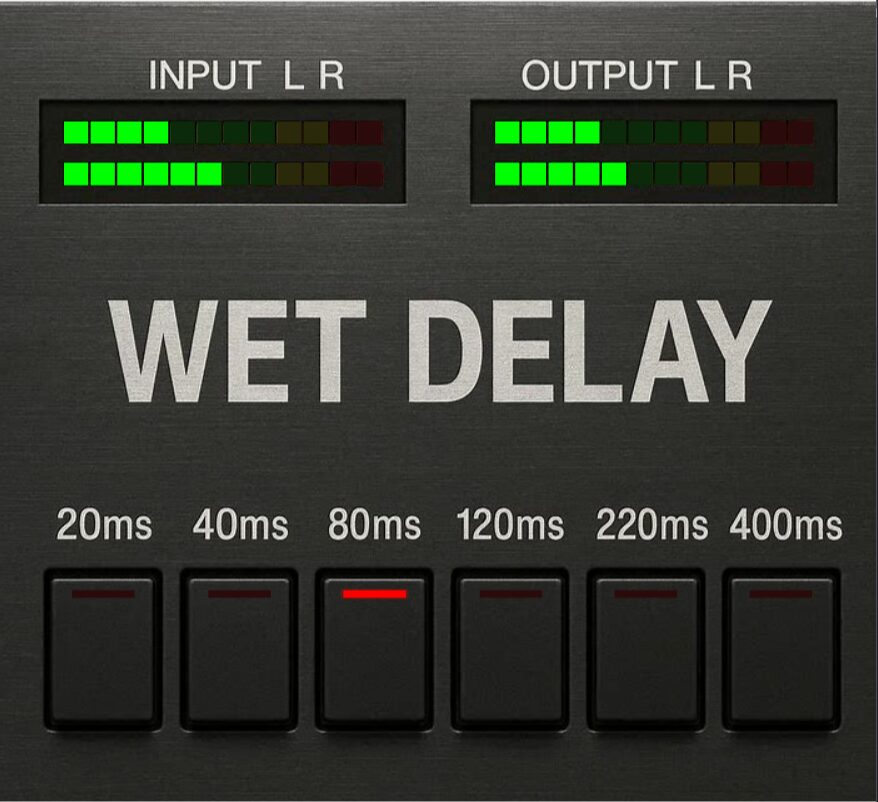
The plugin offers six fixed delay times, independent processing for the left and right channels, real-time input and output meters and full VST3 parameter automation.
Why This Free VST Plugin Matters
Modern delay plugins are often designed to be extremely clean and flexible. They may include multiple taps, modulation matrices, pitch shifting, convolution, diffusion and elaborate visual editors.
WET Delay takes the opposite approach. Its limited controls encourage producers to concentrate on the tone of the echoes rather than programming a complicated effect.
This makes it useful when a track needs character quickly. The lower internal sample rate and 12-bit processing naturally reduce brightness and detail, helping delayed signals sit behind the dry source.
For home studio producers, it also provides a free way to explore early digital delay coloration without buying a commercial hardware emulation.
A 100 Percent Wet Delay Effect
WET Delay outputs only the delayed signal. It does not include a conventional dry and wet mix control.
This design makes the plugin especially suitable for use on an auxiliary send or effect return. The dry source remains on its original channel, while WET Delay produces the echoes on a separate bus.
Working this way gives producers independent control over the level, equalization, panning and additional processing of the delayed signal.
The plugin can also be inserted directly on a track when a fully delayed output is required for sound design, resampling or special effects. However, producers looking for a normal insert delay will need to create a parallel routing setup inside the DAW.
Six Fixed Delay Times
WET Delay offers six selectable delay times:
- 20 milliseconds
- 40 milliseconds
- 80 milliseconds
- 120 milliseconds
- 220 milliseconds
- 400 milliseconds
These fixed values reflect the direct workflow of older digital hardware, where delay times were sometimes selected from switches or predefined ranges rather than continuously adjusted.
The shortest settings can be used for doubling, thickening and stereo positioning. Midrange values work for slapback effects and rhythmic space, while the longer settings create more clearly separated echoes.
The delay times are not described as tempo-synchronized. Producers who need note-value synchronization must choose the closest available time manually or calculate the appropriate millisecond value before selecting a setting.
24 kHz Internal Sample Rate
The plugin processes its delay path at an internal sample rate of 24 kHz.
This is significantly lower than the 44.1, 48 or 96 kHz rates commonly used in modern music production. A lower internal rate restricts the available frequency bandwidth and contributes to a darker, less detailed sound.
WET Delay resamples the incoming audio before processing and reconstructs it when returning the signal to the host.
This approach is part of the plugin’s intended character. It should not be confused with a compatibility limitation, since the host itself can operate at sample rates ranging from 22.05 kHz to 384 kHz according to the developer.
12-Bit Quantization
The delayed signal is processed using 12-bit quantization with 4,096 discrete levels.
Compared with modern floating-point audio processing, 12-bit resolution introduces more noticeable quantization texture. Quiet signals and decaying echoes can reveal a grainier digital edge, particularly when levels fall closer to the available resolution steps.
This character can help synths, drums, vocals and guitars sound less polished and more reminiscent of early digital studio equipment.
The plugin uses triangular probability density function dithering, commonly shortened to TPDF dither, to make the quantization behavior smoother and less correlated with the original signal.
Vintage-Style Filtering
WET Delay applies an 80 Hz high-pass filter and a 9 kHz low-pass filter to the processed signal.
Both filters use gentle 6 dB-per-octave slopes.
The high-pass filtering removes some low-frequency content from the echoes, helping prevent the delay return from becoming excessively heavy or muddy.
The 9 kHz low-pass filter reduces high-frequency detail and reinforces the darker character created by the 24 kHz internal processing rate.
These filters are built into the processing architecture and are not presented as adjustable controls.
Stereo Processing and Channel Crosstalk
WET Delay processes the left and right channels independently while introducing a small amount of signal bleed between them.
The developer specifies bidirectional channel crosstalk of approximately one percent, or minus 40 dB.
This simulates the imperfect separation found in some analog circuitry surrounding early digital processors.
The effect is subtle, but it can prevent the stereo channels from feeling completely isolated. On wide synths, guitars and stereo percussion, the slight interaction can make the delay return feel more cohesive.
Input and Output Metering
The interface includes real-time peak meters for both the input and output signals.
These meters provide immediate feedback when routing audio through the plugin, which is particularly useful because the output is completely wet.
Users can confirm that the effect is receiving audio and monitor the level of the delayed return before sending it into additional processing.
The metering system uses peak detection with an exponential visual decay, allowing short transients to remain visible long enough to be read.
VST3 Automation
The delay-time selector supports VST3 parameter automation.
This allows producers to change between the six fixed delay settings during a song. Automating the selector can create sudden spatial shifts, rhythmic jumps and pitch-like transitions caused by changes in delay-buffer timing.
The developer states that the plugin passes the official VST3 validation tests, including parameter handling, state transitions, preset recall and plugin suspend or resume behavior.
Sound and Processing Character
WET Delay is intentionally darker and rougher than a transparent modern delay.
The restricted bandwidth reduces bright transients and high-frequency detail, while the 12-bit quantization adds a subtle digital grain to the echoes.
On vocals, this can produce delay throws that remain behind the lead instead of competing with its clarity. On synths, it can add retro digital character without using a separate bit crusher and filter chain.
Drum hits can develop short, textured reflections, while guitars and electric pianos can take on a compact rack-effect quality associated with older studio productions.
The plugin does not include feedback, modulation or a tone control. Its identity comes from the processing resolution, filtering and stereo crosstalk rather than from a large collection of adjustable parameters.
Best Uses for WET Delay
This free delay VST plugin can be useful in several music production situations:
- Short stereo doubling effects
- Vintage-style vocal delay throws
- Slapback echoes on guitars and vocals
- Dark parallel delays for synthesizers
- Retro digital effects for synthwave production
- Textured echoes on drum and percussion buses
- Lo-fi effects for sampled instruments
- Resampling and experimental sound design
- Early reflection-style thickening
- Parallel processing inside a home studio mix
Vocal Delay Throws
The fully wet output makes WET Delay well suited to a dedicated vocal effect bus.
A producer can send individual words or phrases into the plugin, then automate the return level to create delay throws without changing the dry vocal.
The limited high-frequency response helps keep the echoes behind the main performance. Additional EQ, saturation or reverb can then be placed after the plugin on the return channel.
The 220 ms and 400 ms settings are the most obvious choices for separated echoes, while shorter values can produce doubling and compact slapback effects.
Synths and Electronic Music
WET Delay can add early digital character to modern software synthesizers.
Clean wavetable leads, bright arpeggios and precise digital pads can sometimes feel overly polished. Passing their echoes through 12-bit quantization and restricted bandwidth creates a less pristine contrast around the original signal.
This can work particularly well in synthwave, electro, ambient, lo-fi house and other styles that use vintage or retro-futuristic textures.
The shorter delay values can thicken mono synth parts, while longer settings create darker echoes that remain separate from the dry attack.
Drums and Percussion
On drums, the 20 ms and 40 ms settings can create compact reflections and stereo thickening.
The 80 ms and 120 ms options can introduce short rhythmic repeats, particularly on snares, claps, rimshots and percussion.
Because the plugin removes low bass and limits the high frequencies, the delayed signal can sit more easily around the original transients.
Producers should still monitor the return level carefully, since a completely wet effect can build up quickly when used on a full drum bus.
Guitar and Electric Piano
Short digital delays were frequently used to add width and dimension to guitars, keyboards and electric pianos.
WET Delay can recreate that general production approach without attempting to model one named hardware unit.
The 20 ms and 40 ms settings are useful for thickening, while the longer delay times can create slapback and separated echo effects.
Its dark frequency response can complement clean guitar tones, chorus-heavy parts and electric piano chords without adding excessively bright repeats.
Plugin Format and Operating System Compatibility
WET Delay is available exclusively in VST3 format.
- Windows: Windows 10 or Windows 11, 64-bit
- Linux: x86-64 systems with VST3 host support
- macOS Intel: macOS 10.13 or later
- macOS Apple Silicon: macOS 11 or later
The cross-platform download contains versions for Windows, Linux and macOS, including Intel and native Apple Silicon builds.
No VST2, Audio Unit, AAX, CLAP, LV2 or standalone version is officially listed.
DAW and Host Requirements
Users need a DAW or audio host that supports VST3 audio effects.
The developer mentions Reaper, Cubase, Ableton Live and FL Studio as examples of compatible VST3 hosts. This does not guarantee that every version or system configuration has been individually tested.
Producers should confirm that their DAW supports 64-bit VST3 plugins and allows effect returns or auxiliary buses if they intend to use WET Delay as a parallel effect.
Installation on Windows
Windows users can download the latest release from the official GitHub repository, extract the archive and copy the WetDelay.vst3 file into a recognized VST3 directory.
The developer lists the following common locations:
- C:\Users\[Username]\Documents\VST3\
- C:\Program Files\Common Files\VST3\
After copying the plugin, restart the DAW and perform a plugin rescan when necessary.
Installation on Linux
Linux users can place the extracted VST3 plugin in a user or system VST3 directory.
The documented locations include:
- ~/.vst3/
- /usr/lib/vst3/
The host must support Linux VST3 plugins. Compatibility should be verified with the specific DAW and distribution being used.
Installation on macOS
On macOS, the WetDelay.vst3 bundle can be copied to the following user plugin directory:
~/Library/Audio/Plug-Ins/VST3/
The macOS build is not signed or notarized. As a result, Gatekeeper may prevent it from opening because the developer cannot be verified.
The official installation instructions explain how to remove the quarantine attribute manually with the macOS Terminal. Users should read those instructions carefully and obtain the plugin only from the official GitHub repository.
This additional step is an important limitation for users who prefer installers that are signed and immediately recognized by macOS.
Registration and License Manager
WET Delay does not require an account, email registration, activation code or license manager.
The compiled versions can be downloaded directly from the official GitHub Releases page.
The complete source code is also publicly available for inspection and independent compilation.
Open-Source MIT License
WET Delay is released under the MIT License.
This permissive open-source license allows the software and its source code to be used, copied, modified, merged, published, distributed and sublicensed under the conditions stated in the included license notice.
The plugin also uses Steinberg’s VST3 SDK, which is covered by its own licensing terms.
Users or developers planning to redistribute modified builds should read both the MIT License and the relevant VST3 SDK license documentation.
Important Limitations
WET Delay is intentionally simple, but that simplicity introduces several limitations.
There is no dry and wet mix control, so the plugin is primarily intended for auxiliary sends or completely wet sound design chains.
There is no feedback control, which means it produces a single delayed signal rather than a repeating chain of decaying echoes.
The six delay times are fixed and are not synchronized to the DAW tempo. There are no dotted, triplet or note-value options.
The plugin also lacks modulation, ping-pong routing, adjustable filtering, saturation controls and presets for complex rhythmic patterns.
These omissions make it less flexible than a full commercial delay workstation. They also keep the workflow immediate and preserve the focused early-digital concept.
Why Free Open-Source Audio Plugins Matter
Open-source audio plugins provide more than a zero-cost download. They allow musicians, developers and students to inspect how real-time audio processing is implemented.
In the case of WET Delay, the repository documents its resampling, quantization, filtering, buffer management, metering and cross-platform build process.
This transparency can make the plugin useful as both a production tool and an educational project for people learning audio programming.
It also gives users a way to preserve, rebuild or adapt the software if development eventually stops.
Future Development
WET Delay received several updates during 2026.
Version 1.1 introduced cross-platform support for Windows, Linux, Intel macOS and Apple Silicon. A later update corrected an issue that prevented the selected delay time from being restored properly when reopening DAW sessions.
The latest release displayed in the official repository is version 1.1.4, published on April 17, 2026.
No detailed public roadmap promises feedback, tempo synchronization, additional formats or new processing modules. Future features should therefore not be assumed unless they are announced by the developer.
Official Download
Official website: Visit WET VST
Official product page and source code: View WET Delay on GitHub
Official download page: Download the latest WET Delay release
Official license: Read the MIT License
Final Verdict
WET Delay by Yonie is a focused free VST3 plugin for producers who want early digital delay character without navigating a complicated interface.
Its 24 kHz internal processing, 12-bit quantization, fixed filtering and subtle channel crosstalk give the delayed signal a darker and grainier identity than a clean modern effect.
The lack of feedback, tempo sync and dry or wet mixing limits its flexibility. It works best as a fully wet parallel processor rather than an all-purpose insert delay.
Within that role, WET Delay is useful, lightweight and refreshingly direct. It does one specific job, documents exactly how it does it and releases the complete source code under the MIT License. Not every delay needs a modulation matrix the size of airport security. Sometimes six buttons and a little 12-bit grit are enough.