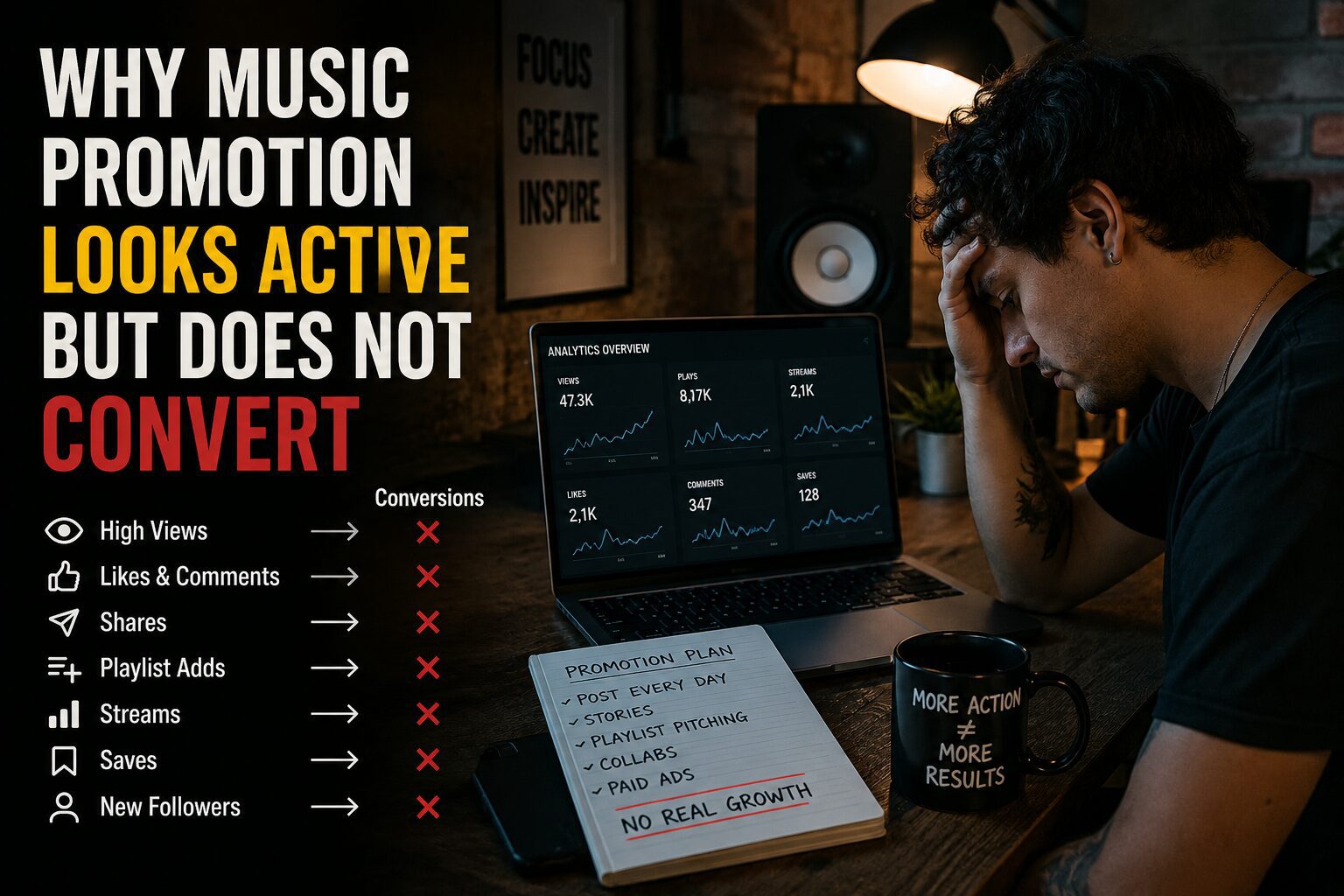

And yet the results remain frustratingly thin. Streams rise for a day, then disappear. A reel gets views, but nobody clicks the link. A playlist placement brings plays, but no saves. A post gets likes, but no followers. A release gets attention, but no real audience growth. The promotion looks active, but it does not convert.
This is one of the most common problems in independent music marketing. Activity is easy to measure because it feels visible. Conversion is harder because it requires a listener to do something meaningful: stream the song, save it, follow the artist, join the community, share the track, buy something, attend a show, or come back later. Promotion creates noise. Conversion creates movement.
The uncomfortable truth is that many music campaigns fail not because artists do too little, but because they do too much without a clear path. They confuse visibility with strategy. They mistake posting for positioning. They treat every platform like a loudspeaker, when the real goal is to guide strangers toward becoming listeners, and listeners toward becoming fans.
The Difference Between Attention and Action
Attention is the first step, but it is not the destination. A listener can see a post, watch a clip, like a photo, or leave a comment without ever pressing play. In the current music landscape, attention is cheap, fast, and unstable. Conversion is slower, more valuable, and far harder to earn.
This distinction matters because many artists judge promotion by surface signals. A video with thousands of views looks successful. A release post with likes feels encouraging. A playlist screenshot creates a sense of momentum. But those numbers only matter if they lead somewhere.
A campaign converts when attention turns into behavior. The listener leaves the platform to stream the track. They save the song because they want it back. They follow the artist because they care about the next release. They add the track to a personal playlist because it has entered their routine. They visit the artist profile, watch another video, or send the song to someone else.
Without that movement, promotion becomes decoration. It proves that the artist is active, but not that the audience is moving closer.
The Campaign Has No Clear Promise
One of the biggest reasons music promotion fails to convert is that the campaign does not clearly explain why someone should listen. The artist says the song is out now. They say it is available on all platforms. They say they are proud of it. They may describe it as emotional, powerful, fresh, authentic, or different. But none of that automatically creates a reason for a stranger to care.
Listeners do not click because a song exists. They click because something in the message gives them a reason to imagine a feeling, a scene, a mood, an identity, or a personal connection. A strong campaign does not simply announce music. It frames the experience.
A dance track might promise late-night energy, club tension, or summer movement. A lo-fi track might promise calm, nostalgia, focus, or emotional softness. A rock song might promise release, anger, drive, or raw performance. A cinematic track might promise scale, atmosphere, suspense, or escape. When the promise is clear, the listener knows what kind of experience is waiting.
Too many artists promote the release date instead of the feeling. They push the link before they build the desire. The result is predictable: people see the post, understand that music exists, and keep scrolling.
Your Content Gets Views But Does Not Create Intent
Short-form video has become one of the most powerful discovery tools in music promotion, but it also creates a dangerous illusion. A clip can perform well without making anyone want the full song. Views are not always intent. Sometimes they are only frictionless consumption.
This happens when the content is entertaining but disconnected from the track. The video may be funny, visually strong, or emotionally interesting, but if the song itself is not the reason people stay, the conversion will be weak. The audience remembers the clip, not the artist. They react to the format, not the music.
It also happens when the strongest part of the song is not used. Many artists tease a track from the beginning because that is how the song is structured. But social media does not always reward patience. The listener may need the hook, drop, chorus, vocal phrase, bassline, or emotional peak immediately. If the first seconds do not create a reason to stay, the campaign loses potential before the song has a chance.
Good content does more than fill space. It creates intent. It makes the viewer curious enough to hear the full track, learn more about the artist, or save the sound. A post that gets fewer views but sends real listeners to the song may be more valuable than a viral clip that produces no streaming movement.
The Call to Action Is Too Generic
“Listen now” is clear, but it is rarely powerful by itself. “Out now” is useful, but it is not persuasive. “Available everywhere” gives information, but it does not create desire. These phrases are not wrong. They are simply incomplete.
A strong call to action connects the action to the reason. Instead of asking people to listen because the song is released, the artist gives them a moment to enter. The message might invite listeners into the story behind the track, the emotion of the chorus, the atmosphere of the production, or the specific situation where the song makes sense.
For example, a campaign for a late-night electronic track should not speak like a generic pop announcement. A song built for driving at night, headphones after midnight, underground club sets, or deep focus needs a call to action that matches that world. The words around the link should prepare the listener for the experience.
Conversion often improves when the artist stops shouting “stream my song” and starts giving the listener a reason to place the song inside their life.
The Link Journey Is Leaking Listeners
Many campaigns lose people between interest and playback. This is where the link journey becomes critical. A person may like the clip, tap the profile, click the link, land on a confusing page, fail to find their preferred platform, get interrupted, and disappear. The artist sees views and maybe clicks, but not streams.
Every extra step creates friction. Every unclear button weakens intent. Every mismatched platform reduces the chance of listening. If the landing page is slow, crowded, poorly labeled, or visually disconnected from the campaign, the listener may not complete the journey.
The path from discovery to playback should feel effortless. The post creates curiosity. The caption reinforces the reason to listen. The link is easy to find. The landing page offers clear platform choices. The first option matches the likely audience. The song opens quickly. The artist profile looks professional enough to encourage further exploration.
This may sound simple, but many artists overlook it. They spend hours creating content, then send listeners into a messy funnel. Promotion does not convert when the path is unclear.
The Audience Is Too Broad
Another common problem is promoting to everyone. Artists often want the biggest possible audience, so they describe their music in broad terms and target vague categories. They want fans of pop, house, hip-hop, rock, chill music, electronic music, good vibes, real music, or emotional songs. The problem is that broad messaging rarely feels personal.
Conversion improves when the audience feels recognized. A deep house listener looking for warm late-night grooves responds differently from a festival EDM fan. A lo-fi listener studying alone at night responds differently from someone looking for background café music. A synthwave fan attracted to retro cinematic aesthetics responds differently from a general electronic listener.
The more precise the audience, the sharper the campaign becomes. The visuals, captions, playlists, hashtags, pitches, and content ideas all become easier to align. The artist stops speaking to a crowd and starts speaking to a scene, mood, or listener identity.
Music promotion does not become smaller when it becomes precise. It becomes stronger. A focused audience can create the first real wave of conversion, and that wave can later expand.
The Branding Does Not Support the Music
A listener may enjoy a song and still not follow the artist if the brand feels unclear. This is a painful but important reality. In an overcrowded music market, the track opens the door, but the artist identity decides whether people stay.
Branding does not mean pretending to be something artificial. It means making the artist easy to understand. The listener should quickly sense the world around the music: the sound, the mood, the visual identity, the emotional territory, the aesthetic, and the reason this artist is different from the endless stream of new releases arriving every week.
If the profile picture, artwork, bio, posts, visuals, and music all feel disconnected, conversion becomes harder. The listener may like one song but fail to understand the project. They do not know what they are following. They do not know what kind of future music to expect.
Strong branding creates continuity. It helps each release support the next one. It turns scattered songs into a recognizable world. Without that world, promotion may create isolated reactions but not lasting growth.
You Are Promoting the Song, Not the Story
Songs need context. Not every track requires a dramatic backstory, but every campaign benefits from a reason to care. The story might be emotional, creative, technical, cultural, visual, personal, or scene-based. It might be about the lyric, the production process, the collaboration, the city, the genre, the struggle behind the release, or the mood the artist wanted to capture.
When artists promote only the song, they rely entirely on the audience pressing play before understanding anything. When they promote the story, they give the audience a doorway into the music.
This is especially powerful for independent artists because personality and process can create connection before scale exists. A major artist can release a song and attract attention through fame. An emerging artist often needs context. The listener wants to know why this song deserves time, why this voice matters, why this sound exists now.
The story does not need to be long. It needs to be specific. A precise sentence can create more conversion than a polished paragraph full of vague enthusiasm.
The Campaign Stops Too Early
Many artists promote a release heavily for a few days, then move on when the initial reaction slows down. This creates a short burst of activity, but not a real campaign. Listeners often need multiple touchpoints before they act. They may see the first post and ignore it, watch a clip later, notice a playlist mention, hear a different part of the song, then finally click.
Conversion usually requires repetition with variation. The same link posted ten times becomes annoying. The same song presented through ten different angles becomes a campaign.
An artist can show the hook, then the story, then the studio process, then a lyric moment, then a playlist update, then a live version, then a visual mood, then fan feedback, then a personal reflection, then a reminder connected to a specific listening moment. Each post adds a new reason to enter the track.
If the campaign stops after the release announcement, the artist is depending on one moment to do all the work. Most songs need more than that.
The Data Is Not Being Used
Artists often collect numbers without turning them into decisions. They know how many streams they have. They know which reel performed best. They know a playlist created a spike. But they do not adjust the campaign based on that information.
Data only matters when it changes behavior. If a certain country responds strongly, the next post can speak to that audience. If a specific video drives clicks, the artist can build variations around it. If saves are strong but reach is low, the song needs more exposure. If views are high but streams are weak, the link journey or call to action needs work. If playlist streams are high but followers do not grow, the audience may be too passive or poorly targeted.
The campaign should become smarter as it runs. That is the difference between active promotion and strategic promotion. Activity repeats. Strategy learns.
The Music Is Reaching Listeners, But Not the Right Moment
Timing is not only about release dates. It is also about listening context. A song can fail to convert if it reaches people in the wrong mood, platform, or environment.
A track designed for late-night headphones may not convert from a loud, chaotic video. A club track may not work with a static visual that makes it feel slow. A lyrical song may be wasted if the campaign never highlights the words. A cinematic instrumental may need visual storytelling more than a standard streaming link. A lo-fi track may convert better through routine-based content than through release hype.
The campaign has to match the way the song is meant to be experienced. When the context is wrong, the listener may not reject the music. They may simply never meet it properly.
Successful music promotion often comes down to alignment: the right song, the right message, the right visual, the right platform, the right moment, and the right listener.
How to Fix a Campaign That Does Not Convert
The first step is to stop measuring success by activity alone. Posting more is not always the answer. Pitching more is not always the answer. Spending more is not always the answer. The answer is to identify where the chain breaks.
If people do not stop scrolling, the problem is attention. The opening visual, headline, hook, or first second may need work. If people watch but do not click, the problem is intent. The content may entertain without making the song desirable. If people click but do not listen, the problem is friction. The link journey may need to be cleaner. If people listen but do not save, the problem may be audience fit, song positioning, or replay value. If people save but do not follow, the artist identity may need to become clearer.
This way of thinking turns vague frustration into practical diagnosis. The artist no longer says, “My promotion is not working.” They say, “My content gets attention, but my call to action does not create enough listening,” or “My playlist traffic creates streams, but not saves,” or “My audience likes the post, but the link path is too weak.”
Specific problems can be solved. Vague disappointment cannot.
Build a Conversion-Based Music Promotion System
A strong campaign should be built like a path. At the top, people discover the artist through content, playlists, recommendations, press, radio, search, or social media. In the middle, they understand the song’s mood, story, and reason to listen. At the bottom, they take a meaningful action: stream, save, follow, subscribe, share, or return.
Each part of the path needs its own material. Discovery content should grab attention quickly. Context content should explain why the song matters. Conversion content should make the next step clear and easy. Retention content should keep the relationship alive after the first listen.
This system is more powerful than random posting because it respects how listeners actually behave. Most people do not become fans instantly. They move through stages. They notice, understand, listen, connect, return, and eventually support.
Independent artists who build promotion around that journey become less dependent on luck. They stop asking every post to do everything. Instead, each piece of content has a role.
Visibility Without Direction Is Just Noise
The modern artist is under constant pressure to be visible. Post more. Release more. Pitch more. Share more. Make more content. Use every platform. Chase every trend. Stay present. Stay active. Stay in the feed.
But visibility without direction is exhausting. It can make an artist feel productive while the audience remains unmoved. The goal is not to be everywhere. The goal is to move the right people from awareness to action.
That requires clarity. What is the song’s promise? Who is it for? What feeling does it deliver? Which part should be heard first? What should the listener do next? Why should they come back? What makes the artist worth following beyond one track?
When those questions are answered, promotion becomes more than activity. It becomes architecture. Every post, link, visual, pitch, and playlist target works together.
A campaign that converts does not simply make noise around a release. It builds a bridge between the music and the people most likely to care.
The Real Goal Is Not More Promotion, It Is Better Movement
If your music promotion looks active but does not convert, the answer is not always to push harder. Sometimes the answer is to slow down, read the signals, and rebuild the path.
Attention is only the beginning. A listener needs a reason to care, an easy way to act, and a clear sense of who the artist is. A campaign needs more than posts. It needs intention. It needs a story, a promise, a target, a clean link journey, and follow-up that keeps the song alive beyond release day.
Independent artists do not need to turn every campaign into a complicated marketing machine. But they do need to understand the difference between being seen and being followed, between getting views and getting listeners, between creating activity and creating growth.
The strongest promotion does not simply prove that an artist is working. It helps the audience move.
That is where real conversion begins.
Discover more independent music promotion strategies, artist resources, and playlist insights on Audiartist.