ZL Compressor is a free open-source dynamics processor designed for producers and mixing engineers who need more than conventional downward compression. Updated to version 0.5.0 in May 2026, it combines four processing directions, several compressor characters, detailed sidechain control and extensive visual feedback inside a resizable interface.
The plugin can handle transparent peak control, vocal leveling, drum-bus glue, upward compression, expansion and more experimental dynamic shaping. Its combination of lookahead, RMS processing, parallel mixing, oversampling and stereo control makes it suitable for everyday mixing as well as more technical sound design.
What Is ZL Compressor?
ZL Compressor is a dynamic range processor developed by ZL Audio. Unlike a basic compressor limited to reducing peaks above a threshold, it offers four different processing directions:
- Compress: conventional downward compression.
- Inflate: upward compression that raises quieter material.
- Expand: downward expansion for reducing low-level signals.
- Shape: upward expansion for increasing dynamic contrast.
This makes the plugin useful for corrective mixing, transient enhancement, ambience control and creative reshaping. The processing can be blended with the original signal through the Wet control, allowing parallel compression without additional routing.
Four Compression Styles
ZL Compressor provides four processing styles with different envelope behavior:
- Clean: a precise feedforward design for transparent dynamic control.
- Classic: a smoother feedback design suited to bus compression and musical glue.
- Optical: a softer response inspired by optical-style leveling.
- Vocal: a gentle feedback mode intended for controlled and natural vocal processing.
The Clean mode is useful when the compressor should remain relatively invisible. Classic can add movement and cohesion to drums, percussion and instrument buses, while Optical and Vocal provide smoother behavior on melodic instruments and voices.
Additional Pump and Smooth controls modify the attack and release response. Pump makes the attack more assertive, while Smooth creates a slower and more controlled release transition.
Detailed Dynamics Control
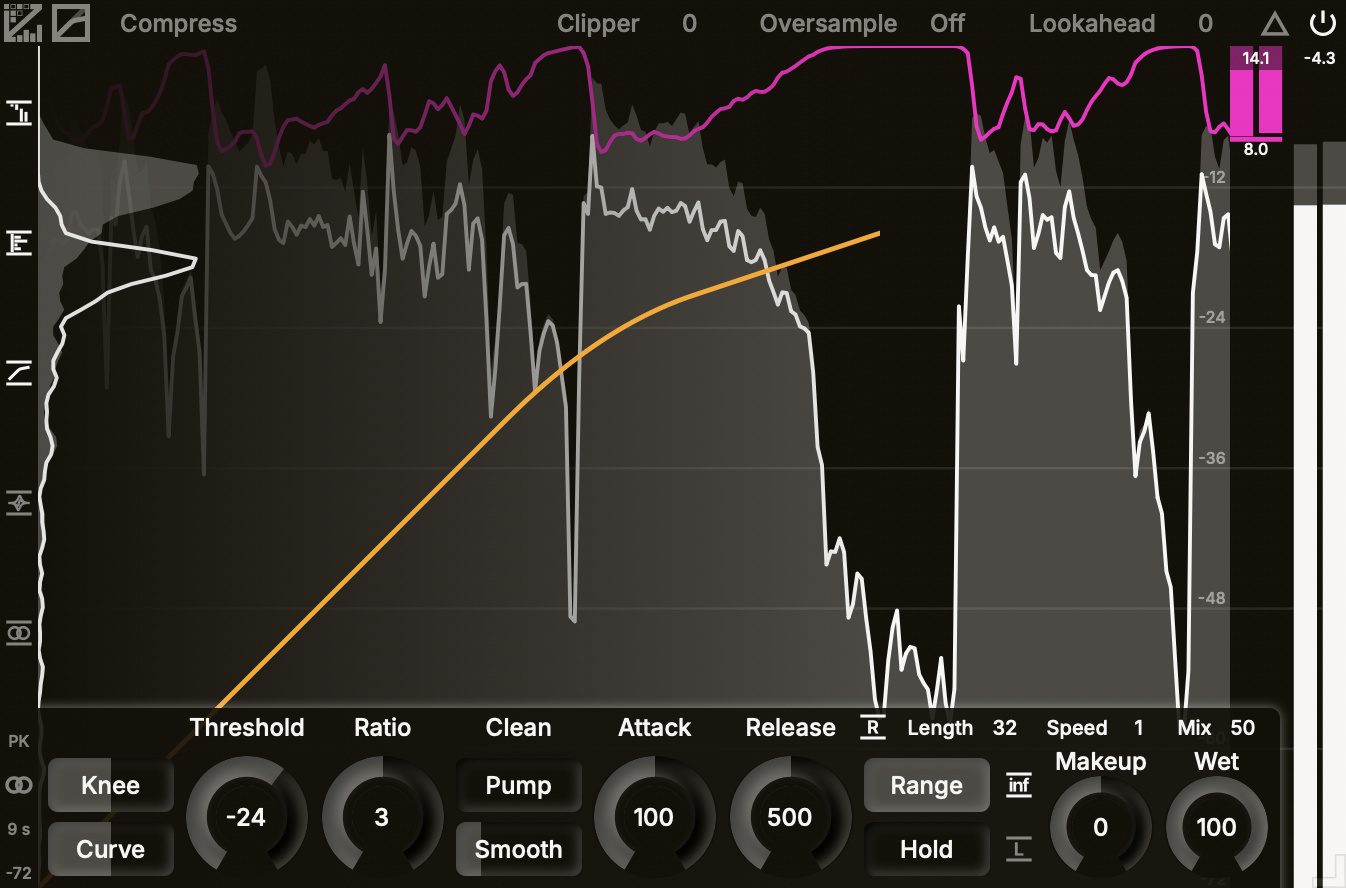
The main section includes threshold, ratio, knee, attack, release, hold, range and makeup gain. A curve control adjusts the nonlinear behavior of the compression stage, while RMS processing allows the detector to react to average energy rather than only short peaks.
Lookahead can delay the main signal so the compressor reacts before a transient reaches the output. This is useful for controlling sharp drum hits and preventing brief peaks from escaping the gain-reduction stage.
The Range control limits the maximum amount of processing. It can prevent a vocal, bassline or drum bus from being compressed more heavily than intended, even when the input level changes.
Oversampling and Built-In Clipping
ZL Compressor provides oversampling at 2x, 4x and 8x, alongside a zero-oversampling mode. Higher settings can improve the behavior of nonlinear processing and the integrated clipper, although they also increase CPU use and latency.
The post-processing clipper can control remaining peaks or add additional density. It is especially useful on drum buses, basses and electronic instruments where a small amount of clipping can increase perceived impact.
Oversampling should normally be selected before playback or rendering rather than automated, as changing it during processing may produce clicks.
Visual Feedback and Loudness Matching
The central display shows the input, output and gain-reduction curves over time. Producers can switch between peak and RMS views and adjust the display range and time window.
A cumulative analyzer compares the average input and output levels, while the gain-reduction computer displays the response curve used by the processor.
ZL Compressor also includes a loudness-learning function. It measures the integrated input and output levels, then adjusts the makeup gain to create a fairer comparison between the processed and bypassed signals.
This is valuable because louder processing has an unfair habit of sounding better during quick comparisons, even when it is simply louder and wearing a confident expression.
Advanced Sidechain Processing
The internal sidechain includes an eight-band parametric equalizer. Producers can filter the detector signal without changing the audible output of the track.
A high-pass filter can prevent deep bass from triggering excessive gain reduction, while a focused midrange boost can make the compressor react more strongly to a vocal, snare or specific tonal area.
An external sidechain input is also available for classic ducking and frequency-conscious interaction between tracks. A kick can control a bassline, a vocal can reduce a synth layer, or a percussion loop can create rhythmic movement on a pad.
Stereo and Mid/Side Control
ZL Compressor supports Left/Right and Mid/Side processing, with adjustable linking between both channels. Maximum-linked modes can preserve stronger gain reduction while still allowing some stereo independence.
Mid/Side processing is useful when the center and edges of a mix require different dynamic behavior. A centered kick and bass can remain controlled while wide pads, reverbs and percussion retain more movement.
The stereo wet controls also allow different parallel-processing amounts for each channel or component of the stereo signal.
Practical Uses in Current Music Production
- Vocals: use Vocal or Optical mode with moderate RMS processing for smoother level control.
- Drum buses: use Classic mode, slower attack and controlled clipping for additional glue and impact.
- Bass: limit dynamic movement while preserving the initial transient with lookahead and range control.
- Afro House percussion: shape organic drum layers without flattening their natural groove.
- Tech House and Hardgroove: create controlled pumping and stronger rhythmic cohesion.
- Parallel compression: increase density with the Wet control while retaining the original transients.
- Sound design: use Inflate, Expand or Shape modes to reveal ambience and exaggerate dynamic movement.
Formats and System Compatibility
- Current version: 0.5.0
- Latest update: May 6, 2026
- Price: Free and open source
- License: AGPLv3
- Windows: Windows 10 or later
- macOS: Intel and Apple Silicon builds
- Linux: x86-64, AVX2 and ARM64 packages
- Formats: VST3, Audio Unit, LV2 and AAX, depending on the operating system and installer
- Registration: No account, serial number or license manager required
The developer provides separate builds for different processor architectures. Windows and Linux users should select the correct x86-64, AVX2 or ARM64 package for their system.
The installers are not notarized on every platform. Users who prefer not to run an unsigned installer can build the plugin directly from its publicly available source code.
Visit the official ZL Compressor product page for the documentation and installation guide.
The latest installers and source packages are available from the official ZL Compressor GitHub Releases page.
License and Commercial Use
The AGPLv3 license covers the plugin software and source code. It does not transfer to music, mixes or masters processed with the plugin.
ZL Audio confirms that the plugin can be used for commercial releases, client work and professional studio production without mandatory credit. Different obligations apply only when modifying or redistributing the software itself.
Important Limitations
ZL Compressor provides many controls, so it is less immediate than a simple two-knob leveling plugin. New users may need time to understand the different processing directions, stereo modes and analyzer panels.
The interface also depends on hardware-accelerated graphics on Windows and macOS. Linux builds do not offer the same hardware acceleration, and compatibility can vary between distributions.
Changing oversampling or lookahead during playback may produce clicks, so these parameters should not normally be automated. AAX availability may also depend on whether the current installer has been digitally signed.
Final Verdict
ZL Compressor is one of the most complete free dynamics plugins available to producers in 2026. It combines transparent and characterful compression with upward processing, expansion, detailed metering, sidechain EQ, Mid/Side operation and flexible parallel mixing.
It may be excessive for users who only need a fast vocal leveler, but its depth makes it valuable for drums, vocals, basses, buses and full electronic arrangements.
For producers looking for a free cross-platform compressor that can handle both traditional mixing and experimental dynamic shaping, ZL Compressor offers serious control without subscriptions, activation systems or an artificially restricted free edition.