
AI Music Is Gaining Streams, but a Artificial intelligence is becoming increasingly visible across music streaming platforms, but the latest industry data suggests that its commercial impact remains concentrated around a surprisingly small number of tracks.
According to Luminate’s 2026 Midyear Report, global on-demand audio streaming reached a record 2.8 trillion plays during the first half of the year. That represents a 9.8% increase compared with the same period in 2025, when the global total stood at approximately 2.5 trillion streams.
The figures confirm that music streaming continues to expand at an extraordinary scale. They also provide essential context for the growing debate surrounding AI-generated music. Although several AI-associated tracks are now accumulating tens or even hundreds of millions of plays, they still represent isolated successes within a market processing trillions of streams every six months.
Global Music Streaming Reaches Another Record
Global on-demand audio consumption increased from 2.5 trillion streams in the first half of 2025 to 2.8 trillion during the same period in 2026. Outside the United States, streaming grew by 11.8% to approximately 2 trillion plays.
In the United States, on-demand audio streams reached 732.7 billion, compared with 696.6 billion a year earlier. This 4.8% increase was slower than growth outside the country, reinforcing the increasingly international nature of the streaming economy.
The market is therefore not merely growing. It is also becoming more geographically and stylistically diverse. Latin music, country and dance-electronic releases are expanding their audiences, while English-language music represents a slightly smaller share of overall US consumption.
Against that backdrop, AI-generated music is entering an ecosystem that is already fragmented, highly competitive and dominated by an enormous catalogue of human-created recordings.
A Few AI-Associated Tracks Are Generating Major Numbers
Luminate’s analysis identified “Papaoutai (Afro Soul)” by Chill77 and Unjaps as the highest-ranking AI-assisted song globally during the first 24 weeks of 2026. The track accumulated approximately 210.7 million global audio streams and reached number 282 in Luminate’s worldwide ranking.
Additional figures reported by the Associated Press indicate that the song generated 17.6 million streams in the United States, with the majority of its consumption coming from international markets.
Another AI-associated release, “Let Me Be” by The Second Voice, recorded 75.6 million streams outside the United States and 10.1 million within the country.
In the US market, Breaking Rust’s “Livin’ on Borrowed Time” emerged as the most-streamed AI-generated track identified in the report, producing approximately 19 million domestic streams. It also accumulated 13.4 million streams across international markets.
These are no longer insignificant numbers. An individual track exceeding 200 million global plays has entered a level of consumption traditionally associated with established independent artists, viral hits and commercially supported releases.
However, those figures should not be confused with evidence that AI-generated music has taken control of streaming platforms.
Millions of Streams Inside a Trillion-Stream Market
The difference between visibility and market dominance is critical.
A song generating 200 million streams may appear enormous when viewed independently. Compared with 2.8 trillion global streams during the first half of 2026, however, it represents only a tiny fraction of total listening activity.
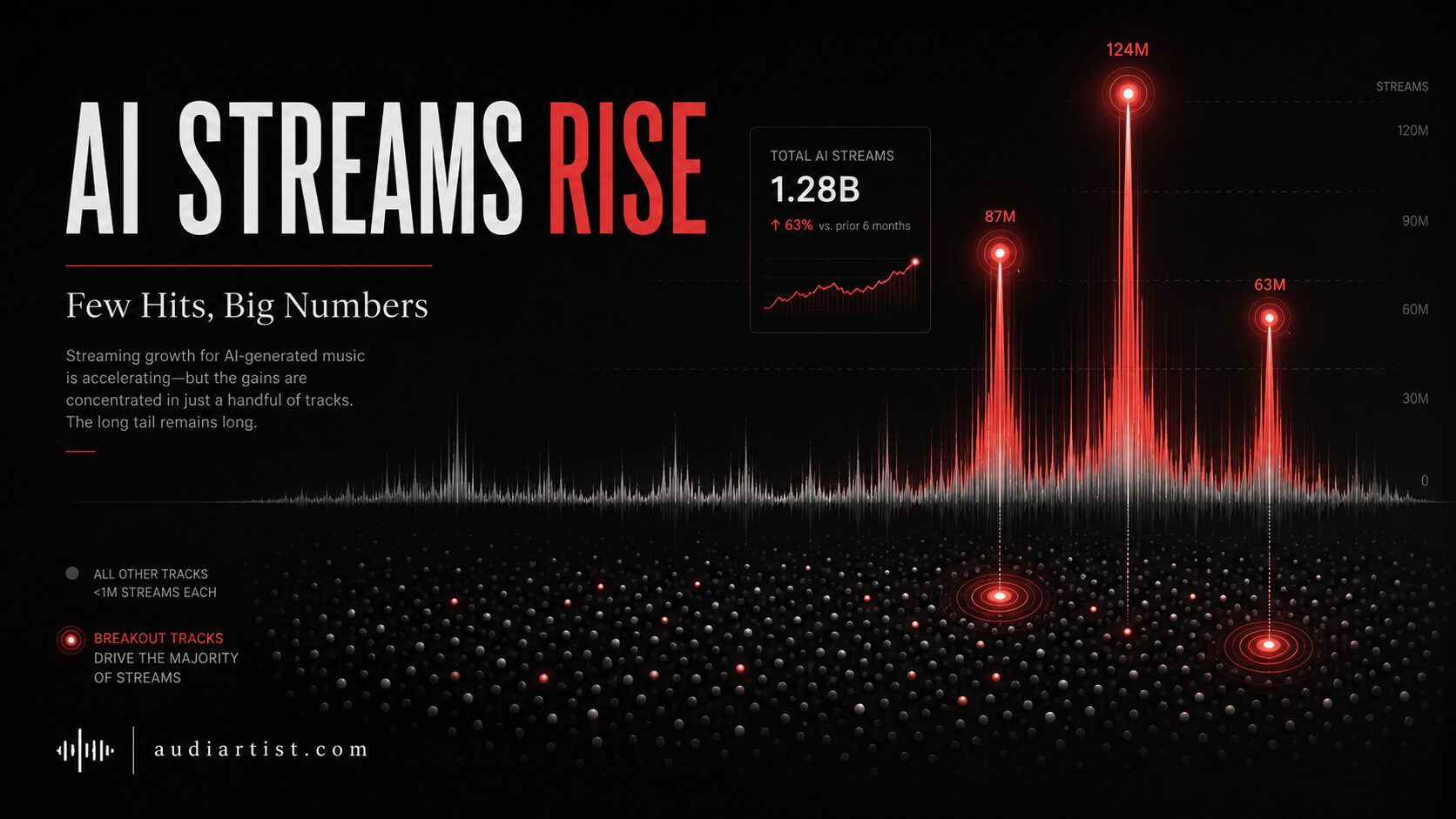
The current AI music market appears to follow a familiar streaming pattern: a limited number of breakout releases attract most of the attention, while the overwhelming majority struggle to develop a meaningful audience.
This concentration is not unique to artificial intelligence. Human artists face the same winner-takes-most dynamics, with a relatively small group of releases capturing a disproportionate share of streams.
AI generation potentially intensifies that imbalance because creators can produce and distribute music at unprecedented speed. Thousands of tracks can be generated with minimal production costs, but increased supply does not automatically create increased demand.
Listeners still need a reason to select one recording from an almost limitless catalogue. Whether a song is produced by a band, a solo musician or a generative model, visibility depends on recommendation systems, playlists, social media exposure, marketing and audience retention.
AI Has Not Yet Changed General Listening Behaviour
Luminate’s conclusion remains cautious. The company states that generative tools are already transforming creative and production workflows, but individual AI-generated tracks have not yet produced a profound or lasting change in overall music consumption.
A small number of successful releases may generate temporary spikes in streams and online discussion. They do not necessarily demonstrate that listeners are actively abandoning human artists in favour of artificial performers.
In many cases, consumers may not even know that AI was involved in the music they are hearing. Disclosure remains inconsistent across platforms, distributors and rights holders.
The industry also lacks a universally accepted definition of AI music. A track may be entirely generated from a text prompt, partially constructed with synthetic vocals, assisted by AI mixing tools or edited using machine-learning software.
Placing all of those uses under a single label risks confusing AI-assisted production with fully automated music generation.
The Question of Classification Remains Unresolved
Luminate distinguishes between fully AI-generated music and recordings created with some form of AI assistance. This distinction is essential when interpreting streaming statistics.
Modern production already includes intelligent tools for vocal processing, stem separation, mastering, restoration, composition and sound design. An artist using one of these systems is not necessarily surrendering authorship or creative control.
Fully generated tracks present a different issue. These recordings may be produced from prompts with little or no traditional performance, songwriting or studio involvement.
Streaming platforms do not yet apply a consistent policy to these different categories. Deezer and Qobuz have developed systems for detecting and labelling fully AI-generated music, while Spotify and Apple Music increasingly rely on metadata supplied by distributors and rights holders.
Deezer and Qobuz have also said that identified AI-generated tracks may be excluded from editorial or algorithmic recommendations. Other services continue to host AI content provided that it does not violate copyright, impersonation or fraud policies.
Popularity Does Not Resolve the Copyright Debate
The emergence of successful AI tracks also raises questions that streaming totals cannot answer.
A recording may attract millions of plays while its training data, vocal identity or stylistic foundations remain disputed. Commercial popularity does not determine whether the underlying model was developed using properly licensed material.
The lawsuits involving Suno, Udio and major music companies demonstrate that the central conflict is not simply whether audiences enjoy AI-generated music. The larger issue is whether technology companies should be allowed to train commercial models on protected recordings without obtaining authorization from artists and rights holders.
That legal uncertainty may eventually affect which AI-generated tracks remain available, how they are labelled and whether they are eligible for royalties or recommendation systems.
Streaming Fraud Creates an Additional Problem
AI-generated music is also closely connected to concerns about streaming manipulation.
Generative platforms make it possible to create large quantities of music rapidly and cheaply. Fraudulent operators can then upload extensive catalogues and use automated accounts to produce artificial streams.
Luminate previously noted that Deezer had identified AI-generated tracks as representing only 1% to 3% of total streams on its service, but approximately 85% of the streams attached to those detected tracks were considered fraudulent.
Those figures do not mean that every AI creator is committing fraud. They do, however, illustrate how automated music production can be combined with automated listening to extract money from royalty systems.
The resulting problem affects legitimate artists because streaming royalties are generally distributed from a shared revenue pool. Artificial plays can redirect money away from music supported by genuine listeners.
AI Music Has Achieved Visibility, Not Dominance
The first half of 2026 confirms that AI-generated music can produce commercially significant tracks. The technology is no longer confined to experimental websites, technical demonstrations or novelty releases.
Some AI-associated songs now compete for attention alongside independent and mainstream recordings. A small number have achieved tens or hundreds of millions of streams, entered specialist charts and generated substantial media coverage.
Yet the wider market tells a more restrained story.
Global audio streaming reached 2.8 trillion plays in six months. Within that immense volume, AI music remains concentrated around a limited group of highly visible releases. There is still no evidence that generative music has fundamentally transformed what most people choose to hear every day.
For now, AI music’s most significant impact may not be its share of total listening. Its real influence lies in the questions it forces the industry to confront: how music should be classified, how creators should be credited, how royalties should be protected and whether training data must be licensed.
Artificial intelligence has clearly entered the streaming economy. It has not conquered it.