
A transient shaper can add punch to a kick, sharpen a snare, shorten room ambience or soften an aggressive percussion loop without relying on traditional compression.
This guide compares four of the best transient shaper plugins in 2026: SPL Transient Designer Plus, Eventide SplitEQ, Auburn Sounds Couture and the free FLUX BitterSweet.
Best Transient Shaper Plugins: Quick Comparison
| Plugin | Price Type | Best For | Workflow |
|---|---|---|---|
| SPL Transient Designer Plus | Paid | Fast drum shaping | Attack and sustain controls |
| Eventide SplitEQ | Paid | Frequency-specific transient control | Transient and tonal EQ |
| Auburn Sounds Couture | Free and paid | Transient shaping with saturation | Dynamics and harmonic processing |
| FLUX BitterSweet | Free | Simple transient enhancement | Single main control |
What Is a Transient Shaper?
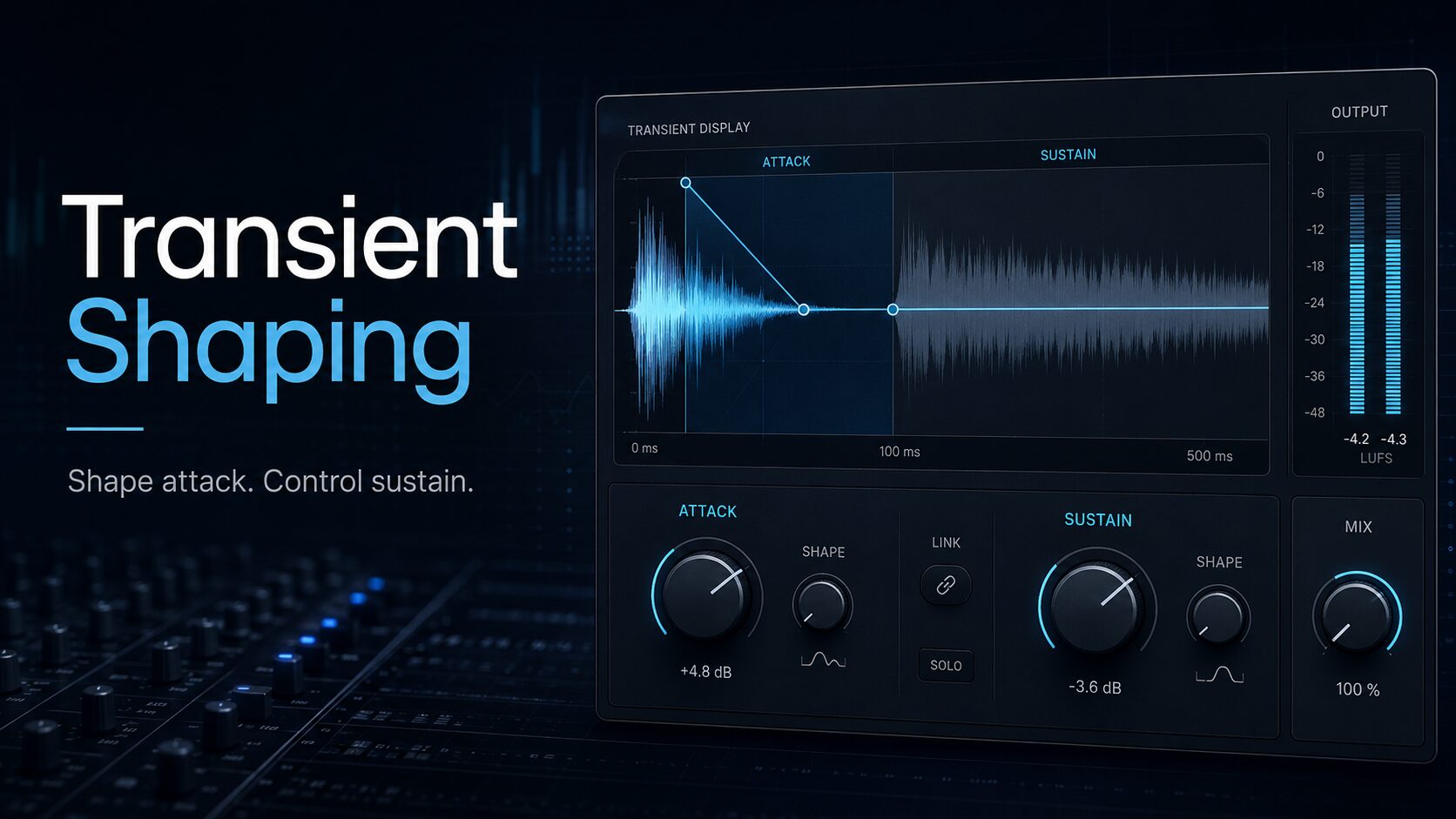
A transient is the short initial burst of energy at the beginning of a sound. It gives a kick its impact, a snare its crack and a plucked instrument its definition.
A transient shaper changes the relationship between this initial attack and the sustained part of the sound. Unlike a compressor, many transient designers do not require a fixed threshold.
Transient shapers are commonly used to:
- add punch to kick drums and snares;
- soften sharp percussion;
- shorten room ambience or reverb tails;
- increase the sustain of guitars and pianos;
- tighten drum loops;
- bring sampled drums forward in a mix.
1. SPL Transient Designer Plus: Best Overall
SPL Transient Designer Plus is based on SPL’s well-known level-independent dynamics technology. Its main controls are Attack and Sustain, making it considerably faster to configure than a traditional compressor.
Increasing Attack makes the initial hit more prominent. Reducing it softens clicks, pick noise and aggressive percussion. Sustain can extend the body of a sound or shorten unwanted room tone.
The Plus version also includes internal and external sidechain options, parallel processing and a built-in soft-clip limiter.
Best Uses
- kick and snare enhancement;
- tightening drum rooms;
- reducing excessive cymbal attack;
- adding sustain to guitars;
- parallel drum processing.
Advantages
- fast and intuitive;
- independent Attack and Sustain controls;
- level-independent processing;
- Dry/Wet control;
- sidechain options;
- zero-latency operation.
Limitations
- no frequency-selective transient shaping;
- strong Attack settings can sound artificial;
- less surgical than SplitEQ.
Verdict: SPL Transient Designer Plus remains the best all-round option for producers who want fast, musical transient control on drums and instruments.
Visit the official SPL Transient Designer Plus page
2. Eventide SplitEQ: Best for Frequency-Specific Transients
Eventide SplitEQ separates audio into transient and tonal components. Each component can then be equalised independently across eight bands.
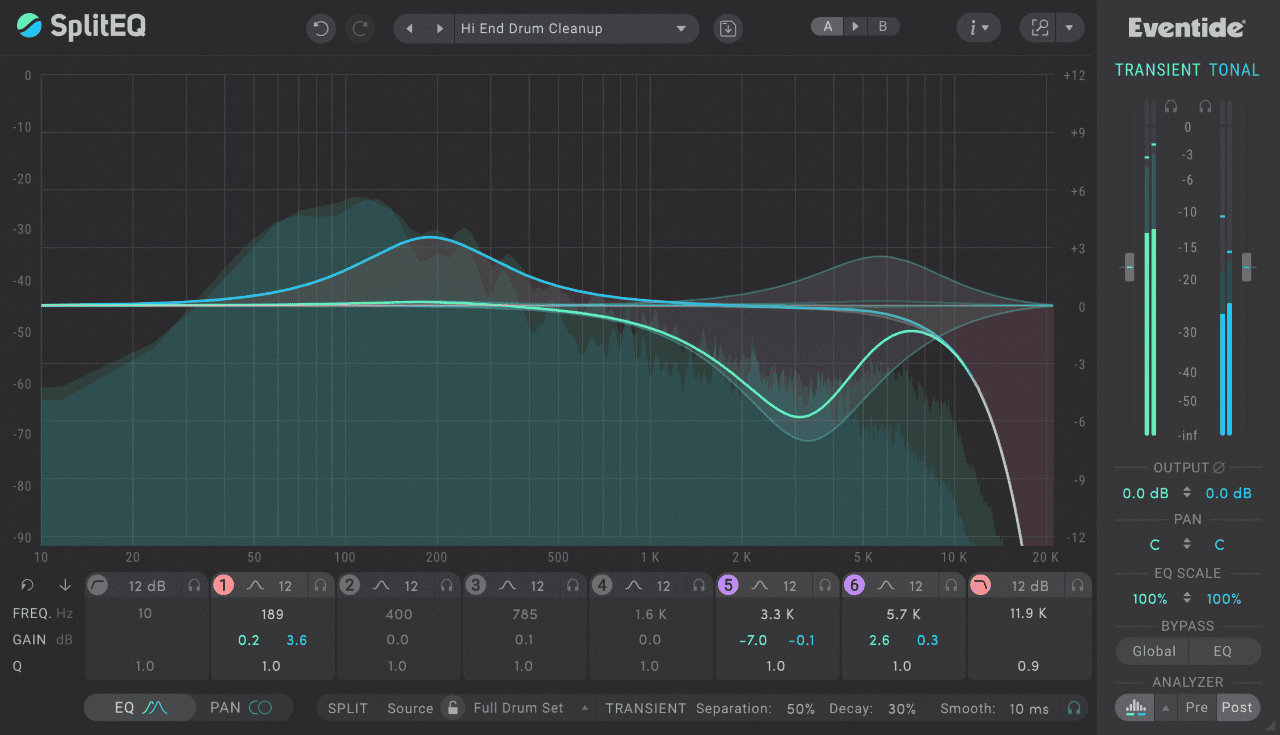
This approach allows a producer to boost the low-frequency transient of a kick without increasing its sustained boom. It can also soften guitar pick attack while preserving the body of the instrument.
SplitEQ includes separate transient and tonal level controls, Mid/Side or left-right panning, a real-time spectrum analyser and more than 150 presets.
Best Uses
- removing kick drum boom while preserving impact;
- reducing vocal plosives;
- controlling guitar pick noise;
- enhancing percussion without boosting harshness;
- advanced sound design and stereo shaping.
Advantages
- independent transient and tonal EQ;
- eight frequency bands;
- detailed spectral display;
- Mid/Side and stereo controls;
- excellent corrective and creative possibilities.
Limitations
- more complex than a standard transient shaper;
- higher latency than simple envelope processors;
- requires more time to configure.
Verdict: SplitEQ is the best choice when transient problems occur only within a specific frequency range. It is closer to a surgical transient equalizer than a conventional two-knob processor.
Visit the official Eventide SplitEQ page
3. Auburn Sounds Couture: Best Free and Paid Hybrid
Auburn Sounds Couture combines transient shaping with optional saturation. A free edition is available, while the paid version unlocks the complete saturation section.
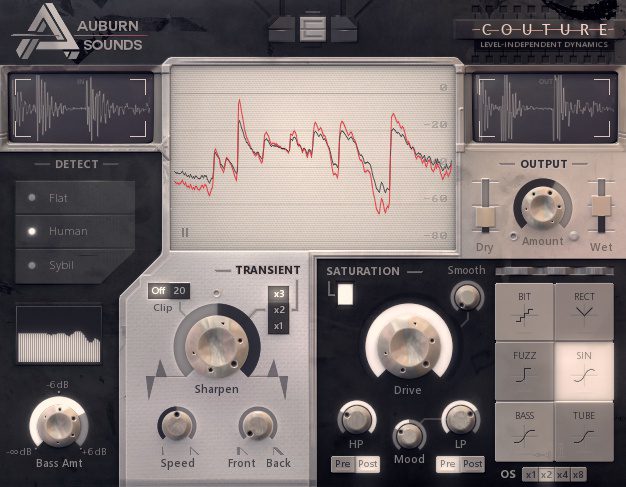
The Sharpen control increases or decreases the dynamic contrast between attacks and sustained material. Couture uses a program-dependent detector and does not require a traditional threshold.
The free version includes the transient shaping engine. The full edition adds several saturation types that can increase density while preserving or reshaping the original dynamics.
Best Uses
- adding punch to drum samples;
- removing kick drum clicks;
- controlling snare room ambience;
- increasing synth definition;
- combining transient shaping and saturation.
Advantages
- free transient shaping edition;
- volume-independent processing;
- precise transient detection;
- optional saturation section;
- available for Windows, macOS and Linux.
Limitations
- saturation is disabled in the free version;
- interface is less immediate than BitterSweet;
- extreme settings can heavily reshape the source.
Verdict: Couture is one of the strongest free transient shapers and becomes even more versatile when upgraded to the full version.
Download Couture Free or view the full edition
4. FLUX BitterSweet: Best Free Option for Beginners
FLUX BitterSweet is a completely free transient processor built around one large central control.
Turning the control toward Bitter increases transient intensity. Turning it toward Sweet reduces attacks and creates a softer result.
The plugin also offers modes that change how it reacts to the stereo signal, making it useful on individual instruments and drum buses.
Advantages
- completely free;
- extremely easy to use;
- no dongle or licence activation;
- effective on drums, loops and percussion;
- quick results with minimal setup.
Limitations
- limited detailed control;
- no independent Attack and Sustain parameters;
- no frequency-selective processing;
- less suitable for surgical correction.
Verdict: BitterSweet is the best free transient shaper for beginners or producers who want immediate results without a complicated interface.
Download FLUX BitterSweet for free
Free vs Paid Transient Shaper Plugins
| Free Plugins | Paid Plugins |
|---|---|
| Excellent for basic drum shaping | More detailed Attack and Sustain control |
| Fast and simple workflow | Frequency-selective processing |
| Suitable for home studios | Better sidechain and stereo options |
| Fewer advanced parameters | More flexible for mixing and mastering |
For straightforward drum processing, BitterSweet or Couture Free may be all that is required. Paid plugins become more useful when you need separate sustain controls, frequency-dependent shaping or detailed stereo processing.
Transient Shaper vs Compressor
A compressor reacts to level and reduces the signal after it crosses a threshold. A transient shaper analyses the envelope of the sound and changes its attack or sustain independently of its absolute volume.
Use a transient shaper when the shape of the sound is the problem. Use a compressor when the overall dynamic range or level consistency needs control.
Both can also be combined. A transient shaper may sharpen a snare before a compressor adds density and glue.
How to Use a Transient Shaper Correctly
Begin With Small Adjustments
A small increase in attack can be enough to move a drum forward. Excessive settings often produce clicks or an unnatural separation between the attack and body.
Listen in the Full Mix
A kick may sound impressive in solo but become too sharp when combined with the bass and percussion. Make final decisions while the complete arrangement is playing.
Watch the Output Level
Increasing transients can create higher peaks. Lower the output gain or place a clipper after the transient shaper when necessary.
Do Not Add Attack to Every Drum
If every percussion element becomes sharper, the mix can quickly feel tiring. Choose which elements should lead and allow the others to remain softer.
Which Transient Shaper Should You Choose?
Best overall: SPL Transient Designer Plus
Best for frequency-specific shaping: Eventide SplitEQ
Best free and paid hybrid: Auburn Sounds Couture
Best free beginner option: FLUX BitterSweet
Frequently Asked Questions
What Is the Best Transient Shaper Plugin?
SPL Transient Designer Plus is the best general option for fast attack and sustain shaping. SplitEQ is better when transient control must be limited to specific frequency ranges.
What Is the Best Free Transient Shaper?
FLUX BitterSweet is the easiest free option, while Couture Free provides more detailed control over transient dynamics.
Can a Transient Shaper Replace Compression?
No. A transient shaper changes attack and sustain, while compression controls dynamic range. They solve different problems and often work well together.
Can Transient Shapers Be Used on Vocals?
Yes. They can soften plosives, reduce aggressive consonants or increase vocal definition. Settings should remain subtle to avoid creating unnatural articulation.
Final Verdict
SPL Transient Designer Plus remains the most efficient all-round choice. Eventide SplitEQ offers the deepest control, particularly when only part of the frequency spectrum needs correction.
For free options, Couture Free provides impressive dynamic control, while FLUX BitterSweet is ideal for quick and simple processing.
A transient shaper can make a kick punch harder, but adding Attack to everything is not mixing. It is simply asking every instrument to enter the room elbows first.