The answer is rarely as simple as “spend more.” Music promotion does not become effective just because a budget exists. A badly planned €500 campaign can disappear in a few days with almost nothing to show for it, while a disciplined €50 push can produce useful data, better content, and a few real listeners who actually return. Money helps, but only when it is attached to strategy.
For emerging artists, the confusion usually starts because most promotion advice treats budget as either unlimited or irrelevant. On one side, there are glossy campaigns with professional videos, publicists, influencers, press teams, playlist networks, ads, and weeks of content production. On the other side, there is the romantic idea that talent alone will travel organically if the song is good enough. Neither version helps the artist trying to promote a single realistically with €0, €50, €150, or €500.
A useful music promotion budget is not about looking rich. It is about choosing the right level of action for the stage you are in. A new artist with no audience should not spend like an established act. An artist with proven listener engagement should not stay trapped in free tactics forever. A song with strong saves deserves a different budget than a track that has not yet shown any sign of connection.
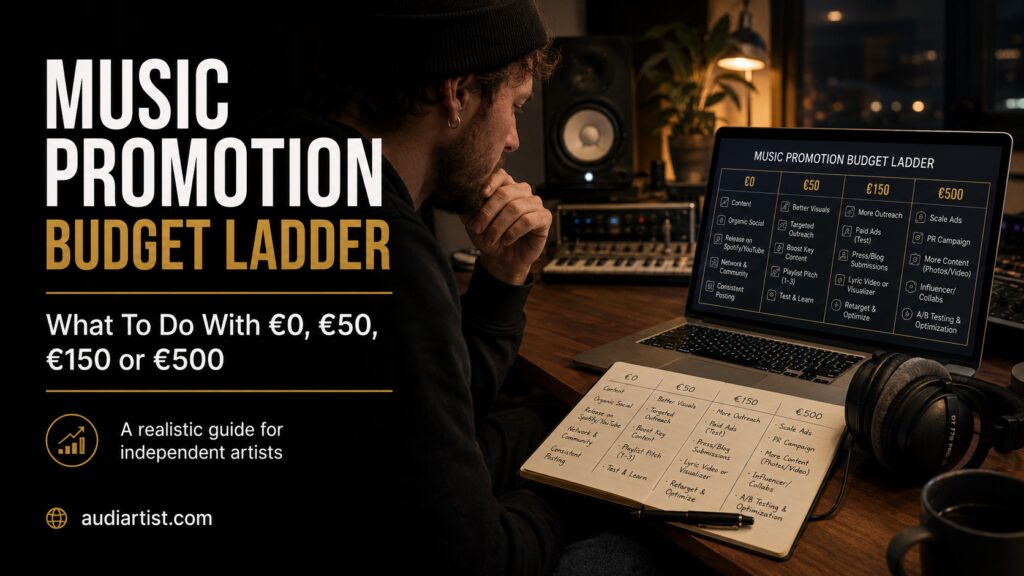
This is the purpose of the music promotion budget ladder. It helps independent artists understand what to do at each level, what to avoid, and how to turn every euro into useful movement rather than empty noise.
Before You Spend Anything, Fix the Foundation
The worst time to spend money on music promotion is before the release system is ready. Paid traffic cannot repair a weak profile, unclear branding, confusing links, poor artwork, missing bio, unfinished visuals, or a song that has no clear audience. Promotion amplifies what already exists. If the foundation is messy, the budget only makes the mess more visible.
Before spending even €1, the artist should make sure the basics are clean. The streaming profiles need updated visuals, a clear bio, working links, and a professional presentation. The release should have strong artwork, a direct listening path, a few pieces of content, and a clear sentence explaining the song’s mood, genre, and audience. The social profiles should not look abandoned the moment a listener becomes curious.
This matters because every campaign creates a path. A listener sees a post, hears a clip, clicks a link, lands on a platform, listens to the track, visits the artist profile, and decides whether to save or follow. If any part of that journey feels unclear, the campaign leaks attention.
Many artists blame budget when the real issue is conversion. They say they need more exposure, but what they actually need is a better reason for people to care once exposure happens.
The €0 Budget: Build Proof Before Buying Attention
A €0 budget does not mean doing nothing. It means using time, clarity, consistency, and direct effort instead of paid amplification. For new artists, this stage is not a punishment. It is often the most important phase because it reveals whether the music can create any signal before money enters the campaign.
With no budget, the goal is simple: build proof. Proof does not mean huge numbers. It means early evidence that the song connects with someone. A few saves, a few comments, a few playlist adds, a curator reply, a message from a listener, a video that performs better than usual, or a small increase in profile visits can all become useful signals.
The €0 strategy should begin with the artist’s own ecosystem. The release needs several pieces of content, not one announcement. One post can introduce the song’s mood. Another can highlight the hook. Another can tell the story behind the track. Another can show the production process. Another can speak directly to the type of listener the song is made for. Another can invite feedback. Another can point people toward a playlist or full listen.
At this level, the artist should also use free outreach intelligently. That means contacting relevant independent curators, small blogs, local radios, niche communities, YouTube channels, genre pages, and music discovery accounts with a concise, personalized pitch. The pitch should not beg. It should explain the sound clearly, provide a direct link, and show why the track fits the recipient.
The €0 budget is also the right moment to strengthen direct relationships. Message people who have supported previous songs. Thank listeners who share the track. Reply to comments properly. Ask for honest feedback from people who understand the genre. Share the song in communities where self-promotion is allowed and where the music genuinely fits.
The mistake at this level is acting as if free means careless. A €0 campaign still needs structure. It should have a release message, content schedule, outreach list, tracking document, and 30-day review. If the artist cannot promote with discipline for free, paid promotion will not magically create discipline later.
What €0 Can Realistically Achieve
A free campaign can create early visibility, audience feedback, small playlist opportunities, better content performance, and a clearer understanding of the track’s audience. It can help the artist test messaging before spending. It can reveal which hooks work, which visuals attract attention, which captions drive clicks, and which communities respond.
What it usually cannot do is create large-scale reach quickly. Without an existing audience, free promotion can be slow. That is normal. The artist should not judge the campaign only by stream volume. At this stage, the most valuable result is learning what converts.
If a song gets very little response with free promotion, spending money immediately may not be the answer. The artist may need a stronger content angle, clearer positioning, better visuals, more targeted outreach, or a sharper listening context. If the song shows strong engagement in small pockets, then moving up the budget ladder becomes more logical.
The €50 Budget: Test, Do Not Pretend to Launch a Major Campaign
A €50 budget is not enough to dominate a release cycle, and pretending otherwise leads to disappointment. But €50 can be extremely useful if it is treated as a testing budget. The purpose is not to make the song famous. The purpose is to discover which audience, message, or content angle deserves more attention.
At this level, the artist should avoid spreading money too thin. Spending €5 here, €10 there, and €15 somewhere else usually produces scattered results. The smarter approach is to choose one or two focused tests.
One option is to boost the best-performing piece of content after it has already shown organic promise. This is important. Do not pay to rescue weak content. Pay to extend content that already seems to create interest. If one short video gets better watch time, more saves, more comments, or more profile visits than the others, it may deserve a small boost to a targeted audience.
Another option is to spend €50 on visual improvement. A stronger cover variation for social media, a clean lyric visual, a short vertical teaser, or a better promotional graphic can improve the entire campaign. For many independent artists, weak presentation reduces conversion more than they realize.
A third option is to use the budget for a small ad test. The campaign should be narrow and measurable. Instead of targeting everyone who likes music, the artist should test a specific genre, mood, or location. The goal is to see whether people click, listen, save, or follow. At this stage, data is the win.
The €50 budget should never be spent on fake streams, suspicious playlist placements, bot-driven services, or anyone promising guaranteed results. That kind of shortcut can damage the artist’s data, credibility, and platform health. If the offer sounds too easy, it is usually the wrong door.
What €50 Can Realistically Achieve
A €50 campaign can identify a promising audience, improve one important asset, extend a good post, or test a song’s appeal beyond the artist’s current followers. It can help answer useful questions: does this hook make people stop? Does this country respond better? Does this visual outperform the release cover? Does this audience click but not stream? Does the song generate saves when placed in front of the right listeners?
The artist should not expect €50 to produce a fanbase. The expectation should be learning. If the test creates strong signals, the artist can scale carefully. If it creates attention without conversion, the artist should fix the message or link journey before spending more.
At this level, the best result is not always streams. Sometimes the best result is discovering what not to spend money on again.
The €150 Budget: Build a Real Micro-Campaign
With €150, an artist can begin building a small but serious campaign. This is still not a major industry push, but it is enough to combine content, targeting, and follow-up in a more structured way.
The biggest shift at this level is that the artist should stop thinking in isolated actions. €150 should not be spent on one random boost or one quick service. It should support a micro-campaign with a clear objective. The objective might be to grow listeners for a new single, test one priority market, build saves around a strong track, drive traffic to a smart link, promote a music video, or push a release after promising first-week data.
A practical €150 campaign could divide energy between visual assets, targeted ads, and outreach. The artist might create two or three strong short-form videos, test the best one with a small paid campaign, then use the data to refine the next post. Another artist might use part of the budget for a clean visualizer or lyric video, then promote it to a narrow audience. A producer might focus on a specific scene, such as Afro house listeners, synthwave fans, lo-fi playlists, underground techno communities, or independent rap audiences.
The most important principle is alignment. The content, audience, song, landing page, and call to action must speak the same language. If the track is emotional lo-fi, the campaign should not look like a generic club ad. If the track is high-energy dance music, the visual should not feel static or sleepy. If the song is cinematic, the campaign should use atmosphere and imagery rather than only a streaming link.
At €150, the artist can also invest in better preparation. A small budget can be used to create a release proof folder, improve photos, design social assets, prepare a press pitch, or clean up the artist profile. Sometimes the best promotional spend is not distribution of the message, but improvement of the material that carries it.
What €150 Can Realistically Achieve
A €150 campaign can create measurable reach beyond the artist’s existing audience. It can test two or three audience segments, support a content sequence, create better visual consistency, and generate enough data to decide whether a second wave is worth it.
It can also help an artist look more professional. That does not mean pretending to be famous. It means presenting the release with enough care that curators, listeners, and collaborators take it seriously. In independent music promotion, perception matters because people often decide whether to listen before they hear the full song.
The danger at €150 is impatience. Some artists expect this budget to produce a dramatic streaming jump. It might produce movement, but its deeper value is diagnostic. It shows whether the track can convert when given a cleaner campaign and a more targeted audience.
The €500 Budget: Treat the Release Like a Campaign, Not a Post
A €500 budget is still modest compared to professional label campaigns, but for an independent artist it is meaningful. At this level, the money should be handled with discipline. Random spending becomes expensive quickly. The artist needs a plan before the first euro moves.
A €500 campaign should usually begin with the question: what is the main goal? It cannot be everything. If the goal is streaming growth, the campaign should focus on targeted listening paths and save behavior. If the goal is video visibility, the campaign should prioritize YouTube, short-form edits, and audience retention. If the goal is brand building, the campaign may need stronger visuals, press angles, and storytelling. If the goal is market testing, the spend should be divided between carefully chosen territories or audience groups.
At this level, the campaign can include several layers. The artist can produce stronger content assets, run focused ads, support a music video or visualizer, pitch independent curators and media, test two or three audience segments, create follow-up posts, and review data after 7, 14, and 30 days. The budget should not disappear in one weekend. It should support a release arc.
One of the smartest ways to use €500 is to separate the campaign into phases. The first phase prepares the assets and message. The second phase tests content organically and with small paid boosts. The third phase supports the best-performing angle. The fourth phase reviews the data and decides whether the track deserves a second push.
This approach is more professional than spending the full budget on day one. A release needs time to reveal what works. A campaign that learns as it moves will usually outperform a campaign that spends everything before the audience has spoken.
What €500 Can Realistically Achieve
A €500 campaign can give a strong independent single a real chance to reach beyond the artist’s immediate circle. It can create a professional first impression, test audience segments, generate streaming and social data, support better visuals, and produce enough movement to guide future releases.
It still cannot guarantee success. No budget can force a weak song to become meaningful. No ad campaign can guarantee fans. No playlist push can create lasting growth if listeners do not save, follow, or return. The purpose of €500 is not to buy certainty. It is to buy controlled opportunity.
If the song has already shown organic promise, €500 can help amplify it. If the artist has a clear identity, strong visuals, a good content sequence, and a clean link journey, the budget can work harder. If those pieces are missing, the same budget can vanish into confusion.
Where Artists Waste Money First
The most common waste in music promotion is paying for reach before understanding the audience. Artists see low numbers and immediately assume they need more exposure. But exposure without fit creates weak results. A song shown to the wrong people may generate clicks, skips, or passive streams, but not fans.
Another common mistake is paying for services that promise guaranteed streams or playlist placements. These offers can be tempting because they reduce anxiety. They make promotion feel simple. But real music growth is not built on artificial activity. Fake or low-quality traffic can distort analytics, hurt targeting, damage credibility, and teach the artist nothing useful.
Artists also waste money by promoting weak content. A poor visual, unclear caption, slow opening, confusing hook, or generic message does not become better because it is boosted. Paid promotion amplifies the weakness. The better move is to test content organically first, then put budget behind the piece that already shows signs of life.
The final major waste is stopping too soon. Some artists spend money for two days, see no miracle, and abandon the campaign. Others spend everything on release day, then have nothing left for follow-up. A good budget works across time. It supports learning, not panic.
How to Decide Which Budget Level Is Right
The right budget depends less on ego and more on evidence. If the artist has no audience, no content, no profile clarity, and no previous data, the €0 or €50 level may be smarter. The priority should be building proof and testing messages.
If the artist has a few releases out, some saves, a small social audience, and clear signs that certain content works, €150 can support a focused micro-campaign. This is the level where the artist starts learning how to turn small signals into bigger movement.
If the artist has a strong track, clear branding, good assets, and early engagement, €500 can make sense. But it should be spent like a campaign budget, not a lottery ticket.
The question is not “How much can I spend?” The better question is “What evidence do I have that spending more will help?”
The Best Budget Is the One That Teaches You Something
Every promotion budget should end with a report. What worked? What failed? Which audience clicked? Which audience saved? Which content held attention? Which playlist produced real listeners? Which country responded? Which call to action converted? Which visual created the strongest reaction? Which spend should never be repeated?
This habit turns each release into a learning system. Without reporting, the artist only remembers feelings. With reporting, the artist builds knowledge. Over several releases, that knowledge becomes more valuable than any single campaign.
The smartest independent artists do not spend blindly. They climb the budget ladder carefully. They use €0 to build proof, €50 to test, €150 to structure, and €500 to scale what already shows promise.
That is how promotion becomes more than hope with a receipt.
Spend Less Randomly, Promote More Intelligently
Music promotion is not a magic button, and money is not a substitute for clarity. A strong campaign begins with the song, the audience, the message, the visual world, and the path from discovery to listening. Budget only becomes powerful when those pieces are aligned.
For independent artists, the goal is not to spend like a label. It is to think like a strategist. A €0 campaign can build proof. A €50 campaign can test direction. A €150 campaign can create a real micro-campaign. A €500 campaign can support a serious release push when the foundation is ready.
The ladder matters because every stage has a purpose. Spending too little can limit reach. Spending too much too early can waste money. Spending without a plan can create the illusion of effort while producing no real growth.
The best budget is not always the biggest one. It is the one connected to the clearest next move.
Discover more independent music promotion strategies, artist resources, and playlist insights on Audiartist.