
Six Sines: A Free Six-Operator FM Synth Plugin
Deep phase modulation, digital ring modulation, CZ-style phase distortion, MPE control and extensive per-voice modulation.
Six Sines is a free and open-source synthesizer developed by BaconPaul, a contributor to the Surge Synth Team. Originally released in January 2025, the instrument explores audio-rate interaction between six operators using phase modulation, frequency modulation and digital ring modulation.
The overall concept recalls classic six-operator FM synthesizers, but Six Sines does not simply reproduce a fixed collection of Yamaha-style algorithms. Its modulation matrix allows each operator to generate audio, modulate itself through feedback or influence operators positioned later in the signal path.
Version 1.2 expanded the instrument with a redesigned interface, CZ-style phase distortion, resonant oscillator sweeps, noise sources, deeper modulation, six SuperMacros and a configurable output reconstruction stage.
The complete synthesizer is distributed free of charge under an open-source licence. Prebuilt versions are available for Windows, macOS and Linux.
What Is Six Sines?
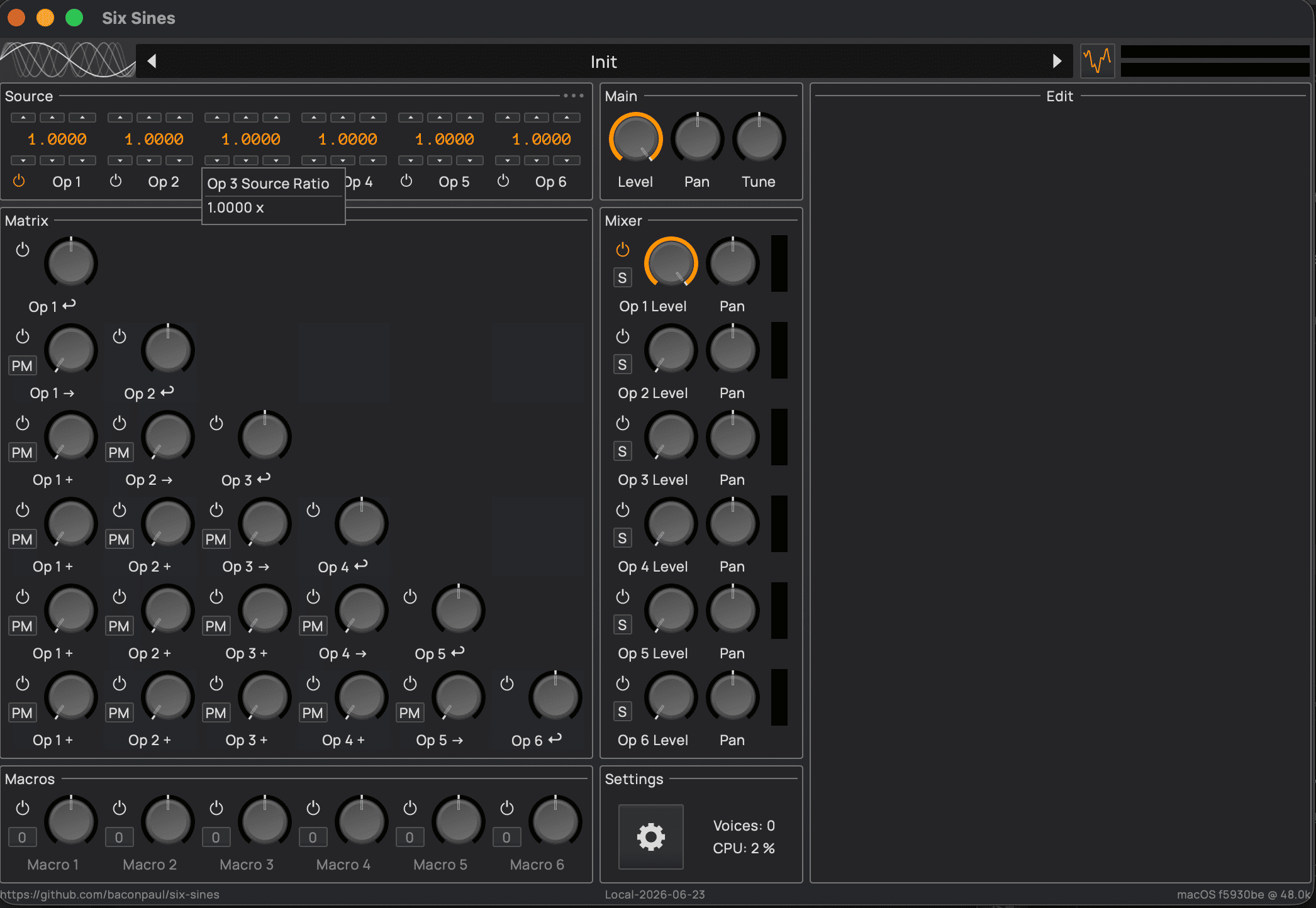
Six Sines is built around six sound sources, also described as operators. Each operator can be heard directly or used to modulate another operator.
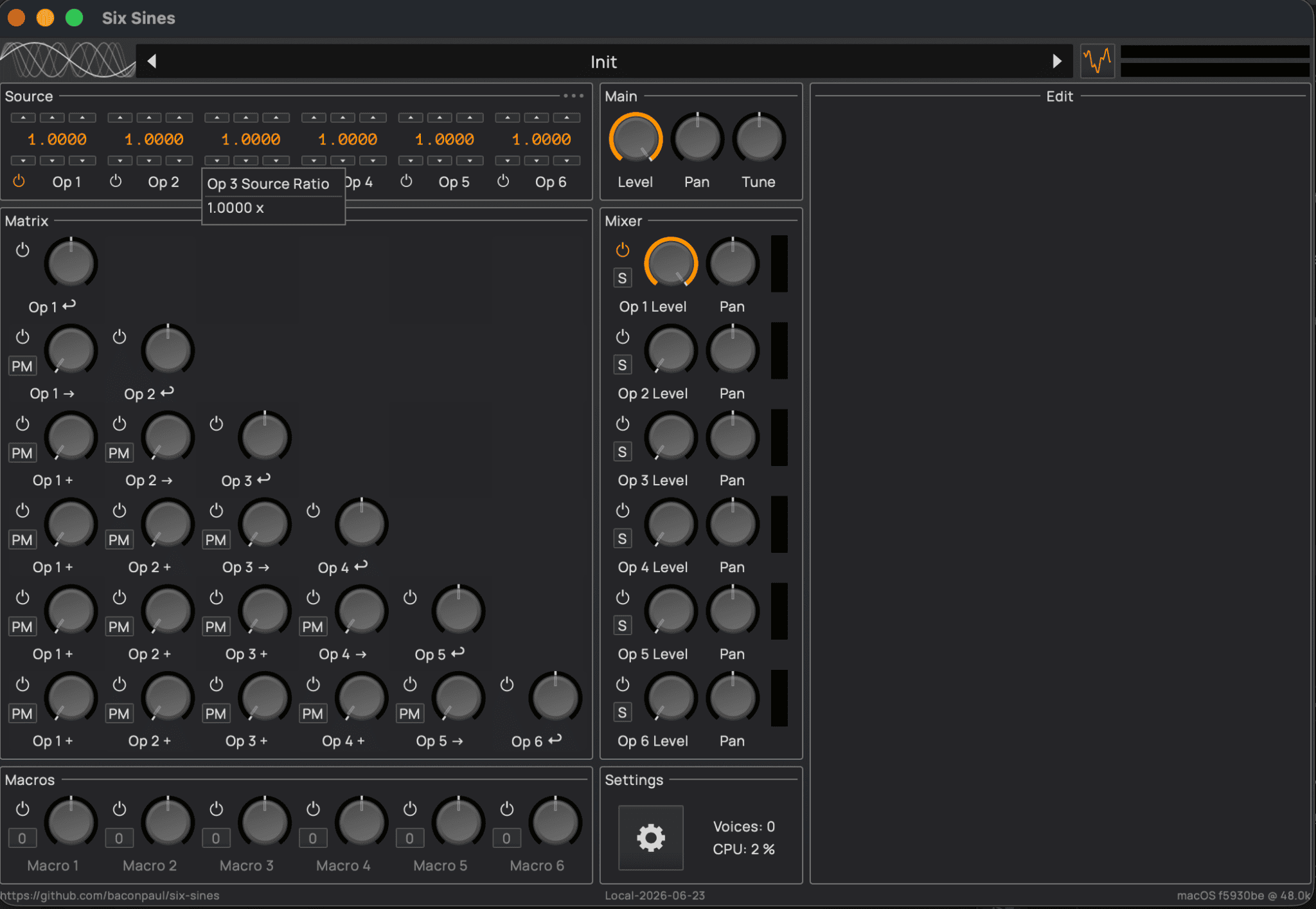
The diagonal cells of the modulation matrix control self-feedback. The remaining cells route one operator into a later operator through several audio-rate modulation methods.
The available processing includes:
- Phase modulation: The foundation of many classic digital FM synthesizers.
- Digital ring modulation: Multiplies two signals to produce metallic and inharmonic tones.
- Through-zero linear FM: Provides more complex frequency interaction.
- Exponential FM: Creates stronger pitch-dependent modulation.
- Self-feedback: Adds harmonics and progressively more aggressive timbres.
This flexible matrix makes Six Sines suitable for traditional FM sounds as well as more experimental synthesis.
Six Operators and Flexible Routing
Every operator includes controls for frequency ratio, coarse tuning, fine tuning and fixed-frequency offsets.
Frequency ratios are especially important in FM synthesis. Whole-number ratios tend to produce harmonic tones that remain clearly connected to the played note. Fractional and unusual ratios create bells, metallic percussion, inharmonic textures and more experimental sounds.
Each operator can be sent directly to the output mixer. This means the instrument does not force producers to use one operator only as a carrier and another only as a modulator.
Several operators can produce audible sound while also participating in the modulation network. This makes it possible to combine a simple bass foundation with brighter FM layers, transient components and evolving harmonics inside one preset.
More Than Sine Waves
Despite its name, Six Sines is not restricted to six identical sine-wave oscillators.
Each source provides a selection of TX-style and windowed waveforms that can introduce additional harmonics before modulation begins.
Version 1.2 also added several extended oscillator modes:
- Phase Map: A CZ-style phase-distortion mode for brighter and more vocal-like waveforms.
- Resonant Sweep: Produces sweeping resonant harmonics inspired by Casio-style digital synthesis.
- Noise: Provides white, pink, tilted and chip-style sequence noise.
- Audio Input: Operator one can process the plugin’s sidechain input as a modulation source.
These options allow Six Sines to move beyond conventional electric pianos and digital bells into basses, pads, drums, drones and destructive sound-design effects.
Independent Modulation for Almost Every Node
One of the deepest parts of Six Sines is its node-based modulation system.
Operator frequency, feedback, modulation depth, output level and the main audio output can each have an independent envelope and LFO.
The envelopes use a DAHDSR structure with delay, attack, hold, decay, sustain and release stages. Envelope rates can be synchronized with the host tempo, and the attack, decay and release curves can also be modulated.
The LFO section includes conventional shapes and a step sequencer. It supports tempo synchronization, bipolar operation, phase control and a song-position mode that follows the DAW timeline.
Each node also provides performance-modulation slots. Sources can include velocity, MIDI controls, macros, envelopes, LFOs, MPE pressure and MPE timbre.
This level of control allows a patch to change significantly across each note rather than remaining a static FM algorithm.
Six SuperMacros
Six Sines includes six assignable SuperMacros for controlling several parts of a preset from a smaller collection of performance controls.
A macro can be connected to modulation depth, feedback, operator level, phase distortion, output processing or other parameters.
Unlike a conventional static macro knob, each SuperMacro can also include its own envelope, LFO and modulation routings.
This means a macro can respond to manual automation while also evolving independently during the note. It can be used to create changing brightness, harmonic movement, rhythmic sequences or transitions between several versions of a sound.
Assigning the most important movements to the SuperMacros also makes complicated presets easier to use during production and live performance.
Output Reconstruction and Digital Character
The final audio signal can pass through a configurable reconstruction section designed to add intentional digital coloration.
- Saturation: Soft processing or stronger overdrive-style coloration.
- Sample-rate reduction: Zero-order-hold processing between approximately 12 and 48 kHz.
- Bit-depth reduction: Adds digital quantization and Lo-Fi texture.
- High-pass filtering: Removes unnecessary low frequencies and DC energy.
These stages can move a clean FM patch toward older digital hardware, game-console textures, distorted basses and deliberately degraded electronic sounds.
Six Sines also provides adjustable internal oversampling. Higher values can improve the behavior of complex feedback patches, although they require additional processor resources.
Best Uses
House and Garage: Create digital basses, metallic keys and sounds inspired by classic FM hardware.
Techno: Design resonant sequences, evolving percussion and aggressive modulation textures.
Synthwave: Build retro keys, electric pianos, glassy pads and digital bass sounds.
Ambient music: Use slow envelopes and independent operator movement to produce evolving drones and pads.
Cinematic production: Create bells, tension layers, synthetic percussion and unstable atmospheric textures.
Experimental sound design: Process an external sidechain signal through audio-rate modulation, feedback and digital output degradation.
Production Tips
Begin with only one audible operator. Create a basic tone before introducing a second operator as a modulator.
Use simple frequency ratios such as 1:1, 2:1 or 3:1 when learning how the matrix changes the harmonic structure.
Add feedback gradually. Small amounts introduce brightness, while extreme values can create sharp and unpredictable frequency peaks.
Use velocity to control modulation depth rather than volume alone. Softer notes can remain clean while harder notes produce brighter harmonics.
Assign the most important sound changes to the SuperMacros. This makes complex presets easier to automate inside the arrangement.
Save frequently while experimenting. Six-operator FM synthesis can travel from a perfect bass to an unidentified emergency alarm with one enthusiastic mouse movement.
Interface, Presets and Accessibility
The redesigned landscape interface places the six operators, modulation matrix, audio mixer and SuperMacros inside one main view.
Clicking a parameter opens its envelope, LFO and modulation settings in a dedicated editor panel on the right side.
An optional analyzer displays the waveform and frequency spectrum, which is useful when adjusting feedback, phase distortion and saturation.
Six Sines includes a large factory preset collection organised by category. Light and dark themes are provided, along with a colour editor for creating and saving custom interface themes.
The developer has also included screen-reader support and keyboard navigation features to make the instrument more accessible.
Compatibility
- Windows: Official prebuilt release available
- macOS: Official prebuilt release available
- Linux: Official prebuilt release available
- Plugin formats: VST3 and CLAP, with Audio Unit support on macOS
- Standalone version: Included in supported release packages
- Performance control: MIDI, velocity, pitch bend and MPE support
- Current stable version: 1.2.1
- Licence: MIT open-source licence
- Price: Completely free
The official release page contains separate download packages for each supported operating system. Producers should select the stable release rather than a nightly build when installing the plugin inside important projects.
Final Verdict
Six Sines is one of the most interesting free synthesizers to emerge from 2025. It combines the depth of six-operator FM synthesis with a more open modulation architecture and several modern sound-design features.
The addition of CZ-style phase distortion, resonant sweeps, noise generation, MPE, SuperMacros and configurable output degradation gives it a broader palette than a conventional retro FM emulation.
Its programming system is undeniably complex. Beginners should begin with the factory presets and modify one operator or modulation route at a time.
For producers interested in FM basses, digital keys, metallic percussion, evolving pads and experimental electronic textures, Six Sines offers remarkable depth without a purchase, account or subscription.
The plugin contains six operators, hundreds of modulation possibilities and enough feedback to occupy an entire afternoon. Fortunately, the download remains much simpler than the synthesis.
Download Six Sines from the official GitHub repository: