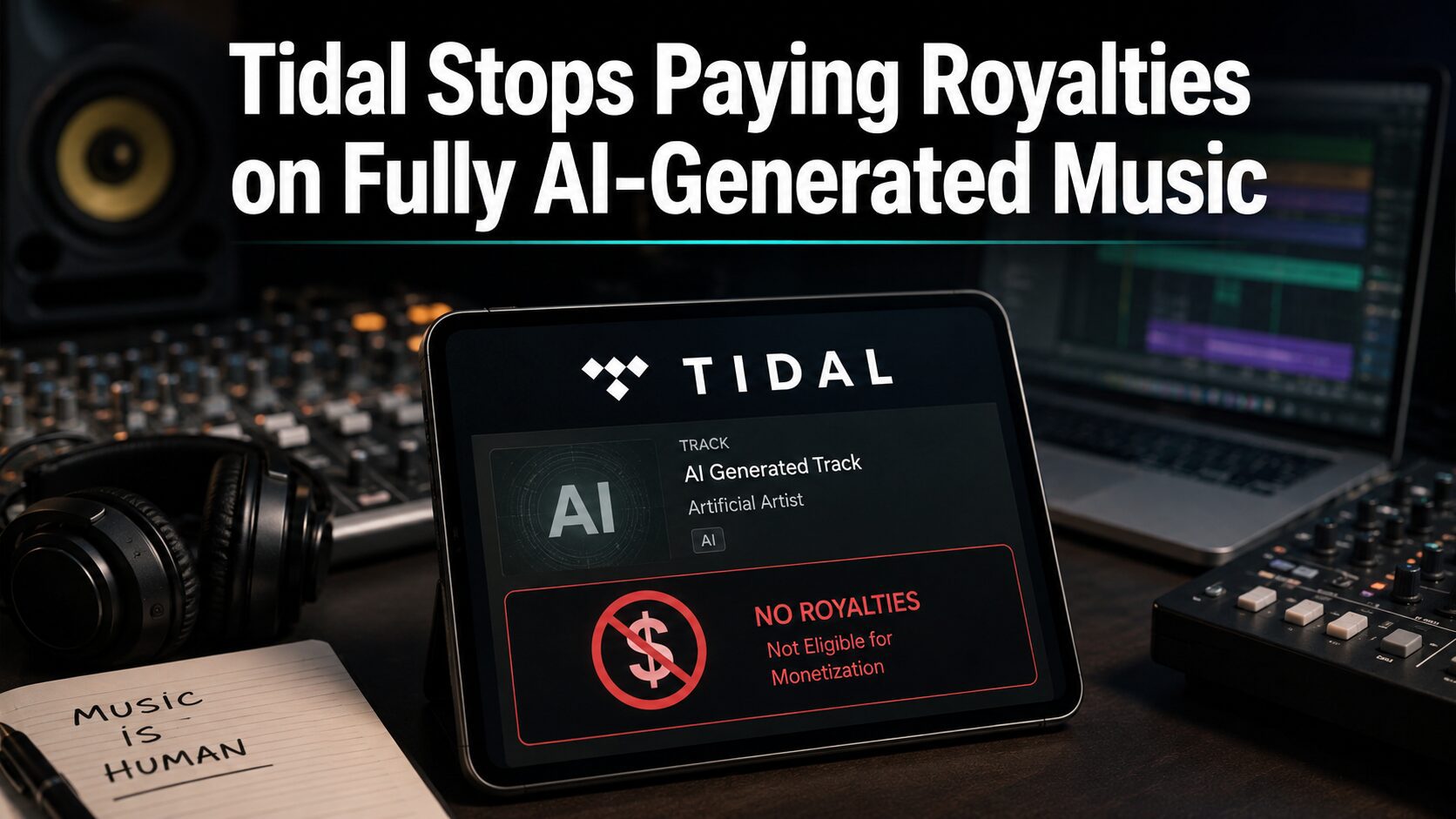

Tidal has taken one of the clearest positions yet in the growing conflict between generative artificial intelligence and the music streaming economy. Under its new AI policy, tracks identified as entirely generated by AI are no longer eligible to receive royalties on the platform.
The measure does not amount to a complete ban on artificial intelligence in music. Fully AI-generated releases may remain available when they comply with Tidal’s rules, but they can now be labelled, excluded from monetisation and removed when they are connected to fraud, impersonation or suspicious streaming activity.
For musicians, distributors and rights holders, the message is difficult to misunderstand: Tidal wants subscription revenue to reward music directly created, written and performed by people.
Tidal Draws a Line Between AI Tools and AI-Generated Music
The distinction at the centre of the policy is important. Tidal is not attempting to prohibit every production that involves artificial intelligence.
AI-assisted mastering, restoration, sound design, workflow automation or other production tools are not automatically covered by the royalty restriction. The current policy focuses on music that Tidal determines was wholly generated through generative AI systems.
This allows the company to defend human authorship without pretending that modern recording studios can be separated entirely from machine learning. Artificial intelligence has already become part of many creative and technical workflows. Tidal’s target is not the tool itself, but content created without meaningful human musical authorship and uploaded as though it were a conventional artist release.
Fully AI-Generated Tracks Can Stay, but They Cannot Earn
Tidal’s approach differs from a simple removal policy. A track identified as fully AI-generated may remain playable, provided that it does not violate the platform’s wider content standards.
However, it will not receive royalty attribution. Releases uploaded through Tidal Upload are also excluded from direct-to-fan monetisation when they are identified as wholly AI-generated.
This creates a significant economic barrier for large-scale AI music operations. The cost of generating hundreds of tracks has fallen dramatically, allowing uploaders to flood streaming catalogues with automated releases across multiple genres.
Removing the possibility of royalty income attacks the business model at its most sensitive point. An automated catalogue can still exist on Tidal, but it can no longer quietly compete for the same royalty pool as musicians, songwriters, producers and performers.
An AI Label Gives Listeners More Control
Tidal is also marking music it identifies as entirely AI-generated with a dedicated label. The objective is to provide transparency before or during playback rather than forcing listeners to guess whether an artist, voice or production is authentic.
Users can disable AI-labelled content in their settings. Once the option is turned off, tagged tracks will no longer play and should gradually disappear from personalised recommendations as those recommendations are refreshed.
This is a notable development because it treats AI disclosure as a listener choice, not simply as internal metadata. A person who enjoys generative music can continue to access it, while someone who wants recommendations centred on human artists can filter it out.
Fraudulent AI Music Faces Removal
The strongest enforcement measures concern content associated with deceptive or fraudulent behaviour.
Tidal may block or remove AI-generated music that impersonates an existing artist, exploits a person’s name or likeness, misleads listeners, interferes with authentic artists or damages the integrity of the service.
The platform also identifies high-volume uploads and unusual streaming activity as possible indicators of fraud. This matters because the problem is larger than the musical quality of AI-generated tracks.
Automated catalogues can be combined with artificial streaming, misleading artist profiles and mass distribution strategies designed primarily to extract money from royalty systems.
In that context, Tidal is not merely moderating content. It is attempting to protect the infrastructure through which music is discovered, recommended and paid for.
Distributors Will Be Expected to Identify AI Content
Tidal has made it clear that detection should not be the platform’s responsibility alone. Music distributors will increasingly be expected to identify AI-generated releases before delivering them to the service.
This could become one of the most consequential parts of the policy. If distributors are required to declare how a recording was created, AI information may eventually become standard metadata alongside artist names, composers, publishers and copyright ownership.
It could also expose distributors that currently accept enormous quantities of automated content without meaningful verification. A platform can remove suspicious music after delivery, but the most effective control point may be earlier in the distribution chain.
The Detection Problem Has Not Disappeared
Tidal’s policy is firm, but its enforcement will depend on the reliability of AI detection.
The company currently limits action to music it identifies as wholly AI-generated, partly to reduce the risk of false positives. Partially generated or heavily AI-assisted music may remain unlabelled until detection technology becomes more dependable.
Artists who believe their music has been incorrectly classified can submit an appeal. That process will be essential because no detection system is infallible, particularly when AI-generated stems are combined with human vocals, live instruments, editing and conventional production techniques.
The boundary between “AI-generated” and “AI-assisted” will become increasingly difficult to define. A song created from a single text prompt is relatively easy to categorise. A production involving a human composition, synthetic backing vocals, AI-generated percussion and traditional mixing is far less obvious.
A Major Signal to the Streaming Industry
Tidal is not the largest music streaming platform, but its decision could influence the wider market. Streaming services are facing growing pressure to prevent synthetic catalogues from overwhelming recommendations, imitating real artists and diverting revenue away from human creators.
Other platforms have introduced AI detection, visibility restrictions, artist verification systems and disclosure tools. Tidal has gone further by directly connecting AI classification to royalty eligibility.
The policy therefore establishes a principle that competitors may eventually be forced to address: should music generated entirely by software participate in the same royalty economy as recordings built through human composition, performance and production?
Human Creativity Becomes an Economic Standard
Tidal’s decision does not settle the broader debate over artificial intelligence and copyright. It does, however, establish a practical commercial rule.
Fully AI-generated music can be distributed, labelled and heard, but it will not automatically be treated as economically equivalent to human-created work.
That distinction could prove more effective than a symbolic ban. It preserves experimentation while removing the financial incentive behind mass-produced AI catalogues, deceptive artist identities and automated streaming operations.
For genuine artists, the decision represents a rare attempt to protect both visibility and royalty income. For factories capable of releasing 48 albums before breakfast, the buffet may finally be closing.