
Quick Take
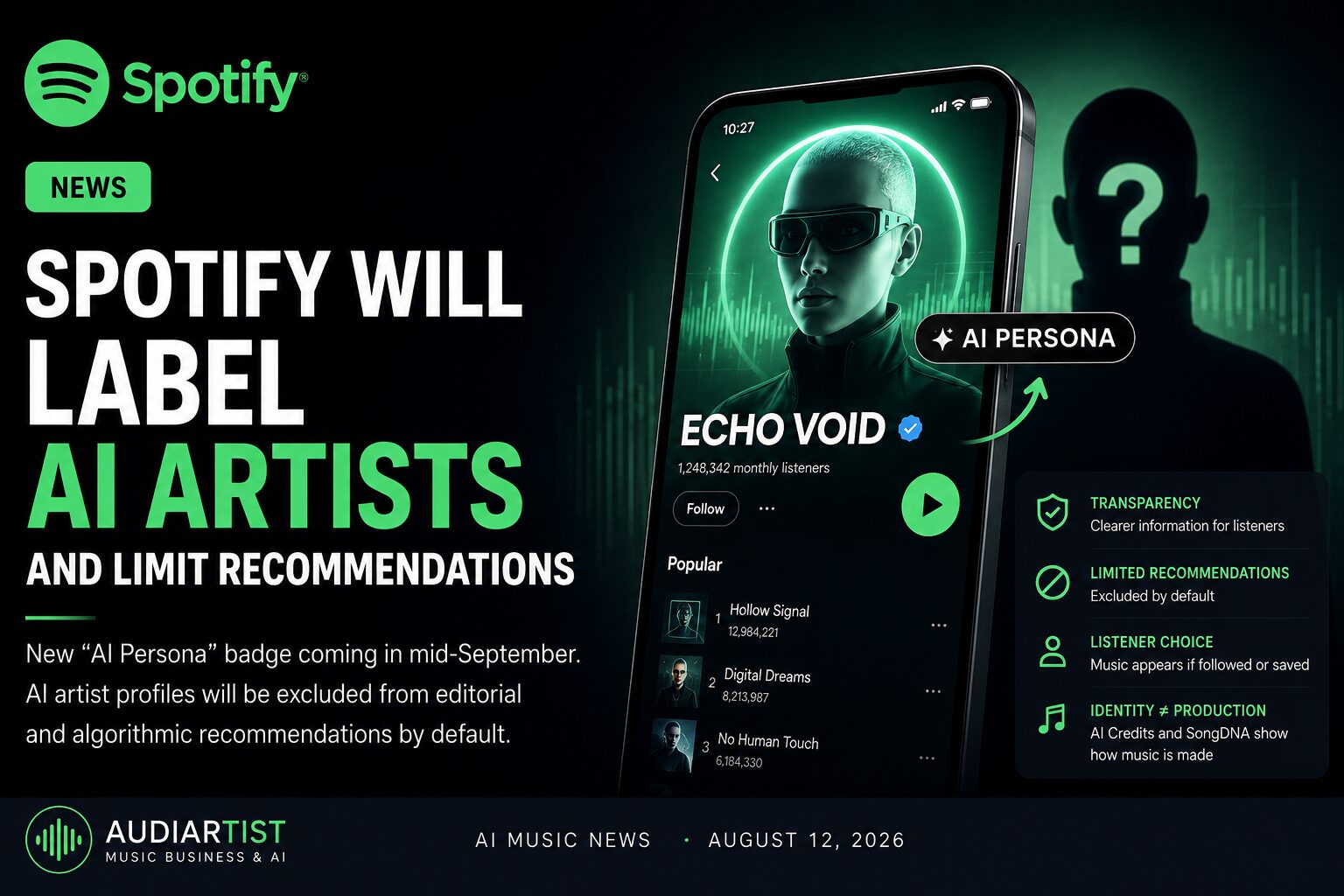
Spotify is introducing a new AI Persona badge for artist profiles whose public identity is generated by artificial intelligence and does not represent a real person. The move is more than a transparency feature. By default, music from these profiles will be excluded from Spotify’s editorial and algorithmic recommendations, marking one of the platform’s strongest actions yet against synthetic artist identities.
Spotify is moving beyond simple disclosure and into active visibility control. Starting in mid-September, the streaming platform will begin displaying an AI Persona badge on certain artist profiles. The label is designed for profiles whose public identity appears to be AI-generated and does not correspond to a real human being.
This is not just a cosmetic update. Spotify says music from these AI Persona profiles will not be included by default in editorial or algorithmic recommendations. In practice, that means users will not normally encounter these artists through personalized suggestions, recommendation feeds, or Spotify’s editorial programming unless they deliberately choose to follow the profile or save its music.
The decision marks an important shift in how streaming platforms may handle synthetic identities. Spotify is not banning AI artists outright, but it is making a clear distinction between transparency and discoverability. A synthetic artist may still exist on the platform, but it will not automatically benefit from the same recommendation engine that helps human artists grow audiences.
Key Points
- Spotify will begin showing an AI Persona badge from mid-September.
- The label applies to artist identities that appear AI-generated and not tied to a real person.
- By default, these artists will be excluded from editorial and algorithmic recommendations.
- Artists can already self-disclose an AI Persona through Spotify for Artists.
- Spotify will also run its own reviews using human teams and investigative tools.
- The badge concerns the artist identity, not necessarily the way the music itself was produced.
- For production transparency, Spotify separately uses AI Credits and SongDNA.

Photo: Pexels
Spotify Wants to Separate Identity From Production
One of the most important aspects of the announcement is the distinction Spotify makes between an artist’s public identity and the production process behind a track.
The AI Persona badge is specifically about how the artist presents itself publicly. Spotify describes it as a label for profiles whose name, visuals and general presentation suggest a photorealistic AI-generated identity rather than a real human artist.
This does not automatically mean that every track associated with such a profile was fully generated by AI, nor does it mean that human artists who use AI tools in their workflow will receive the badge.
Spotify is clearly trying to avoid collapsing every form of AI usage into one category. The company says that information about how a song was actually made belongs elsewhere. That is where its AI Credits and SongDNA systems come in. In other words, one part of Spotify’s transparency framework focuses on who the artist is, while another focuses on how the music was created.
This distinction matters because the current music landscape contains many hybrid forms. A human singer may use AI for vocal processing, arrangement ideas or sound design. Another profile may present a fully fictional photorealistic persona while still involving human producers behind the scenes. Spotify’s new policy suggests that the platform sees synthetic identity as a separate issue from AI-assisted production.
Editorial Insight
Spotify is not just asking for honesty. It is now attaching a visibility consequence to synthetic artist identities. That is a major step for the streaming economy, where recommendations often determine whether an artist grows or disappears.
Why Recommendation Exclusion Changes Everything
The most consequential part of the announcement is not the badge itself. It is the recommendation policy attached to it.
Streaming platforms have enormous power because they do not simply host music. They decide what gets surfaced, suggested and amplified. Spotify’s editorial playlists, algorithmic recommendations, radio features and personalized feeds can have a direct effect on whether a track is discovered by listeners.
By removing AI Persona profiles from these systems by default, Spotify is making a strong editorial statement. It is saying that synthetic artist identities will not receive automatic recommendation support in the same way that authentic human artists do.
This could significantly reduce the commercial attractiveness of mass-producing AI-generated artist profiles. A creator may still be able to upload music under a fictional persona, but the built-in growth mechanisms of the platform will be limited unless users make a conscious choice to follow or save that music.
That changes the incentive structure. Instead of relying on passive algorithmic discovery, AI Persona creators may have to generate their own audience externally and persuade listeners to opt in directly.
For Spotify, the message is also clear: recommendations should be a space where human artistic careers remain central. The company is not prohibiting synthetic identities from existing, but it is refusing to treat them as equal default candidates for growth.

Photo: Pexels
Self-Disclosure Starts Now, but Spotify Will Not Rely on It Alone
Spotify says creators can already declare their profiles as AI Personas through Spotify for Artists. That provides a straightforward route for transparency and gives synthetic creators the option to be open about the nature of their project.
However, the platform also makes clear that self-disclosure alone will not be enough.
Spotify will conduct its own reviews using human teams and investigative tools. It plans to identify profiles whose public identity appears to be AI-generated, starting with profiles that have met defined audience thresholds so that the label covers the vast majority of artist pages visited by users.
This is an important operational detail because it shows Spotify is not leaving the issue entirely to honesty. If the platform suspects that a profile is presenting an artificial identity as if it were a real person, it can intervene and apply the badge independently.
Artists who receive such a classification will be notified and given the opportunity to self-disclose or appeal. That appeals process is crucial. Without it, the system would risk becoming a blunt instrument capable of misclassifying legitimate artists. With it, Spotify at least acknowledges that the distinction between human presentation, altered imagery and full synthetic identity may sometimes require contextual review.
A New Layer in Spotify’s Trust Strategy
The AI Persona badge does not stand alone. It is part of a broader effort by Spotify to present itself as the most transparent and trustworthy place to listen to music.
In 2026, the company has already introduced or expanded several related tools, including Verified by Spotify, AI Credits, SongDNA and Artist Profile Protection. Together, these features form a broader identity and trust architecture.
Verified by Spotify is intended to signal that a profile belongs to a real human artist presenting themselves authentically. AI Credits allow artists to describe how they used AI in the creative process. SongDNA gives listeners context about the contributors behind a track, while Artist Profile Protection helps reduce confusion caused by misattributed releases.
Viewed in that context, the AI Persona badge is less a standalone announcement than the next piece of a much larger platform strategy. Spotify is building an ecosystem in which authenticity, metadata transparency and identity verification become central to the way music is organized and recommended.
Why It Matters for Artists
- Independent human artists may benefit from reduced algorithmic competition from synthetic persona farms.
- Creators using AI responsibly can still disclose their production methods without necessarily being treated as AI Personas.
- Projects built around fake human identities may face much lower organic reach on Spotify.
- Recommendation visibility is becoming increasingly linked to authenticity and identity trust.
What This Means for the AI Music Economy
The announcement has consequences well beyond one streaming feature. It speaks directly to the economics of AI-generated music.
One of the central fears in the music industry has been that AI makes it possible to create endless synthetic artist profiles that imitate human authenticity closely enough to blend into the streaming ecosystem. Once these profiles enter recommendation systems, they can potentially compete for attention, playlist space and royalties alongside human artists.
Spotify’s new policy creates friction in that model. An AI-generated public persona may still attract listeners, but it will no longer be able to depend on default algorithmic promotion. This matters because recommendation systems are one of the most scalable growth engines in digital music.
In simple terms, Spotify is lowering the platform advantage of the synthetic artist profile. It is saying that if users truly want to listen to such a persona, they may do so, but Spotify itself will not proactively push it into discovery channels.
That could influence how AI music companies design their strategies. Instead of relying on passive discovery, they may have to focus on external fan acquisition, niche communities or transparent framing of AI-based projects. It may also reduce the appeal of large-scale spam operations built around photorealistic fake artists.

Photo: Pexels
Transparency, Control and the Future of Discovery
Spotify’s move is also likely to influence the broader industry conversation around AI and discovery.
For months, many discussions focused on whether AI music should be labeled. Spotify is now moving beyond labeling and into ranking logic. That is a more serious development. Once a platform starts tying trust signals to recommendation treatment, transparency stops being a symbolic gesture and becomes part of the distribution economy.
Other platforms will be watching closely. If Spotify can successfully implement AI Persona labeling at scale, handle appeals fairly and avoid major false positives, it may establish a model others will follow. If the system proves too ambiguous or too controversial, it may become a cautionary example instead.
Either way, the message is unmistakable: the debate around AI in music is shifting from content creation to platform control. The central question is no longer only what AI can generate. It is also what streaming platforms choose to amplify.
Conclusion
Spotify’s AI Persona badge is a small label with large implications.
On the surface, it is a transparency tool. Beneath that, it is a recommendation policy. And beneath that, it is a statement about what kind of music ecosystem Spotify wants to promote.
By default, synthetic public personas will not be part of the same discovery pipeline as authentic human artists. Users may still seek them out, follow them and save their music, but Spotify itself is drawing a line between hosting such profiles and actively helping them grow.
For listeners, this is a move toward greater clarity. For artists, it is a sign that authenticity and identity are becoming even more important in platform visibility. For the AI music sector, it is a warning that the era of effortless algorithmic reach may be coming to an end.
Spotify is no longer just labeling AI artists. It is beginning to decide how much platform power those identities should receive.