
Suno has found a clever new door into the independent music scene. Not through the back rooms of major-label licensing, not through the usual Silicon Valley sermons about disruption, but through something much softer, warmer and harder to criticize: artist support.
Its Spark program is presented as an incubator for independent artists, a package of grants, mentorship, marketing help and creative resources designed to help unsigned musicians grow. On paper, it sounds like the kind of opportunity many artists spend years chasing. Money, visibility, platform support, industry access, all wrapped in the language of empowerment.
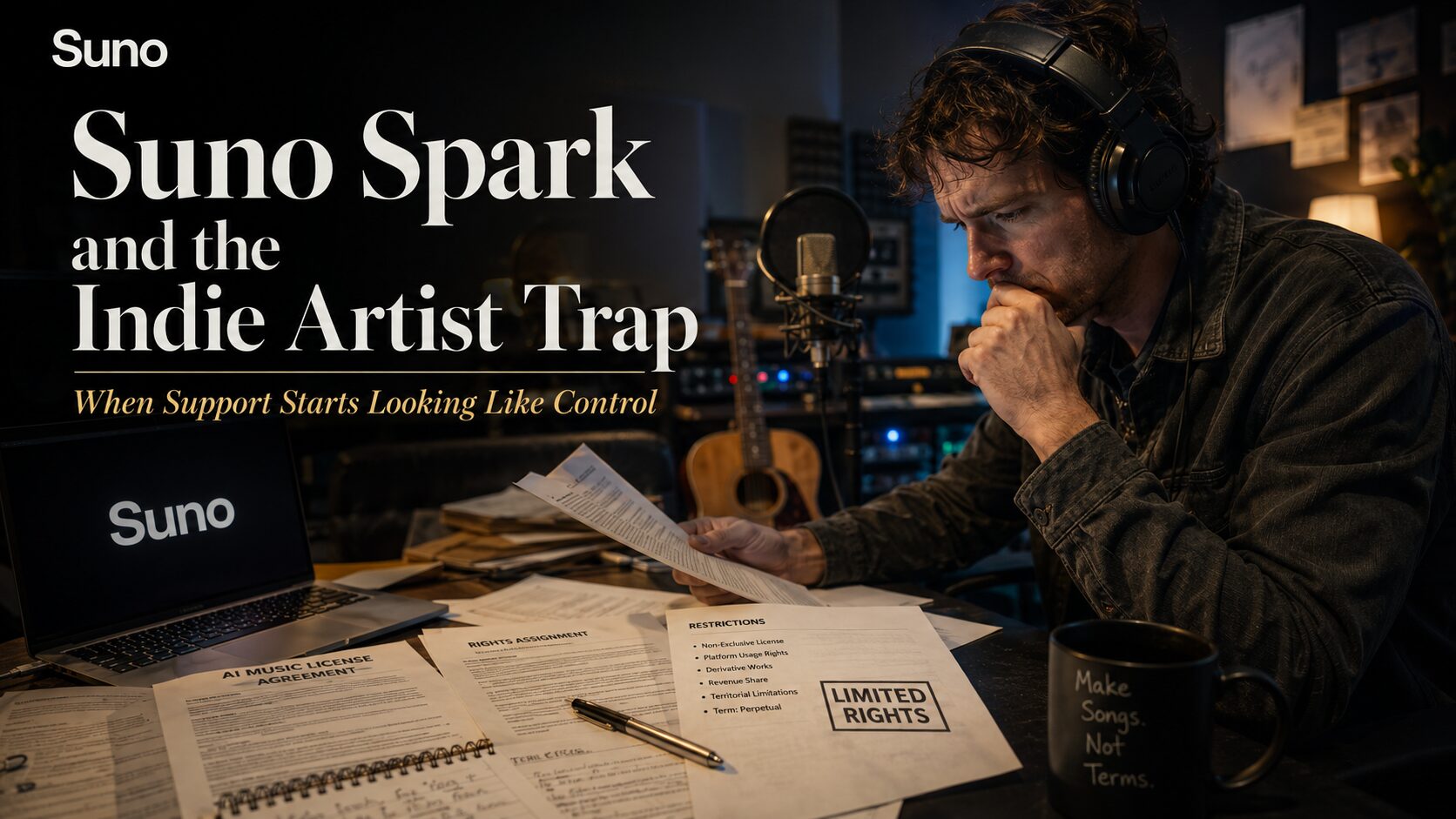
But read the fine print and the mood changes quickly. Spark does not simply look like a helping hand. It looks like a contract designed to pull independent artists deeper into Suno’s ecosystem while limiting what they can say, how they can fight, and how much control they really keep once their music, image and creative identity become part of the machine.
The Sweet Pitch: Grants, Growth and the Indie Dream
The public message is polished. Suno says Spark exists to support independent artists, especially unsigned singers, songwriters and producers looking for a bigger platform. For musicians fighting for attention in an overcrowded streaming economy, that pitch lands exactly where it is supposed to land.
Independent artists are exhausted. They are expected to write, record, mix, master, design visuals, post reels, pitch playlists, build communities, decode algorithms, answer emails, promote releases and somehow still have the emotional strength to make music that feels alive. So when a company offers funding, marketing support and access to a growing music creation platform, it is not difficult to understand why some artists might look twice.
The problem is not that artists need help. They do. The problem is what help costs when it comes attached to legal language that gives a powerful AI company wide access to an artist’s work, persona and future options.
The Fine Print Is Where the Song Changes Key
The most sensitive issue is not the grant. It is the license.
Programs like Spark are built around content, and content does not only mean finished songs. It can mean recordings, lyrics, performances, visuals, names, likenesses, creative materials and promotional assets. Once an artist agrees to broad platform rights, the relationship is no longer a simple sponsorship. It becomes a controlled exchange: support on one side, usage rights on the other.
Suno’s wider terms have already raised concerns because they give the company significant freedom to use submitted content in connection with its services. That type of language matters enormously in music, where a vocal tone, a hook, a melody fragment, a topline demo or even an artist’s image can become commercially valuable.
For an independent artist, the question is brutally simple: are you getting support, or are you feeding a system that may later use your creative identity in ways you cannot fully predict?
“You Keep Control”, But Control Needs a Definition
One of the most important tricks in modern tech language is the word “control.” It sounds reassuring, but it often hides the real question: control over what, exactly?
An artist may keep ownership of a master or retain commercial rights while still granting a platform a broad license to use, display, modify, distribute, promote or create derivative works connected to that content. Ownership and usage rights are not the same thing. In music, that distinction is everything.
You can own your house and still sign a contract allowing someone else to use the keys, repaint the walls, host parties in the living room and film the whole thing for a marketing campaign. Technically, you still own the house. Practically, you may no longer feel like the only person living there.
That is why independent artists must look beyond the headline promise. “You keep your rights” is not enough. The real question is what rights the company receives in return, how long those rights last, whether they survive after the program ends, whether they can be sublicensed, and whether they can be used to develop or improve AI systems.
The Remix Question: When Your Music Becomes Raw Material
Suno is not just a streaming platform or a playlist curator. It is an AI music company. That changes the entire meaning of artist participation.
When a traditional music partner promotes your song, it may push the track to listeners, add it to campaigns, or place it in content. When an AI music platform receives broad permissions, the concern becomes bigger: can the artist’s work become fuel for remix culture, derivative creations, model improvement or user-generated outputs?
This is where the indie artist community has reason to be especially cautious. Independent musicians already face a brutal visibility crisis. AI music is multiplying the volume of tracks entering the market. If artists allow their work to be absorbed into systems that can generate endless variations, they may be helping build the very environment that makes it harder for human-made music to stand out.
That is not paranoia. That is basic market logic. If your voice, style, compositions or aesthetic become part of a platform’s creative supply chain, you need to know exactly where the boundaries are.
The “Good Vibes Only” Clause: Smile for the Algorithm
Perhaps the most revealing part of the controversy is the so-called “Good Vibes Only” spirit around the program. The idea that artists receiving support should not publicly criticize the platform sounds friendly at first. After all, brands do not fund campaigns hoping to be attacked by their own participants.
But in the context of AI music, this kind of clause becomes much heavier. Suno operates in one of the most disputed areas of the modern music business. Artists, labels, publishers and platforms are still fighting over training data, copyright, consent, voice imitation, likeness rights and the economic impact of machine-generated music. Asking independent artists to stay positive while entering that debate is not a harmless branding request. It is a pressure mechanism.
It tells artists: take the opportunity, but do not bite the hand that writes the contract.
For musicians used to being underpaid, underpromoted and ignored, that can create a nasty imbalance. The company has capital, lawyers, platform infrastructure and media reach. The artist has a catalogue, a name, a voice and maybe a few thousand followers. When the contract says “good vibes,” the artist may hear something else: stay grateful, stay quiet, and do not make things awkward.
Arbitration and Class-Action Waivers: The Legal Mute Button
The most misunderstood part of the issue is the claim that these contracts block “criminal prosecution.” That is not the right way to frame it. A private contract generally cannot stop public authorities from investigating or prosecuting criminal wrongdoing. If a law enforcement body or regulator decides to act, a company’s terms of service do not magically turn into a legal force field.
What these clauses can do, however, is severely limit civil action. Mandatory arbitration clauses and class-action waivers are common in tech contracts, and they are often designed to prevent users from joining together in public court proceedings. Instead of a group of affected people building one visible case, disputes are pushed into individual arbitration, usually away from the public spotlight.
For independent artists, that matters. Most musicians do not have the money to fight a major tech company alone. A class action allows people with similar claims to pool pressure and legal resources. Remove that option, and the artist is standing alone at the bottom of a very expensive mountain.
So no, this is not necessarily a shield against criminal prosecution. It is something more practical and more useful to a company: a way to make civil resistance harder, quieter and more fragmented.
The Timing Is Not Innocent
Spark arrives at a moment when AI music companies are under intense scrutiny. Suno has faced legal pressure over copyright and training data, while the broader music industry is trying to decide whether AI platforms are partners, competitors, parasites or all three depending on the quarter.
That timing matters. Independent artists are not just being offered support. They are being invited into a public relations battlefield. A program full of real indie musicians can soften the image of an AI company accused by critics of benefiting from human creativity without fair consent or compensation.
Put bluntly, indie artists make good optics. They are relatable. They are passionate. They look better in a campaign than a room full of venture capital slides. If a controversial AI music company can say it is supporting real artists, the narrative becomes easier to sell.
But that does not mean the support is neutral. In the music business, goodwill is often a strategy. Sometimes the smile is part of the contract.
Independent Artists Are Not Lab Samples
The deeper concern is cultural, not just legal. Independent artists have spent years trying to reclaim power from labels, gatekeepers, playlist scams, exploitative promo companies and streaming economics that rarely reward the people actually making the music. Now they face a new kind of gatekeeper: the AI platform that presents itself as a creative partner while building tools capable of flooding the market with synthetic songs.
That creates a strange contradiction. Suno wants human artists to legitimize its ecosystem, but its core technology raises difficult questions about the long-term value of human authorship in that same ecosystem.
For some musicians, AI may be a tool. For others, it may be a threat. For many, it will be both. But no artist should enter that relationship without understanding the power imbalance. A grant can help fund a release. A bad contract can follow an artist for years.
The Real Price of Exposure
Artists have heard the word “exposure” too many times. It has been used to justify unpaid gigs, free features, low-budget sync deals, bad management contracts and every possible version of “trust me, this will be good for your career.” Spark dresses exposure in modern clothes: platform access, AI creativity, marketing infrastructure, future-facing innovation.
But the old question remains: who benefits most?
If an artist gets funding, visibility and new fans, that is real value. Nobody should pretend otherwise. Some artists may decide the trade-off is worth it. The music industry is full of calculated compromises, and independence has never meant refusing every opportunity.
But consent only means something when it is informed. Artists need to know whether their music can be remixed by users, whether their likeness can be used in marketing, whether their content can help improve AI systems, whether they can criticize the company later, whether they can work with competitors, and whether they can join future legal action if things go wrong.
Without those answers, “opportunity” becomes a velvet rope around a trapdoor.
Why This Matters Beyond Suno
The Suno Spark debate is not only about one company. It points to a much bigger shift in the music business. AI companies are moving from pure disruption into relationship-building. They no longer want to be seen only as tools that generate songs from prompts. They want artist partnerships, licensing narratives, incubator programs, creator communities and cultural legitimacy.
That is smart. It is also dangerous if artists enter those structures without leverage.
The next phase of AI music will not be fought only in courtrooms. It will be fought in contracts, creator programs, opt-in campaigns, artist grants, licensing dashboards and platform terms that most musicians accept without reading because they are too busy trying to survive release week.
The danger is not always dramatic. It does not always arrive as a villain kicking down the studio door. Sometimes it arrives as a friendly email saying you have been selected.
What Independent Artists Should Take From This
The lesson is not that every artist must reject every AI-related opportunity. The lesson is that independent artists must stop treating contracts like annoying admin and start treating them like part of the creative process.
Before signing anything connected to AI music, artists should understand exactly what they are giving away. They should ask whether the license is exclusive or non-exclusive, whether it is perpetual, whether it is revocable, whether it includes derivative works, whether it covers voice, likeness or image, whether it allows training or model improvement, whether disputes must go to arbitration, and whether public criticism is restricted.
That may sound heavy, but it is lighter than regret.
In the old music industry, artists lost rights through bad publishing deals, unfair recording contracts and managers who treated catalogues like personal ATMs. In the new music industry, artists may lose control through platform terms, AI licenses and “support programs” that look generous until the legal language starts chewing.
The Bottom Line: Read Before You Spark
Suno Spark may give some independent artists money, visibility and momentum. For the right artist, with the right legal advice, it could be useful. But nobody should confuse a polished incubator campaign with a harmless creative opportunity.
This is not just about grants. It is about leverage. It is about who gets to use an artist’s work, who gets to shape the narrative, who gets to silence criticism, and who gets to decide where disputes are heard when the dream turns sour.
The independent music world does not need more fake saviors. It needs fair tools, transparent contracts, real consent and platforms that respect artists before they turn them into marketing material.
Suno is offering a spark. Artists should make sure they are not the fuel.