STVTIQ D-Lay: Free Diffuse Stereo Delay VST3/AU for Windows and macOS
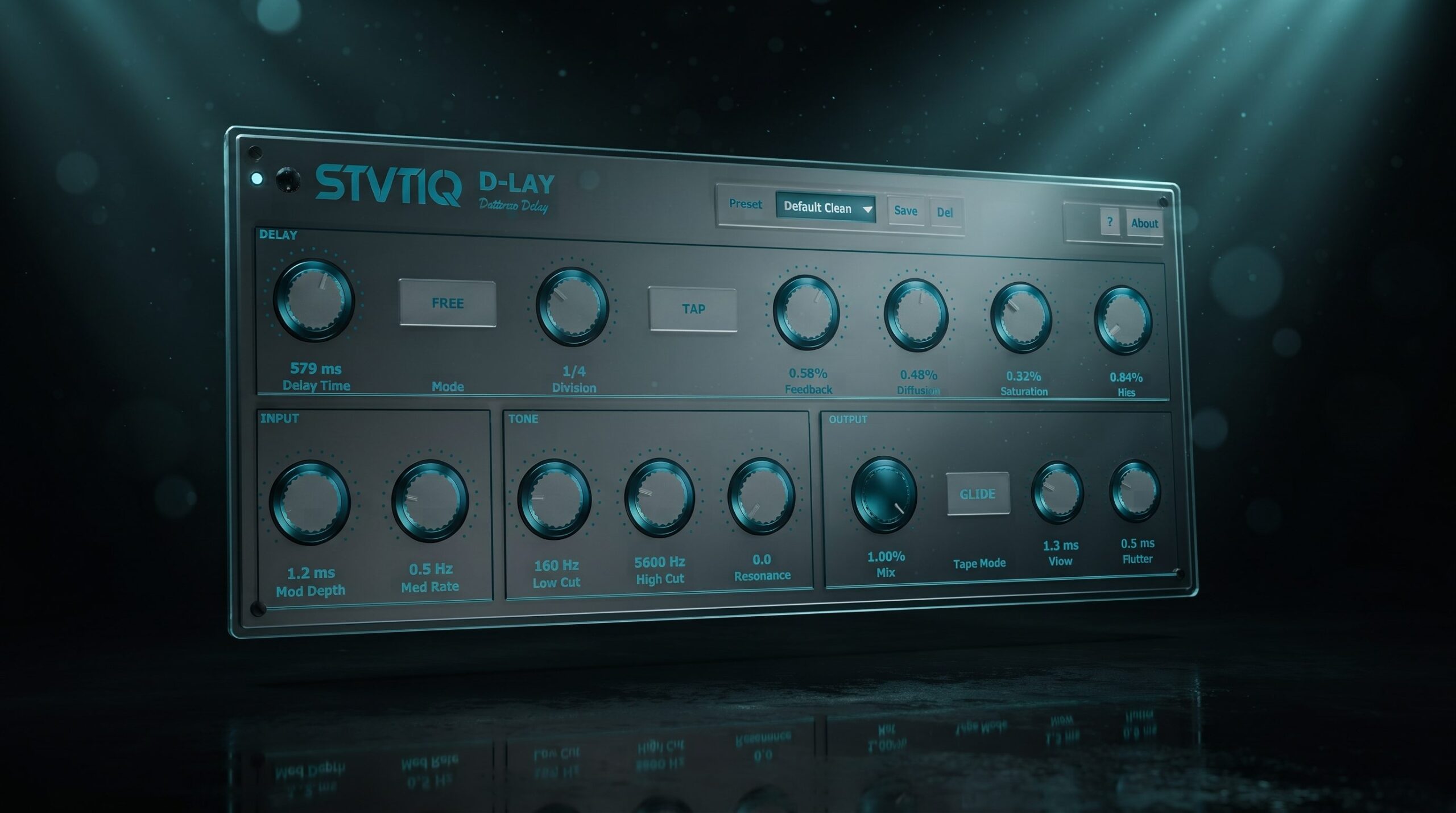
STVTIQ D-Lay is a free diffuse stereo delay for producers who want rhythmic echoes, atmospheric spaces and tape-style movement in one streamlined plugin. It combines tempo sync, diffusion, modulation, filtering and analog-inspired character while remaining completely free.
Free Diffuse Stereo Delay With Tape Character
D-Lay goes beyond a conventional delay by adding a cross-coupled diffusion network to the feedback path. The result can range from clean tempo-synced repeats to wide, cloud-like spaces that sit somewhere between delay and reverb.
Tape hiss, soft saturation, wow, flutter and internal modulation give the repeats extra movement without forcing you to stack several effects.
What Is STVTIQ D-Lay?
At its core, D-Lay is a flexible stereo delay with delay times from 10 to 1000 ms. You can work freely in milliseconds, use tap tempo or synchronize the effect to your DAW.
The plugin offers 14 straight, dotted and triplet note divisions, making it easy to create classic quarter-note echoes, tighter rhythmic patterns or more unusual syncopated effects.
Its diffusion section is what gives D-Lay its own identity. As diffusion increases, individual repeats become denser and smoother, turning the delay into a much more atmospheric effect.
Diffusion, Tape Character & Modulation
The feedback path includes soft saturation and adjustable tape hiss, while dedicated wow and flutter controls add subtle pitch instability.
Internal modulation provides separate rate and depth controls. At restrained settings this can soften pristine digital material; pushed harder, D-Lay becomes a creative sound-design tool for unstable echoes, psychedelic transitions and evolving textures.
Low-cut and high-cut filters with resonance help keep the wet signal under control, especially when feedback and diffusion are pushed into more extreme territory.
Glide and Clean Delay Modes
Glide allows delay-time changes to create tape-style pitch movement, making it useful for dub effects, transitions and automation.
Clean uses dual-head crossfading so delay-time changes remain smoother and avoid the obvious pitch-bending effect.
Having both behaviours available makes D-Lay useful both as a traditional mixing delay and as a more experimental performance effect.
At a Glance
System Requirements & Compatibility
Windows: 64-bit VST3
macOS: 64-bit Audio Unit
Activation: None
Best suited to: vocals, synths, guitars, percussion, ambient production, cinematic sound design, synthwave and experimental electronic music.
See It in Action
Listen to D-Lay on synths and other source material to hear how its diffusion, feedback and tape-inspired movement change the character of a standard stereo delay.
Final Thoughts
D-Lay is worth adding to a free-plugin folder because it does more than cover basic delay duties. The diffusion network is the standout feature, letting the plugin move smoothly from rhythmic echoes to dense spatial effects.
The extra tape-style controls make it especially useful when clean digital repeats feel too static. For a free plugin with no activation requirement, it offers a strong balance of practical mixing features and creative sound design.