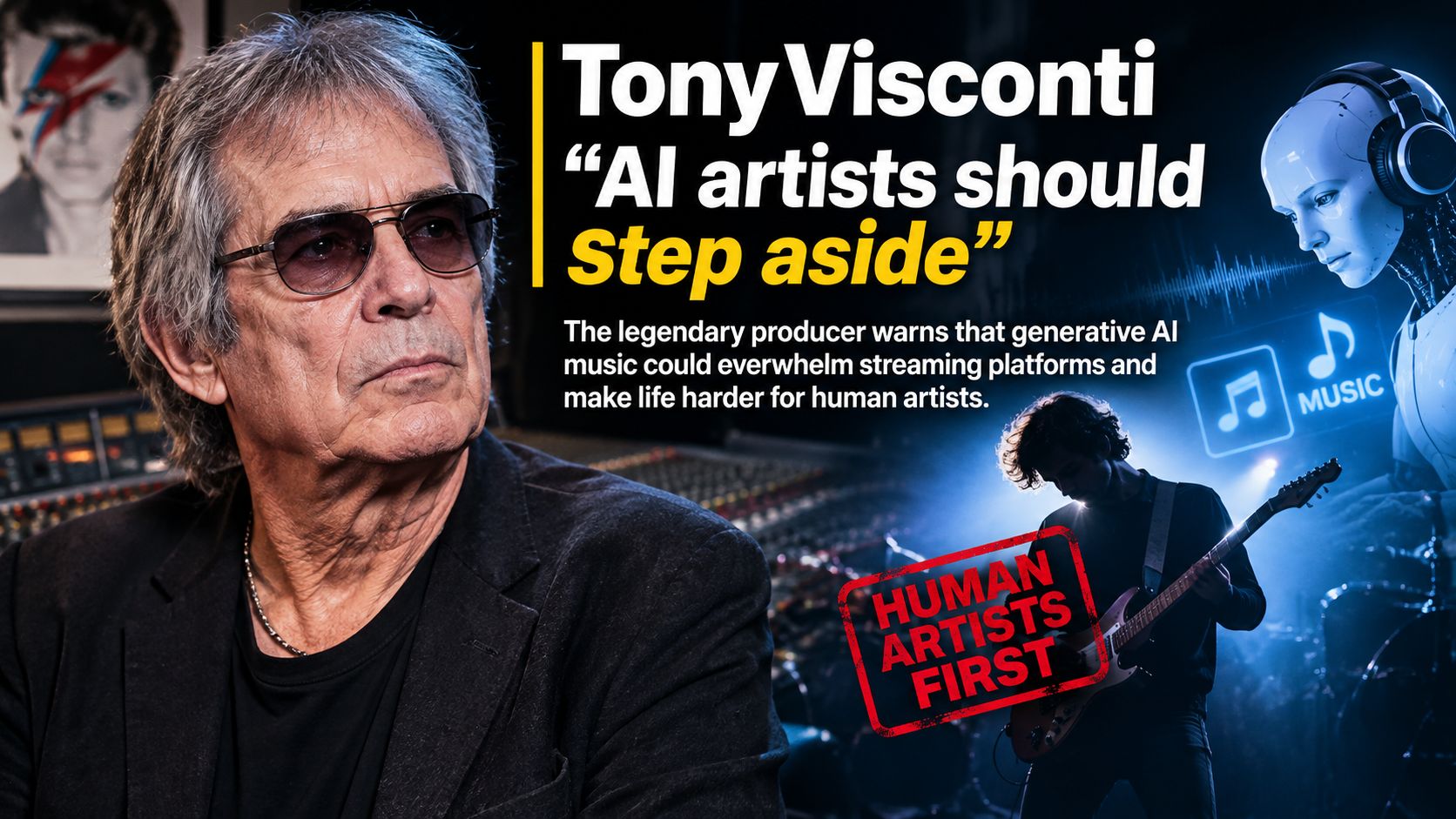

Legendary producer Tony Visconti has delivered one of the strongest criticisms yet of generative AI music, arguing that human musicians are being buried under an increasing volume of low-effort content. His comments reopen a difficult question: is AI democratizing music creation, or simply making an already overcrowded industry even harder for real artists to navigate?
Tony Visconti has little interest in pretending to be neutral about artificial intelligence in music.
The veteran producer, best known for his decades-long creative relationship with David Bowie, has publicly rejected the idea that generative AI represents a meaningful replacement for human musicians.
Speaking to MusicRadar, Visconti said he was “not a fan of AI” and argued that “artists who use AI should step to the side” so human artists can continue doing their work. He also expressed concern about the enormous quantity of amateur music entering the market and described it as clogging the music business.
The comments were published on August 12, 2026, as the music industry continues to struggle with an unprecedented increase in AI-generated content, streaming spam and questions about whether synthetic music should compete directly with human-created recordings.
Key Points
- Tony Visconti says he is strongly opposed to generative AI replacing human creativity.
- He believes the music business is becoming overcrowded with low-effort releases.
- His criticism arrives as streaming platforms introduce stronger AI labels and identity controls.
- The debate raises an important distinction between AI-generated music and AI-assisted production tools.
- Visconti remains convinced that human musicians cannot ultimately be replaced by machines.
Photo: Anna Pou / Pexels
A Producer Who Built His Career Around Human Collaboration
Visconti’s position is particularly interesting because his career has always been closely connected to technological experimentation.
He worked with David Bowie on and off from the late 1960s until Bowie’s final album, Blackstar, released in 2016. Their collaborations regularly pushed recording technology, studio experimentation and production techniques into unusual territory.
Visconti is therefore not criticizing technology simply because it is new.
His objection is more fundamental. He sees a difference between technology that helps musicians realize ideas and technology that can generate much of the creative material itself.
That distinction has become increasingly important as AI enters mainstream music production.
A producer using intelligent EQ, automated mastering, source separation or noise removal is still generally working with an underlying human performance. A prompt-based music generator can instead produce melodies, arrangements, vocals, instrumentation and entire finished songs with very limited human musical involvement.
For critics like Visconti, those two workflows should not be treated as equivalent.
The Real Concern Is Volume
One of Visconti’s most important points is not actually about whether AI can create a convincing song.
It is about how much music AI can create.
Generative systems make it possible to produce hundreds or thousands of tracks in the time traditionally required to write, record, mix and master a handful of songs.
That changes the economics of music creation.
A human artist needs time, equipment, skill, energy and usually money to produce a release. An automated system can generate content continuously at a fraction of that cost.
The result is a streaming environment where legitimate artists may increasingly compete not only against other musicians, but against industrial volumes of synthetic content.
Audiartist Analysis
The strongest part of Visconti’s argument is not that AI music is automatically bad. It is that unlimited generation changes the balance of the market. Even mediocre AI music can become economically important if enough of it occupies recommendations, playlists and passive listening time.
Spotify Is Already Responding to the Problem
Visconti’s criticism arrives just as Spotify is introducing stronger controls around synthetic artist identities.
Starting in mid-September, Spotify plans to display an AI Persona badge on artist profiles whose public identities appear to represent artificial rather than real people. By default, those profiles will not be included in Spotify’s editorial or algorithmic recommendations unless listeners deliberately follow or save them.
The policy does not ban AI music.
Instead, Spotify is beginning to separate the right to upload music from the right to receive automatic recommendation support.
That is an important distinction.
A platform can allow synthetic music to exist while still choosing to prioritize human artists in discovery systems.
The move supports one part of Visconti’s argument: the industry increasingly recognizes that unlimited AI content can create a visibility problem even when the individual tracks themselves are not necessarily illegal.
But Is All Amateur Music Really the Problem?
There is also a weakness in Visconti’s argument.
Describing amateur music as something that “clogs” the industry risks mixing two different issues.
Independent and amateur music existed long before generative AI.
Affordable DAWs, laptops, home studios and digital distributors allowed millions of musicians to release music without traditional record labels. That democratization produced enormous amounts of mediocre music, but it also allowed genuinely talented artists to build careers outside the traditional industry.
The problem is therefore not simply that more people can make music.
The more important question is whether platforms can distinguish between genuine creative participation and automated content produced primarily to occupy streaming inventory.
A teenager making an imperfect song in a bedroom is not the same thing as a server automatically generating 10,000 tracks.
Both may technically be “amateur” releases, but they represent completely different creative realities.

Photo: Anna Pou / Pexels
The Human Process Still Has Value
Visconti’s broader argument is that music is more than the final audio file.
A song carries the circumstances in which it was written, the people who performed it, the decisions made during recording and the relationship between the artist and audience.
Those elements are difficult to measure in streaming statistics.
Two songs may sound equally polished, but listeners may react very differently if one represents years of artistic development while the other was generated in seconds from a prompt.
This is one reason the current AI debate increasingly focuses on transparency.
If listeners know how a piece of music was created, they can decide for themselves whether that matters.
Without disclosure, human and synthetic works are placed in direct competition while listeners lack the information needed to distinguish between them.
AI-Assisted Music Complicates Visconti’s Position
There is another complication.
The line between “AI artist” and “real artist” is becoming increasingly difficult to define.
Many working musicians already use machine learning and AI-assisted tools for tasks such as stem separation, vocal cleanup, mastering, sound design and composition assistance. MusicRadar has reported that AI tools are becoming common throughout electronic music production, even among artists who prefer not to discuss their use publicly.
That does not necessarily mean those musicians have stopped creating their own music.
An artist can remain entirely responsible for a composition while using AI to remove noise from a vocal. Another might use an AI tool to suggest a sound but still write, arrange and perform everything else.
At the opposite end of the spectrum, a creator may enter a short prompt and publish the resulting track with almost no additional musical involvement.
Treating both situations identically would ignore an enormous difference in human contribution.
The Real Question
- Did AI assist a human creative process?
- Did AI generate a significant part of the composition?
- Was copyrighted music used to train the model legally?
- Was the final track substantially shaped by a musician?
- Is the artist transparent with listeners about how AI was used?
The Music Industry Is Splitting Into Two Camps
Visconti represents one side of an increasingly visible cultural divide.
Some musicians and producers reject generative AI almost completely, arguing that creation should remain fundamentally human.
Others see AI as another instrument.
Swedish producer John Dahlbäck, for example, recently told MusicRadar that he is excited by AI when the person using it is creative rather than simply looking for a shortcut.
Techno producer Reinier Zonneveld has taken an even more experimental approach, developing an AI system based on his own musical material and using it as a live creative partner.
These examples demonstrate why the debate is unlikely to be resolved by a simple choice between “AI” and “no AI.”
The more useful distinction may eventually become human-led versus machine-led creation.
Streaming Is Where the Battle Will Be Decided
For musicians, the most important issue may ultimately be distribution rather than creation.
AI tools will continue to improve whether individual artists like them or not.
The crucial question is how Spotify, Apple Music, YouTube, Deezer and other platforms decide to treat the resulting content.
If fully automated music receives unlimited access to the same recommendation systems as human musicians, scale strongly favors automation.
If platforms introduce clear labels, anti-spam measures, identity verification and differentiated recommendation rules, human artists may retain a meaningful advantage.
Spotify’s recent AI Persona policy suggests the second model is beginning to emerge.

Photo: Caleb Oquendo / Pexels
Can AI Replace the Artist?
Technically, AI can already imitate many elements of recorded music.
It can generate vocals, arrangements, lyrics, instrumentation and production styles.
But the artist is not only the recording.
An artist has a biography, personality, audience, live presence, history and cultural context. These things create emotional investment that is difficult to manufacture purely through software.
A synthetic song may achieve millions of streams.
Building a career that listeners genuinely care about is a different challenge.
This is where Visconti’s belief that human musicians will survive the AI era becomes more convincing.
The easier music becomes to generate, the more scarcity may move elsewhere.
The rare commodity may no longer be a professionally produced audio file.
It may be a believable human story behind it.
Conclusion
Tony Visconti’s criticism of AI music is intentionally uncompromising.
His argument reflects a genuine fear among musicians that an industry already suffering from extreme competition could become overwhelmed by endlessly generated content.
That concern deserves to be taken seriously.
But the debate should not confuse independent music, amateur creativity and responsible AI-assisted production with fully automated music factories.
The real challenge for the industry is not preventing technology from entering the studio. Technology has always entered the studio.
The challenge is ensuring that technology continues to serve creativity rather than replacing the economic space in which creativity can survive.
AI can generate music almost infinitely. Human attention cannot expand at the same rate. That may ultimately be the real battle facing musicians.