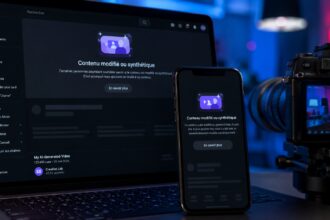
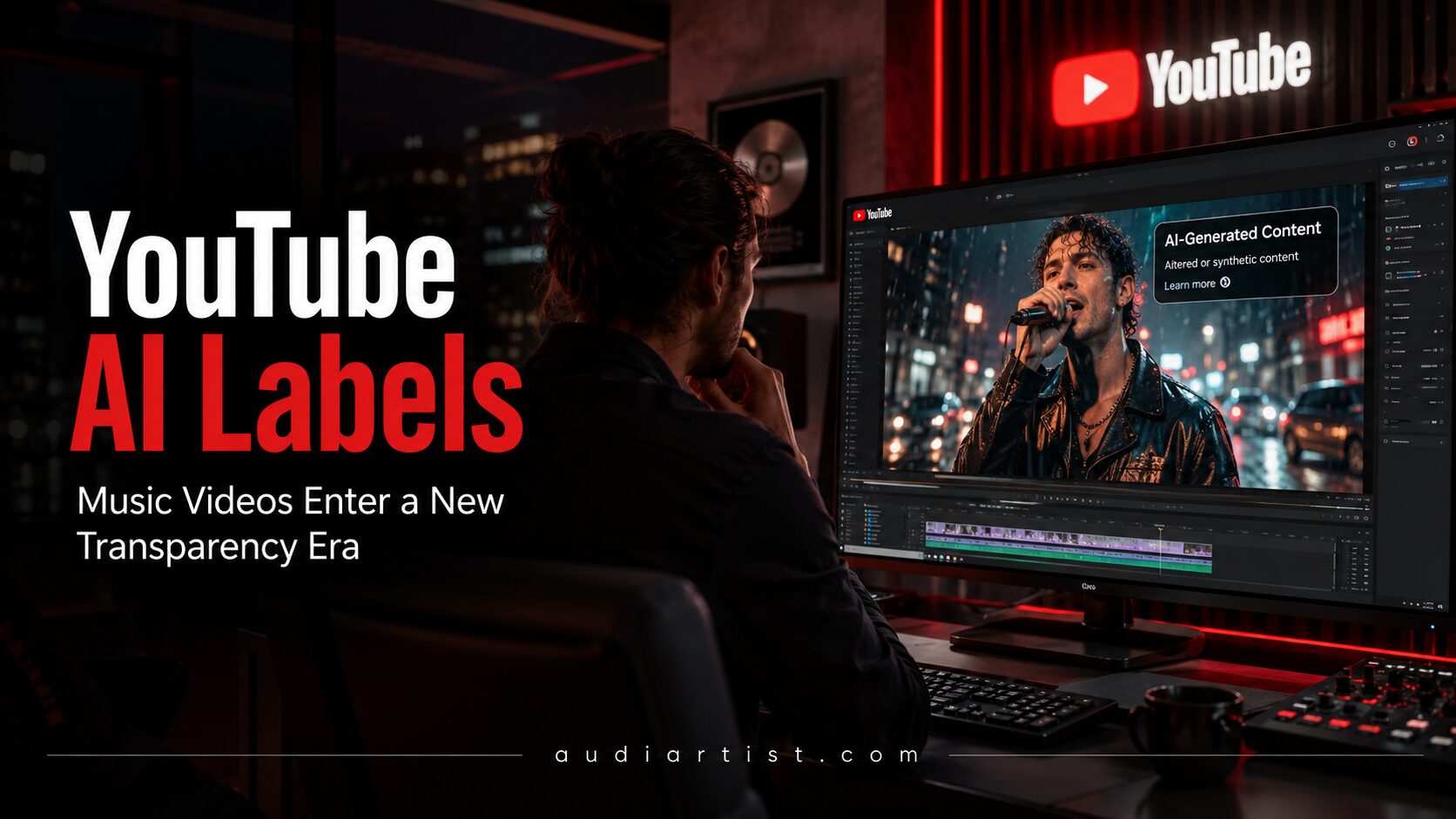

The new YouTube AI labels are designed to make synthetic media more visible to viewers and reduce confusion around photorealistic content that could be mistaken for real people, real performances, real places or real events. For artists, labels, curators and music marketers, this marks a new stage in the fight for transparency across digital music culture.
YouTube AI Labels Now Go Beyond Creator Declarations
YouTube already requires creators to disclose when realistic content has been generated or significantly altered by AI. The major change is that the platform is no longer relying only on manual declarations.
When YouTube systems detect significant photorealistic AI use and the creator has not disclosed it, the platform can now apply an AI label automatically. This means the responsibility for transparency is shifting from a purely creator-led process toward a hybrid system combining self-disclosure and platform detection.
The labels are intended for realistic AI content, not every use of artificial intelligence. YouTube has previously explained that creators do not need to disclose content that is clearly unrealistic, animated, uses standard visual effects or relies on AI only for production assistance.
Why Music Videos Are Directly Affected
The update is especially relevant for music videos, artist promotion and visual storytelling. Modern music marketing no longer lives only inside audio streaming platforms. It moves through YouTube clips, Shorts, lyric videos, visualizers, social edits, avatar performances and cinematic promotional campaigns.
That creates a growing gray zone. A track may be written, recorded and performed by a human artist, while the video may feature a synthetic face, an AI-generated crowd, a fake live performance, an artificial city, or a photorealistic artist double.
For viewers, that distinction matters. A realistic clip can shape how an artist is perceived, how authentic a performance feels and how fans connect emotionally with the release. If the visual identity is artificial, audiences increasingly expect to know it.
The New Line Between Creative Tools and Synthetic Presence
YouTube’s policy does not ban AI in music visuals. Instead, it focuses on disclosure when AI creates realistic content that could mislead viewers.
This distinction is important. Color grading, editing assistance, background cleanup or basic production tools are not the same as generating a realistic human performance that never happened. The issue is not simply whether AI was used. The issue is whether AI changes the viewer’s understanding of what they are watching.
For artists, this means the creative use of AI remains possible, but the presentation must be clearer. A surreal animated visualizer is one thing. A photorealistic singer, fake backstage scene or synthetic live performance is another.
Context: Why This Matters Now
The YouTube AI labels arrive as music platforms, social networks and video services face growing pressure over synthetic media. AI-generated songs, cloned voices, fake artist accounts, virtual influencers and realistic avatars are now part of the same cultural debate.
In music, authenticity is not just a marketing word. It affects trust, fandom, reputation and rights. Fans want to know whether they are watching the artist, a performance, a simulation or a promotional illusion.
The timing is also significant because video now drives music discovery at scale. A viral Short can introduce a song faster than a traditional playlist. A visual identity can become as important as the track itself. If that identity is AI-generated, hidden or misleading, the impact can be serious.
Industry Impact: A New Pressure on Artists and Labels
For independent artists, the update creates a new responsibility around release strategy. Music visuals made with generative AI may still be useful, affordable and creative, but they now require clearer thinking about disclosure and audience trust.
Labels and marketing teams will also need stronger internal checks. If a campaign uses AI-generated artist imagery, synthetic extras, fake locations or photorealistic video sequences, it may fall into a category that YouTube expects to be labeled.
For curators and media outlets, the change adds another layer to music discovery. It is no longer enough to ask whether the song is human-made. The visual ecosystem around the song also matters. A release can be authentic in audio but synthetic in presentation.
What Happens Next
The next phase will depend on how accurately YouTube’s systems identify photorealistic AI content and how creators respond when labels are applied automatically.
Some cases will be simple. Content made with YouTube’s own AI tools or files carrying clear generative AI metadata may be easier to label. Other cases may be more complex, especially when AI is mixed with real footage, human performance and traditional visual effects.
Creators who believe their content has been incorrectly identified may be able to update disclosure information, but the broader direction is clear. Platforms are moving toward more visible AI transparency, especially when synthetic media looks real.
Conclusion: YouTube AI Labels Bring Music’s Visual Gray Zone Into Focus
YouTube AI labels are not just a platform update. They are a warning to the music industry that visual authenticity is becoming as important as audio authenticity.
As artists use AI tools to create clips, covers, avatars, promo edits and cinematic worlds, the question is no longer only what the audience hears. It is also what the audience believes it is seeing.
For music, this could become one of the defining transparency battles of the next era: not whether AI can be used creatively, but whether fans are told when the image in front of them is no longer fully real.