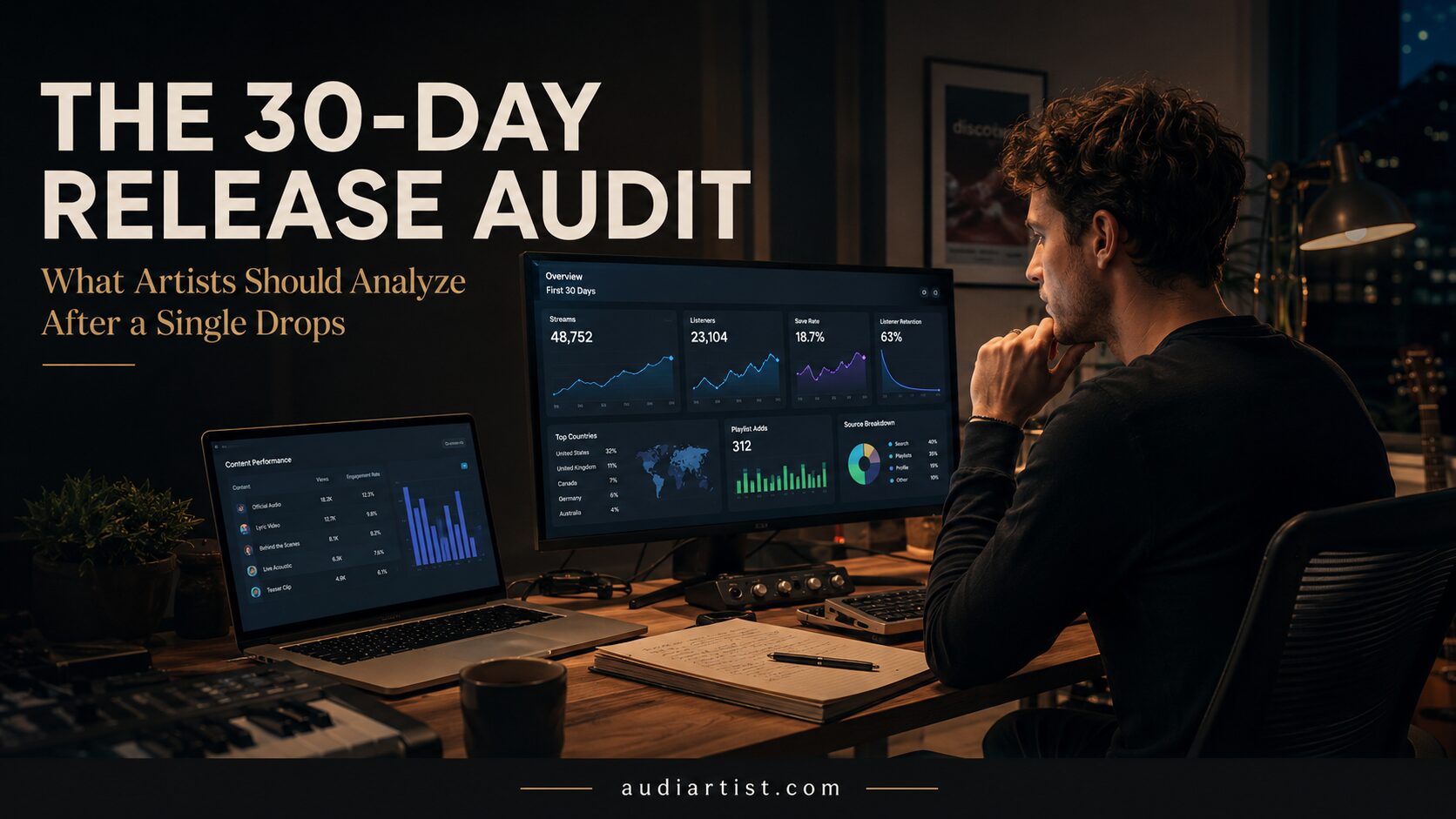

A new single does not end on release day. In many ways, that is when the real work begins.
That is where the 30-day release audit becomes essential. Instead of treating a single as a one-week promotional event, artists should treat it as a data-rich campaign. The first month reveals how listeners react, where attention comes from, what content converts, which territories respond, how playlists behave, and whether the song has real long-term potential. A release is not only a piece of music entering the world, it is a market test, a fanbase signal, and a strategic checkpoint.
Too many artists judge a song too quickly. If the numbers are lower than expected after three days, they assume the release has failed. If a playlist adds the track, they assume success is guaranteed. If a TikTok clip gets views but streams do not rise, they do not know what to do next. The 30-day release audit brings clarity to that chaos. It turns emotion into analysis, and analysis into action.
Why the First 30 Days Matter More Than the Release Day Hype
Release day gets the spotlight, but it rarely tells the full story. A song can start slowly and build steadily through saves, user playlists, algorithmic discovery, short-form video, blog mentions, radio support, or curator activity. Another track can enjoy a flashy first weekend and disappear as soon as the initial audience stops clicking. The difference between the two is not always visible in raw stream counts.
The first 30 days provide a more complete picture because they show patterns rather than isolated reactions. A single day can be distorted by friends, family, curiosity clicks, release radar activity, or one temporary post. A month gives artists enough distance to identify what is actually working. It also gives the platforms time to test the track with different listener groups.
For an independent artist, this period should be treated like a diagnostic window. The goal is not only to ask, “How many streams did I get?” The better questions are sharper: Who listened? Did they save the track? Did they skip it quickly? Did they come from playlists, social media, direct links, search, radio, or profile discovery? Did one country react more strongly than another? Did one piece of content perform better than the official announcement? Did listeners return?
The answers can shape the next single, the next pitch, the next visual campaign, the next ad test, and even the artist’s positioning. Without an audit, every release becomes a guess. With one, each release becomes a lesson.
Day 7: Separate Emotion From Early Evidence
The first week after a single drops is emotionally intense. Artists often look at the numbers too often and interpret every rise or slowdown as a major signal. But the first seven days should not be used to declare victory or failure. They should be used to understand the early response.
At this stage, the most obvious number is total streams, but it is rarely the most useful number on its own. A track with 2,000 passive playlist streams and almost no saves may be weaker than a track with 500 highly engaged listens from a smaller but more connected audience. Early streams matter, but engagement matters more.
The first metric to study is the save rate. When listeners save a song, they are saying that the track has personal value beyond the first listen. Saves can help indicate whether the single has replay potential. A weak save rate does not automatically mean the song is bad, but it does suggest that the campaign may be attracting the wrong audience, or that the song is being heard in contexts where listeners are not deeply engaged.
The next signal is playlist activity. Artists should look at whether the track has been added to editorial playlists, algorithmic playlists, independent playlists, personal listener playlists, or no playlists at all. Each type tells a different story. A personal playlist add can be small in volume but strong in meaning, because it shows that a listener made an active choice. An independent playlist placement can create visibility, but it must be evaluated carefully. A spike in streams without saves, followers, or listener retention can be a warning sign.
Day 7 is also the moment to review the launch content. Which post brought people to the link? Did the cover reveal perform better than the release announcement? Did a behind-the-scenes clip outperform the official visualizer? Did a simple story with a direct message generate more action than a polished reel? Music promotion is not always won by the most expensive asset. Sometimes the most human piece of content carries the strongest conversion.
The first-week audit should end with a simple conclusion: what created attention, what created listening, and what created real engagement. Those are three different things, and confusing them is one of the most common mistakes in independent music promotion.
Streams Are Not the Whole Story
Stream counts are seductive because they are easy to understand. A bigger number feels like progress. A smaller number feels like disappointment. But streams alone do not explain the health of a release. They show consumption, not necessarily connection.
A serious release audit looks beyond volume. It studies the quality of listening. Are people playing the song all the way through? Are they skipping in the first few seconds? Are they coming back later? Are they saving it? Are they adding it to their own playlists? Are they following the artist after listening? Are they clicking from social media and leaving immediately, or are they exploring the artist profile?
This is where artists need to become less obsessed with vanity metrics and more interested in listener behavior. A song with modest numbers but strong retention can be worth pushing further. A song with high traffic and low engagement may need a different audience, a different visual angle, or a more accurate pitch.
The key is context. A club-oriented house track may perform differently from an intimate acoustic ballad. A cinematic instrumental may not generate the same social reactions as a vocal pop single. A dark techno release may attract niche listeners who do not comment often but listen repeatedly. The audit must judge the song according to its genre, purpose, and audience, not according to a generic viral fantasy.
Day 14: Identify the Real Sources of Momentum
By the second week, the release begins to move out of the initial launch bubble. Friends have already clicked. The announcement has slowed down. The first wave of curiosity has faded. This is when the real promotional signals become easier to read.
Day 14 is the time to study traffic sources. If most listeners came from direct links, the artist’s own audience did the work. If playlist streams dominate, the campaign depends heavily on third-party exposure. If social media drove a meaningful share of listeners, the content strategy has potential. If listeners arrived through search or profile discovery, the artist may be building stronger brand recognition than expected.
The most valuable discovery at this stage is not simply where streams came from, but which sources produced the best listeners. A playlist may deliver a high number of plays but very few saves. A small Instagram story may deliver fewer clicks but stronger engagement. A blog feature may not create a huge spike on day one, but it can improve credibility and support long-term search visibility. A YouTube short may create attention without direct streaming conversion, but still introduce the artist to new people.
This is why the audit must compare traffic with results. The right question is not “Which source gave me the most streams?” It is “Which source gave me the most valuable listeners?”
Valuable listeners are not always loud. They save, replay, follow, add, search, share privately, or return later. They are the people who slowly turn a release into a catalog asset. Finding them matters more than chasing empty exposure.
Analyze Countries, Cities, and Listener Context
Territory data can reveal unexpected opportunities. An artist based in France may discover early traction in Germany, Brazil, Mexico, the United States, or the Netherlands. A producer making Afro house may find that one city responds more strongly than the home market. A lo-fi artist may notice steady listening from study-heavy urban areas. A synthwave project may find a pocket of fans in countries where retro electronic scenes are active.
These details should not be treated as trivia. They can guide promotion. If one country shows strong engagement, the next campaign can include localized hashtags, targeted ads, local blogs, radio shows, playlist curators, or collaborations with artists in that scene. If a city repeatedly appears across several releases, it may become a priority market.
The mistake is to promote every song everywhere with the same message. A 30-day audit helps narrow the field. Instead of shouting into the entire internet, the artist starts speaking more directly to the places where the music is already landing.
This does not mean abandoning the home audience. It means recognizing that digital music discovery does not follow old geographic rules. A track can travel before the artist does. Smart promotion follows the evidence.
What Skips Reveal About the First Impression
Skip data can be uncomfortable, but it is one of the most useful indicators in a release audit. If listeners leave quickly, something is not connecting in the opening moments. That does not always mean the song is weak. It may mean the intro is too long for the audience being targeted, the playlist context is wrong, the genre tag is misleading, or the promotional clip promised a different energy than the full track delivers.
For modern music promotion, the first 10 to 30 seconds matter. Listeners are impatient, especially when they discover a song through playlists or short-form content. A slow-burn intro can still work beautifully, but the campaign must place it in front of listeners who appreciate that kind of build. A dance track pitched as high-energy needs to deliver movement quickly. A cinematic piece can take more time, but it needs atmosphere from the first breath.
Skip behavior should be used carefully. One data point does not define a song. But if the pattern repeats across platforms, campaigns, and audiences, the artist has something to learn. Maybe the next single needs a stronger opening hook. Maybe the preview clip should start later in the track. Maybe the playlist targeting should be refined. Maybe the song is better suited to visual storytelling than pure streaming discovery.
The audit is not there to punish the artist. It is there to reveal how the audience experiences the music in real conditions.
Study the Content That Actually Converted
Artists often assume that the most polished content will perform best. In reality, the strongest conversion can come from surprising places. A quick studio video, a personal story, a rehearsal clip, a lyric explanation, a rough acoustic moment, a DJ test, a reaction video, or a simple post about the meaning of the song can outperform a perfectly designed announcement.
The 30-day release audit should compare content performance across several layers. Views are the first layer, but they are not enough. Watch time, comments, shares, saves, link clicks, profile visits, and streaming movement matter more. A reel with 20,000 views and no streaming lift may be less useful than a post with 800 views that sends real listeners to the track.
This is especially important for artists using Instagram, TikTok, YouTube Shorts, Facebook, or X to promote new music. Short videos can create awareness, but awareness alone is fragile. The real challenge is turning attention into action. If a video performs well, the artist should ask why. Was it the hook? The emotion? The visual setting? The story? The text on screen? The first second? The performance? The mood?
Once that answer becomes clear, the artist can produce follow-up content instead of starting from zero again. A good release campaign does not rely on one announcement. It builds variations around what people are already responding to.
Day 30: Decide Whether to Push, Pivot, or Archive
After 30 days, the single has usually produced enough evidence for a strategic decision. The artist does not need to abandon the song, but they do need to decide what role it should play next.
If the track shows strong saves, playlist adds, repeat listening, follower growth, or territory-specific traction, it may deserve a second promotional wave. That could mean a new visualizer, a performance video, a remix, a lyric video, a behind-the-song article, a focused ad test, a fresh curator pitch, or a social campaign built around the strongest hook.
If the track generated attention but weak engagement, the artist may need to pivot. The song might need better positioning, a different audience, a clearer story, or stronger content. A track that does not perform well with one campaign can sometimes improve when presented from a new angle.
If the release produced limited traction across every signal, the smartest decision may be to archive it as part of the catalog and move forward. That is not failure. Every artist needs songs that teach them something. Not every release will become a breakthrough, but every release should make the next one sharper.
The danger is emotional overreaction. Some artists give up too soon. Others keep pushing a song long after the data suggests it is not connecting. A 30-day audit helps avoid both mistakes. It gives the artist a calmer, more professional basis for decision-making.
The Link Problem: When People Click But Do Not Listen
One of the most overlooked parts of a release audit is link performance. Artists often share one streaming link everywhere and assume the job is done. But a click is not the same as a listen.
If social posts generate clicks without streaming growth, the problem may be the landing page, the call to action, the platform choice, the loading time, or the message around the link. Sometimes the audience is interested, but the path is too messy. Sometimes the post creates curiosity, but the song is not presented clearly enough. Sometimes the artist pushes listeners to a platform they do not use.
A good audit looks at the journey from discovery to playback. The listener sees a post, understands the reason to care, clicks the link, chooses a platform, opens the song, listens, and ideally saves or follows. Every step can leak attention. The more friction there is, the fewer listeners arrive.
This is where a clear landing page, direct platform links, and consistent messaging become important. Artists should also test different calls to action. “Listen now” is simple, but not always compelling. A stronger message might connect to the emotion of the song, the story behind it, the genre community, or the specific moment the track is designed for.
Promotion is not only about reaching people. It is about guiding them.
Playlist Results Need a Reality Check
Playlist placement can be powerful, but it is often misunderstood. A playlist add is not automatically a successful campaign. The quality of the placement matters more than the screenshot.
Artists should examine how playlist streams behave over time. A healthy placement usually produces listening that feels natural, with some level of saves, followers, or continued discovery. A suspicious placement may create a sudden spike with almost no engagement, strange territory patterns, or a collapse as fast as it appeared. Not every weak result is suspicious, of course. Some playlists are simply passive, poorly targeted, or too broad for the track.
The 30-day audit should identify which playlists deserve future attention and which ones are not worth chasing again. A smaller playlist with real listeners can be more valuable than a huge playlist with passive or low-quality traffic. For independent artists, playlist strategy should be built around fit, not ego.
The most important question is whether a playlist helped the song find people who cared. If it only inflated the stream count for a few days, it may look good in a screenshot but do very little for the artist’s career.
Turn the Audit Into the Next Campaign
The strongest artists do not treat each release as an isolated event. They build a feedback loop. Every single informs the next single. Every campaign improves the next campaign. Every data point helps refine the artist’s audience, message, content, and timing.
After the 30-day audit, the artist should create a short release report. It does not need to be complicated. It should summarize the strongest territories, best-performing content, most valuable traffic sources, playlist results, save behavior, follower growth, link performance, and key lessons. Over time, these reports become a private map of the artist’s real audience.
This is especially useful for independent musicians who do not have a label team, marketing department, or manager reading the numbers for them. The audit creates professional discipline. It helps the artist stop guessing. It also makes future pitching stronger, because the artist can speak with evidence rather than vague enthusiasm.
An artist who knows that a track performed well in a specific country, gained saves from a certain type of playlist, or converted strongly from a certain video format has a better story to tell. That story can help with curators, media outlets, collaborators, advertisers, and fans.
A Simple 30-Day Release Audit Framework
The audit should not become so complex that the artist avoids doing it. The best system is clear, repeatable, and realistic.
At day 7, the focus should be early engagement. Look at streams, saves, playlist adds, first territories, social content performance, and link clicks. The goal is to understand the first reaction and identify anything worth amplifying immediately.
At day 14, the focus should move toward momentum. Study traffic sources, listener quality, follower growth, skip patterns, repeat content performance, and audience geography. The goal is to separate initial curiosity from real traction.
At day 30, the focus should become strategic. Decide whether the single deserves a second push, a new angle, a remix, a visual extension, a targeted campaign, or a quiet move into the catalog. The goal is to make the next decision based on evidence.
This framework does not require a massive team. It requires attention, honesty, and consistency. The artists who audit their releases carefully are usually the ones who improve fastest, because they stop repeating the same promotional mistakes in different packaging.
The Real Purpose of a Release Audit
The 30-day release audit is not about reducing music to numbers. Music is emotional, cultural, personal, and sometimes beautifully unpredictable. No spreadsheet can measure the full meaning of a song. But data can reveal how the world is responding to that song, and that information is too valuable to ignore.
For independent artists, the modern release cycle is unforgiving. New music arrives constantly. Attention moves quickly. Algorithms test and replace songs every day. Social platforms reward speed, but careers are built through pattern recognition. The artists who survive are not always the ones who release the most. They are the ones who learn the most from every release.
A single is more than a launch. It is a conversation with the audience. The first 30 days show who answered, how they answered, and where the next conversation should begin.
That is the real value of the audit. It gives the artist a clearer mind, a stronger strategy, and a better chance of turning one release into long-term growth.
Discover more music promotion insights, artist resources, and independent music strategies on Audiartist.