
The beginner reaction is predictable. Add another synth. Add a percussion loop. Add a riser. Add a pad. Add a vocal chop. Add a second lead. Add a texture. Add a crash. Add another crash because the first crash looked lonely. Suddenly the session is bigger, the CPU is sweating, and the track still feels flat.
The problem is not always a lack of sounds. Very often, the problem is a lack of energy movement.
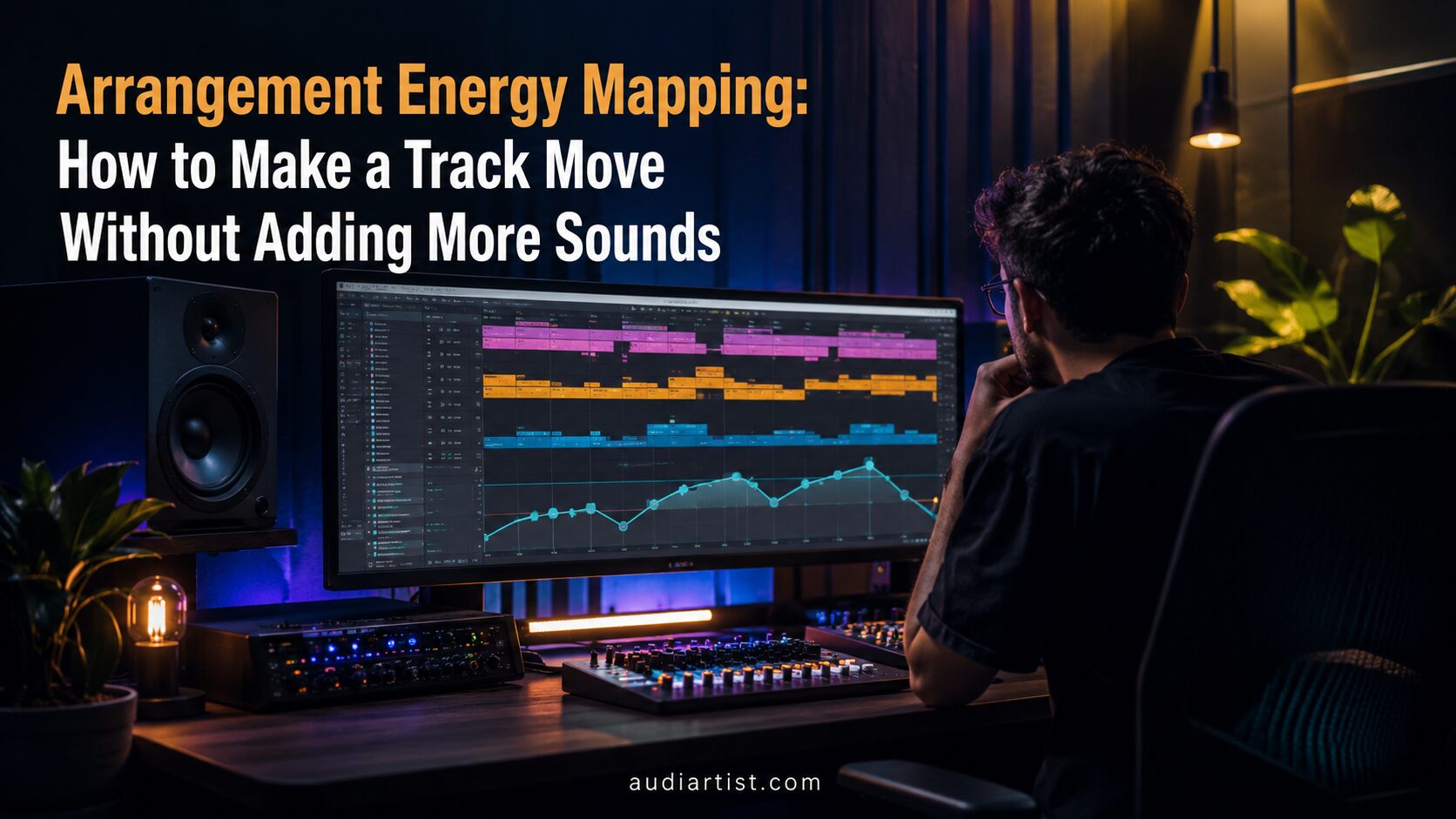
Arrangement energy mapping is the art of controlling how a track rises, falls, breathes, tightens, opens, pauses, and releases over time. It is not about adding more elements. It is about making the elements you already have behave with purpose.
A professional production does not stay at one emotional temperature. It moves. It holds back, then opens. It narrows, then widens. It removes weight, then brings it back. It introduces tension, then releases it. It keeps the listener curious without constantly throwing new sounds into the room like a producer cleaning a sample folder with a leaf blower.
This article explains how to make a track move without adding more sounds, using arrangement energy mapping, automation, dynamics, silence, filtering, stereo contrast, rhythm variation, and a few carefully chosen tools.
What Is Arrangement Energy Mapping?
Arrangement energy mapping is a way of planning the emotional and sonic movement of a track from start to finish. Instead of only asking “What sounds should I add?”, you ask “How should the energy change?”
Every section has an energy level. An intro may feel restrained. A verse may feel intimate. A pre-drop may feel tense. A chorus may feel open. A breakdown may feel distant. A final section may feel larger, wider, or more intense.
The energy map shows the listener where they are in the journey.
A simple energy map might look like this:
- Intro: low energy, filtered, narrow, mysterious.
- First groove: medium energy, drums and bass enter.
- Main hook: high energy, lead and full rhythm active.
- Breakdown: low energy, space, emotion, reduced low end.
- Return: high energy, stronger impact, wider sound.
- Outro: energy decreases, elements leave gradually.
This map can be created with the same sounds. You do not always need another layer. You need movement.
Why Tracks Feel Static
A track can feel static even when it has many elements. This usually happens when too many parts enter too early, stay too long, and change too little.
Common reasons a production feels flat:
- The main loop repeats with no variation.
- The drums do not evolve between sections.
- The bass plays the same rhythm throughout the track.
- The chords stay at the same brightness and volume.
- The lead never leaves, so it loses impact.
- The stereo width stays constant.
- The reverb and delay never change.
- The low end is always full, so drops feel weaker.
- There is no silence or reduction before big moments.
- Every section has the same density.
When everything is active all the time, nothing feels special. Energy mapping gives each section a reason to exist.
The First Rule: Do Not Add, Move
Before adding another sound, choose one existing element and make it move.
You can move a sound in many ways:
- Open its filter over time.
- Lower its volume in one section and raise it in another.
- Make it drier in the verse and wetter in the breakdown.
- Make it narrow in the intro and wider in the hook.
- Shorten its note length before a drop.
- Remove it for two bars, then bring it back.
- Change its rhythm slightly every 8 or 16 bars.
- Automate delay only at the end of phrases.
This is the difference between arrangement and accumulation. Accumulation adds objects. Arrangement creates motion.
The Energy Curve
Imagine your track as a curve. The listener should feel changes in pressure. Some moments should rise. Some should relax. Some should hold tension. Some should release.
A beginner arrangement often looks like a flat line:
- Everything starts.
- Everything loops.
- Everything continues.
- Everything ends.
A stronger arrangement has shape:
- A small beginning.
- A first lift.
- A stronger section.
- A reduction.
- A build-up.
- A release.
- A final variation.
- A controlled ending.
The listener may not consciously analyze this curve, but they feel it. If the energy never changes, attention drops. If energy changes too randomly, the track feels confused. The goal is controlled movement.
Energy Mapping With Only Five Parameters
You can create movement using five simple parameters:
- Density: how many elements are active.
- Brightness: how open or dark the sound feels.
- Width: how narrow or wide the stereo image feels.
- Depth: how dry, close, wet, or distant the section feels.
- Low-end weight: how much kick, bass, and sub energy is present.
These five parameters are enough to make a track evolve without adding new sounds.
For example, a hook can feel bigger than a verse if it is brighter, wider, denser, and has more low-end weight. A breakdown can feel emotional if it is darker, wetter, narrower, and reduced in low end. A build-up can feel tense if brightness rises while low end disappears.
The sounds may be the same. The energy is different.
Density: Add and Remove With Intention
Density is the easiest energy control to understand. More active parts usually create more energy. Fewer active parts usually create less energy. But density is not only about track count. It is about perceived activity.
A single busy percussion loop can feel denser than three long pad tracks. A fast arpeggio can make a section feel more active than a sustained chord. A repeated vocal chop can create more energy than a background synth layer.
Use density changes to create section contrast:
- Start with only chords and FX.
- Add drums without bass.
- Bring bass in after the groove is established.
- Save the lead for the main section.
- Remove percussion before the breakdown.
- Bring back the full rhythm after silence.
Do not reveal the full track too early. If everything arrives in the first 16 bars, the rest of the arrangement has fewer ways to grow.
Brightness: Open the Track Over Time
Brightness is one of the strongest ways to control energy. A darker section feels restrained. A brighter section feels more open, more exciting, and often more expensive.
You can control brightness with:
- Low-pass filter automation.
- EQ automation.
- Opening a synth filter.
- Changing cymbal or hi-hat intensity.
- Adding or removing high-frequency percussion.
- Automating reverb brightness.
- Reducing harshness before big moments.
Try this simple move: keep the chords filtered during the intro, then slowly open the filter over 16 bars. The track feels like it is waking up, without adding a single new sound.
Brightness should not be constant. If the whole track is bright all the time, the ear gets tired. Use darker sections to make brighter sections feel important.
Width: Make Sections Expand
Stereo width is powerful when it changes. A wide chorus feels wider after a narrower verse. A big drop feels larger when the build-up pulls inward before it lands.
Width can be controlled by:
- Panning support elements.
- Using stereo delay returns.
- Automating width on pads or FX.
- Keeping verse elements more centered.
- Making the hook wider than the pre-hook.
- Reducing side information before a drop.
- Keeping low-end elements mono and stable.
The mistake is widening everything. If the kick, bass, lead, chords, percussion, reverb, and FX are all wide, the track may feel large but unfocused.
Width works because of contrast. Keep the center strong. Let supporting elements create expansion around it.
Useful Tool: Cableguys PanCake 2
PanCake 2 by Cableguys is a free panning modulation plugin that lets you create rhythmic movement across the stereo field. It is useful for energy mapping because it can animate existing sounds instead of forcing you to add new ones.
Use it for: moving percussion, animated textures, stereo motion, rhythmic panning, subtle section changes.
Energy mapping tip: Place PanCake 2 on a background texture, shaker, vocal chop, or FX layer. Use it more actively in transition sections and less actively in the main hook. The listener feels motion without the arrangement becoming crowded.
Official website
Download PanCake 2
Depth: Bring Sounds Closer and Push Them Back
Depth controls whether sounds feel close, distant, dry, wet, intimate, or atmospheric. A track that has no depth movement can feel flat even if the sounds are good.
You can create depth changes with:
- Reverb send automation.
- Delay throws.
- Dry verse, wetter breakdown.
- Short room on drums, long tail on selected FX.
- Reducing reverb before a drop.
- Pushing pads back while keeping the lead close.
- Automating predelay or decay time.
Depth is not the same as drowning everything in reverb. A sound feels close because another sound feels far away. If everything is distant, the track loses impact.
Use depth like stage direction. The lead steps forward. The pad sits behind. The FX moves into the distance. The drums stay close enough to drive the track.
Useful Tool: Valhalla Supermassive
Valhalla Supermassive is a free delay and reverb plugin that can create huge spaces, evolving tails, dreamy echoes, and cinematic transition moments. It is ideal for energy mapping because it can change the emotional size of a section without adding another musical part.
Use it for: breakdown depth, transition tails, delay throws, atmospheric moments, evolving reverb spaces.
Energy mapping tip: Use Supermassive as a send. Keep it subtle during the groove, push more signal into it during the breakdown or pre-drop, then reduce or cut it before the full section returns. The contrast makes the return feel more powerful.
Official website
Download Valhalla Supermassive
Low-End Weight: The Most Physical Energy Control
Low end is not just a frequency area. It is physical energy. The return of the kick and bass can make a section feel larger than any riser or crash.
Many beginner tracks lose impact because the low end is active too often. If the kick and bass stay full from start to finish, the listener never feels the low end return. The body stops being surprised.
Use low-end mapping to create impact:
- Remove bass from the intro.
- Bring bass in after the drums establish the groove.
- Cut low end during the breakdown.
- Remove kick for one beat before the drop.
- Mute the bass for one bar before the chorus.
- Use a controlled bass return after silence.
- Reduce low-end density before the final section.
The low end should not always be present at full strength. It should arrive with purpose.
The 8-Bar Energy Check
A simple way to keep a track moving is to check energy every 8 bars. Something should change. It does not need to be obvious, but the listener should feel progression.
Possible 8-bar changes include:
- Open a filter slightly.
- Remove a percussion element.
- Add a short drum fill.
- Automate reverb send on one phrase.
- Change the bass note length.
- Mute the lead for two bars.
- Bring in a delayed answer.
- Widen the pad slightly.
- Darken the chords before the hook.
- Create one beat of silence before a new section.
This prevents the arrangement from becoming static without forcing you to add new tracks.
Automation: The Producer’s Movement Engine
Automation is the most important tool for energy mapping. It turns static sounds into evolving parts.
Useful automation targets include:
- Volume.
- Filter cutoff.
- Filter resonance.
- Reverb send.
- Delay send.
- Delay feedback.
- Stereo width.
- Pan position.
- Distortion amount.
- Drum decay.
- Synth release.
- Noise level.
- EQ brightness.
One automated filter can create more movement than three extra layers. One delay throw can create more emotion than a random FX loop. One volume dip can create more impact than another crash.
The question is not “What can I add?”
The better question is “What can I move?”
Useful Tool: Kilohearts Essentials
Kilohearts Essentials is a free collection of practical effects that includes tools such as filters, delay, reverb, chorus, flanger, phaser, distortion, tape stop, compressor, transient shaping, and more. Its strength is speed. The plugins are simple enough to automate quickly, which makes them useful for arrangement movement.
Use it for: filter automation, tape stop moments, delay movement, distortion build-ups, rhythmic effects, creative transition processing.
Energy mapping tip: Use one effect as an automation move rather than leaving it on permanently. For example, automate distortion amount only during the last 4 bars before a drop, or use a tape stop once as a reset before a new section.
Official website
Download Kilohearts Installer
Energy Mapping by Section
Intro
The intro should create curiosity without giving away everything. Keep it smaller than the main section. Use filtering, reduced low end, partial drums, or a simplified version of the hook.
Possible intro energy settings:
- Low density.
- Reduced bass.
- Darker chords.
- Narrower stereo field.
- Subtle FX or atmosphere.
First Groove
The first groove establishes rhythm and identity. Bring in drums and bass, but avoid revealing every element too early. Save some movement for later sections.
Possible first groove settings:
- Medium density.
- Kick and bass active.
- Chords partially open.
- Lead absent or minimal.
- Short transition fills every 8 or 16 bars.
Main Hook
The main hook should feel like a lift. It does not always need more elements, but it should feel more focused, brighter, wider, stronger, or more emotionally clear.
Possible hook settings:
- Higher density.
- Lead active.
- Chords brighter.
- Wider support elements.
- Stronger drum movement.
- Full low-end return.
Breakdown
The breakdown gives the listener contrast. It should not simply be the same loop with fewer drums. It should shift perspective.
Possible breakdown settings:
- Lower density.
- Reduced or removed low end.
- More depth and reverb.
- Darker or softer tone.
- Lead fragment or vocal detail.
- Less rhythmic pressure.
Build-Up
The build-up creates tension. It should prepare the return, not just fill space with noise.
Possible build-up settings:
- Rising brightness.
- Increasing drum activity.
- Low end reduced before the drop.
- Delay throws.
- Short fills.
- Filter movement.
- One brief silence before release.
Final Return
The final return should feel earned. It can be stronger than the first hook through wider support, clearer drums, a lead variation, a stronger bass return, or a more confident arrangement.
Possible final return settings:
- High density, but not clutter.
- Full low-end energy.
- Clear hook.
- Wider background elements.
- Small variation in lead or drums.
- Controlled reverb and delay.
Make the Same Loop Feel Different
A strong exercise is to take one 8-bar loop and make three versions without adding new sounds.
Version 1: Intro Energy
- Filter the chords.
- Remove bass.
- Use only light drums.
- Keep the lead muted.
- Add a small reverb tail.
Version 2: Groove Energy
- Bring in kick and bass.
- Open the chords halfway.
- Add hi-hats or percussion.
- Keep the lead minimal.
- Keep effects controlled.
Version 3: Hook Energy
- Open the filter fully.
- Bring in the lead.
- Increase width on support elements.
- Use a short delay throw at phrase endings.
- Keep low end strong and centered.
This teaches one of the most important production lessons: movement can come from transformation, not addition.
The Role of Silence in Energy Mapping
Silence is not empty space. It is energy control.
A one-beat silence before a drop can make the return hit harder. A two-bar reduction before the final section can refresh the listener’s ear. A sudden stop in the drums can create surprise. A muted bass before the hook can make the low end feel enormous when it comes back.
Use silence before:
- Drops.
- Choruses.
- Main hooks.
- Bass returns.
- Drum re-entries.
- Breakdown transitions.
- Final sections.
Many producers are afraid of silence because they think the track will sound unfinished. But controlled silence sounds confident. It tells the listener that the next moment matters.
Energy Mapping by Genre
House and Tech House
Use kick removal, clap delays, filter movement, short drum fills, bass stops, and gradual opening of hats and stabs. Keep the groove central. Energy often comes from small rhythmic changes rather than big new layers.
Afro House and Organic House
Use percussion call-and-response, gradual bass movement, vocal or melodic fragments, reduced low end before returns, and evolving atmospheric depth. The track should breathe around the groove.
Trap and Hip-Hop
Use 808 stops, hat roll changes, snare fills, sample filtering, vocal cuts, and hook reduction before the main section. Energy comes from contrast, not constant density.
Lo-Fi
Use soft automation, vinyl or room tone level changes, muted drums, chord filtering, simple breakdowns, and subtle delay movement. The energy map should feel intimate, not overproduced.
Synthwave
Use arpeggio filtering, drum machine fills, bass pulse changes, wide pad openings, delayed lead phrases, and dramatic but controlled reverb tails. Let the cinematic mood evolve.
Cinematic and Ambient Music
Use gradual swells, evolving reverb, harmonic tension, density changes, low-frequency removal, and large dynamic arcs. Movement can be slow, but it must still be intentional.
Measure Energy Without Killing Musical Feeling
Energy is not only visible on a meter, but loudness tools can help you understand how sections compare. A chorus may feel bigger because it is louder, brighter, denser, wider, or more rhythmically active. A breakdown may feel smaller because it has less low end and more depth.
Metering should confirm what your ear hears. It should not replace musical judgment.
Useful Tool: Youlean Loudness Meter
Youlean Loudness Meter is a free loudness meter that helps producers understand LUFS, loudness range, true peak level, and perceived loudness. It can be useful for energy mapping because it shows how different sections behave dynamically.
Use it for: checking section loudness, comparing breakdown and hook energy, monitoring loudness range, avoiding over-compressed arrangements.
Energy mapping tip: Compare the loudness and loudness range of your verse, hook, breakdown, and final return. If every section measures and feels almost identical, the arrangement may need more contrast before the mix stage.
Official website
Download Youlean Loudness Meter
The 20-Minute Energy Mapping Exercise
Open a project that feels flat. Do not add any new tracks. Spend 20 minutes only changing the energy map.
Minute 1 to 4: Label the Sections
Name the intro, groove, hook, breakdown, build-up, return, and outro. If the sections are not clear, the energy map cannot be clear.
Minute 5 to 8: Reduce the Intro
Remove full bass, mute the lead, darken the chords, or make the stereo field narrower. Give the track somewhere to grow.
Minute 9 to 12: Strengthen the Hook
Open the filter, bring the lead forward, widen support elements, and make the drum pattern more active. Use existing sounds only.
Minute 13 to 16: Make the Breakdown Contrast
Remove low end, increase depth, reduce drum pressure, and let one emotional element stand forward.
Minute 17 to 20: Create One Strong Return
Use silence, bass removal, filter movement, or a delay throw before the full groove returns. The return should feel like a reward.
The Energy Mapping Checklist
Before adding a new sound, ask:
- Does the track have a clear energy curve?
- Do sections feel different from each other?
- Is the intro smaller than the hook?
- Does the breakdown reduce energy with intention?
- Does the low end leave and return at meaningful moments?
- Does the brightness change over time?
- Does the stereo width expand or contract?
- Does the reverb or delay change between sections?
- Is there movement every 8 or 16 bars?
- Can automation solve the problem instead of another layer?
If the answer is yes, the track may not need more sounds. It may need better motion.
Final Thoughts: Make the Track Move
A track does not need to be crowded to feel alive. It needs motion, contrast, and intention.
Arrangement energy mapping helps you make music move without constantly adding sounds. It teaches you to control density, brightness, width, depth, and low-end weight. It shows you how to use automation, silence, rhythm variation, filtering, delay, reverb, and section contrast as creative arrangement tools.
Before adding another pad, another percussion loop, another riser, or another synth layer, look at the energy map. Is the intro too big? Is the hook too similar to the verse? Is the low end always present? Does the lead ever leave? Does the track ever get narrow before it gets wide? Does anything actually change?
The best productions do not move because they have more tracks. They move because every section knows what it is supposed to do.
Make the track rise. Make it fall. Make it breathe. Make it wait. Make it open. Make it return.
That is arrangement. And it is often more powerful than adding one more sound.
« `