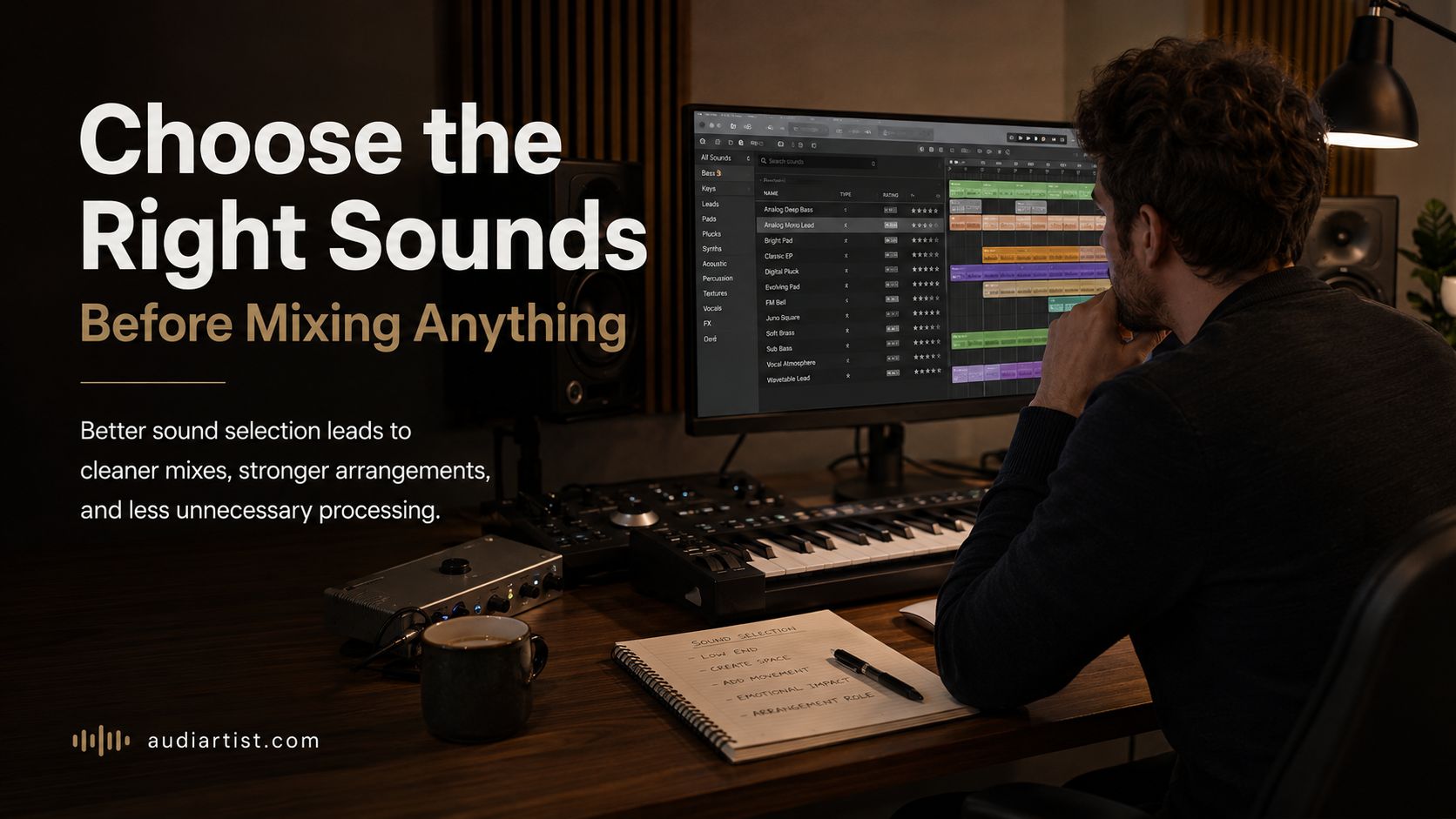

Most beginner producers discover mixing too early and sound selection too late.
A great mix starts before mixing. It starts when you choose the kick, the bass, the main chord sound, the lead, the vocal texture, the percussion, the atmosphere, and every small detail that enters the arrangement. Sound selection is not a beginner detail. It is one of the most important production decisions you will ever make.
The right sound can sit in the track almost immediately. The wrong sound can survive 40 minutes of EQ, compression, saturation, stereo widening, transient shaping, and emotional bargaining with your DAW, and still sound wrong.
This article is about making better choices before the mixing stage begins. Because when the source is right, the mix becomes simpler, faster, cleaner, and more musical.
Sound Selection Is the First Mix Decision
Before you touch an EQ, every sound already has a role. A kick has weight, attack, length, tone, and attitude. A bass has movement, sub information, midrange character, and rhythm. A piano has brightness, body, sustain, noise, and emotion. A synth lead has presence, edge, width, and identity.
When sounds are chosen well, they do not need to fight for space. They naturally occupy different areas of the arrangement. The kick gives impact. The bass gives foundation. The chords provide harmony. The lead gives focus. The percussion gives movement. The effects create depth. Each sound has a job.
When sounds are chosen badly, every element wants the same space. The kick and bass collide. The synth and vocal fight. The pads cover the drums. The percussion makes the groove messy. The reverb hides the hook. At that point, mixing becomes a rescue mission.
A better question is not “How do I fix this sound?”
The better question is: “Why did I choose this sound in the first place?”
The Problem With Mixing Too Soon
Mixing too soon can make a producer lose perspective. You may spend 20 minutes shaping a snare that never had the right tone. You may overprocess a bass that does not support the groove. You may try to make a synth sound expensive when it simply has the wrong envelope, wrong octave, or wrong texture for the track.
This is why experienced producers often move faster than beginners. They are not always using magical plugins. They are choosing better sounds earlier.
Good sound selection reduces the need for correction. A well-chosen kick may only need volume balance. A solid bass patch may need a small EQ move instead of a full surgical operation. A strong vocal texture may sit with simple compression and a tasteful send. A great pad may need less width, not more.
The less you need to repair, the more you can focus on emotion, groove, arrangement, and impact.
The Three Questions Every Sound Must Answer
Before adding a sound to your track, ask three questions.
1. What Is Its Role?
Every sound must have a purpose. Is it the hook? Is it supporting the groove? Is it adding rhythm? Is it creating atmosphere? Is it filling a transition? Is it carrying emotion? If you cannot define the role, the sound may not belong.
A sound without a role becomes clutter. Clutter becomes mud. Mud becomes another EQ tutorial at 1 a.m.
2. Where Does It Live?
Every sound occupies space in frequency, stereo width, depth, and rhythm. A sub bass lives low. A vocal often lives in the midrange. Hi-hats live high. Pads may live wide and behind. Leads often need front-facing presence.
If two sounds live in exactly the same area and play at the same time, one of them must change. That change can be a new sound, a different octave, a different rhythm, a smaller arrangement, or a clearer role.
3. Does It Work Before Processing?
A sound does not need to be perfect raw, but it should be close. If a sound only works after five plugins, it may not be the right sound. A strong production usually comes from sounds that already point in the right direction before the mix chain begins.
Processing should refine the choice, not justify it.
Choose the Kick Before You Choose the Mix
In many genres, the kick is not just a drum. It is the engine. In house, techno, afro house, EDM, pop, hip-hop, trap, and many electronic styles, the kick determines the weight, energy, and physical identity of the track.
A kick has several important qualities:
- Attack: how clearly it cuts through the mix.
- Body: the main low-mid weight.
- Sub: the deepest part of the sound.
- Length: how long the kick rings after the hit.
- Tone: whether it feels clean, dusty, acoustic, synthetic, soft, aggressive, or club-focused.
If your kick is too long, it may fight the bass. If it is too short, the track may lose weight. If it has too much low-mid body, the mix may feel boxy. If it lacks attack, it may disappear on small speakers.
Instead of fixing the wrong kick, audition better ones in context. Play the kick with the bass. Play it with the main groove. Do not judge it alone. A kick that sounds huge by itself may be too large for the track. A kick that sounds simple alone may fit perfectly in the arrangement.
Bass Selection: The Foundation Is Not Just Low End
A bass sound must work rhythmically, harmonically, and sonically. Beginners often think bass is only about sub frequencies, but a strong bassline also needs midrange identity, movement, note length, and relationship with the kick.
Ask yourself:
- Does the bass support the groove?
- Can the bass be heard on small speakers?
- Does it leave room for the kick?
- Is the note length too long or too short?
- Does the tone match the genre?
- Is the bass emotional, aggressive, warm, dry, dirty, clean, or deep?
A bass that works in solo may fail in the track. Always choose bass sounds while the drums are playing. In dance music, the kick and bass relationship is more important than the bass patch alone.
Sometimes the solution is not EQ. It is choosing a bass with a different envelope, a shorter release, a clearer midrange, or a less crowded low end.
Chords and Pads: The Danger of Beautiful Sounds
Beautiful sounds can be dangerous. A huge pad may feel inspiring alone, but it can swallow the entire production. A wide piano may sound emotional in solo, then destroy the vocal space. A rich synth chord may create harmonic magic, then make the mix feel cloudy.
When choosing chords and pads, listen for density. Dense sounds often contain wide stereo information, long release tails, low-mid energy, modulation, reverb, and harmonic complexity. That can be wonderful, but only if the arrangement has room for it.
Before using a big chord sound, ask:
- Does this sound leave space for the vocal or lead?
- Is the low-mid range too full?
- Does the reverb belong to the sound, or should I use my own send?
- Is the stereo width helping the track or masking other elements?
- Could a simpler sound create more impact?
Professional production is often not about choosing the biggest sound. It is about choosing the sound with the right size.
Lead Sounds: Identity Beats Complexity
A lead sound does not need to be complicated. It needs identity. The listener should recognize it, remember it, or feel its presence. A good lead can be a vocal chop, a synth line, a guitar phrase, a piano motif, a pluck, a sax texture, a sample, or even a processed one-shot.
The best lead sounds usually have a strong front edge. They speak quickly. They have enough tone to be remembered. They do not rely entirely on effects to become interesting.
When choosing a lead, test it at low volume. If it still catches your ear quietly, it probably has character. If it only feels exciting when it is loud, the sound may not be strong enough.
Sound Selection and Arrangement Are Connected
A weak arrangement often creates bad sound choices. If a track feels empty, the beginner response is usually to add more sounds. More pads. More percussion. More synths. More risers. More ear candy. More chaos wearing a producer hoodie.
But sometimes the arrangement needs better contrast, not more layers.
Before adding another sound, try removing something. Mute the pad during the verse. Keep the bass out of the intro. Let the drums breathe before the drop. Use a smaller sound in the breakdown so the main section feels larger. Make the hook clear instead of decorating around it.
Good sound selection is not just about what you add. It is about what you refuse to add.
The “One Job Per Sound” Method
A simple way to improve your productions is to give every sound one main job.
- The kick delivers impact.
- The bass delivers foundation and groove.
- The snare or clap defines the backbeat.
- The hi-hats create motion.
- The chords define harmony.
- The lead carries attention.
- The atmosphere creates depth.
- The FX guide transitions.
When a sound tries to do too many things, it may create confusion. A bass that is too wide, too bright, too busy, and too long can dominate the track. A pad with too much movement can distract from the lead. A percussion loop with too much rhythm can fight the main groove.
Clarity comes from role separation.
Useful Tools for Better Sound Selection
You do not need hundreds of plugins to choose better sounds. You need a few tools that help you audition, organize, and understand your source material. These tools are especially useful for beginners who want to move faster without falling into the plugin collector trap.
ADSR Sample Manager
ADSR Sample Manager is a free sample management tool that helps you search, tag, preview, and organize samples directly from your own library. For sound selection, this is powerful because speed matters. If it takes 20 minutes to find a kick, the creative flow starts leaking out of the session.
Best use: finding drums, one-shots, loops, percussion, FX, and samples faster.
Production tip: Create custom tags such as “short kick,” “warm clap,” “dark percussion,” “dry vocal chop,” or “small room texture.” Your future self will thank you. Possibly with coffee.
Official website
Download ADSR Sample Manager
Decent Sampler
Decent Sampler is a free sample player that opens a large world of expressive, characterful instruments. It is especially useful when you need musical textures that feel more organic than standard synth presets. Pianos, strings, mallets, ambient layers, lo-fi instruments, and experimental libraries can all become strong arrangement colors when chosen carefully.
Best use: emotional pianos, organic textures, cinematic layers, lo-fi instruments, unusual sampled sounds.
Production tip: Do not choose a beautiful instrument just because it is beautiful. Choose it because it supports the track. A gorgeous piano in the wrong arrangement is still the wrong piano, but with better manners.
Official website
Download Decent Sampler
Spitfire Audio LABS
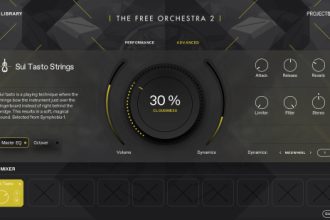
Spitfire Audio LABS gives producers access to expressive sounds with a strong emotional character. It can be useful for ambient music, lo-fi, cinematic pop, organic electronic music, and any production that needs texture rather than another aggressive synth preset.
Best use: soft pianos, strings, pads, atmospheric instruments, cinematic details, emotional layers.
Production tip: LABS sounds often carry a lot of mood. Use them where the arrangement needs feeling, not where it only needs filler.
Official website
Download / Install via Spitfire Audio App
TX16Wx Software Sampler
TX16Wx is a free software sampler for producers who want more control over their own samples. It allows you to build instruments, map sounds, shape playback, and treat samples as playable material rather than static audio files.
Best use: creating custom sampled instruments, drum mapping, one-shot design, experimental sampling, playable textures.
Production tip: If you keep using the same one-shots, turn them into playable instruments. A single strong sample can become a bass, a pad, a percussion layer, or a hook if you design it properly.
Official website
Download TX16Wx
Splice INSTRUMENT
Splice INSTRUMENT is useful for producers who want fast access to playable sounds directly inside the DAW. The main advantage is not just having more presets. It is being able to audition musical colors quickly, then commit to the sound that best supports the track.
Best use: playable instruments, quick sound exploration, textures, keys, synths, drums, and production sketches.
Production tip: Browse with a goal. Search for “soft keys,” “dark pluck,” or “warm texture,” not “something cool.” “Something cool” is how two hours disappear, and nobody has ever found them again.
Official website
Download Splice INSTRUMENT
The 60-Second Sound Test
When you are choosing sounds, do not overthink every option. Use a fast test.
- Play the sound in the context of the track.
- Lower the volume until it sits naturally.
- Check whether it supports the groove or distracts from it.
- Listen on small speakers or low volume if possible.
- Mute it and ask whether the track becomes better or worse.
If the track improves when the sound is muted, the sound is not adding value. That may sound obvious, but many producers keep sounds because they spent time finding them. Time spent is not a musical argument.
Frequency Awareness Without Overthinking
You do not need to become a frequency scientist to choose better sounds, but you should understand basic space.
- Sub range: kick, sub bass, deep impacts.
- Low-mid range: warmth, body, mud risk.
- Midrange: vocals, leads, guitars, synth identity.
- Upper mids: presence, attack, bite, harshness risk.
- Highs: air, sparkle, hats, noise, brightness.
If every sound is warm, the track becomes muddy. If every sound is bright, the track becomes tiring. If every sound is wide, nothing feels centered. If every sound is huge, nothing feels huge.
Contrast is the secret. A deep bass feels deeper when the top end is clear. A wide pad feels wider when the kick, bass, snare, and vocal have a strong center. A bright lead feels more powerful when not every element is fighting in the same frequency range.
Choose Sounds in Context, Not in Solo
The solo button is useful, but dangerous. It lies beautifully.
A sound that feels incredible alone may be too large, too wet, too wide, too bright, too long, or too busy in the track. A sound that feels almost boring alone may be perfect once the groove, vocal, and bass are playing.
Professional producers judge sounds in context. They care less about how impressive a sound is alone and more about how quickly it supports the record.
Use solo to identify problems. Use context to make decisions.
Layering: Add Character, Not Confusion
Layering can make productions sound rich, but bad layering creates mud. Before layering, decide what each layer contributes.
- One layer adds attack.
- One layer adds body.
- One layer adds width.
- One layer adds texture.
- One layer adds sub.
If two layers do the same job, remove one or change it. Layering should create one stronger sound, not a committee meeting of similar noises.
For example, a kick layer can combine a short clicky top with a controlled low-end body. A bass layer can combine a clean sub with a midrange growl. A pad layer can combine a soft harmonic bed with a subtle moving texture.
The goal is a single musical result.
Reverb Is Part of Sound Selection
Many presets come loaded with reverb, delay, chorus, width, and modulation. That can sound inspiring during browsing, but it may create problems later. If every preset arrives already drenched in space, your mix depth becomes hard to control.
When choosing sounds, check whether the built-in effects are helping or hiding the real tone. Sometimes the preset sounds impressive only because the reverb is huge. Turn it down. If the sound collapses completely, it may not be strong enough.
Using your own reverb sends often gives you more control and a more coherent mix. This does not mean you should always remove preset effects. It means you should know what they are doing.
The Small Speaker Test
A strong sound should communicate even when the playback system is not perfect. Many listeners will hear your music through laptop speakers, phones, earbuds, small Bluetooth speakers, cars, and noisy environments.
If the bass disappears completely on small speakers, it may need more midrange content. If the lead becomes harsh, it may have too much upper-mid energy. If the kick loses impact, it may need more attack. If the whole track feels cloudy, the sound selection may be too dense in the low mids.
Do not mix for bad speakers only, but do not ignore them. Real listeners are not always sitting in a treated studio with premium monitors and a spiritual relationship with acoustic panels.
How to Build a Personal Sound Palette
One of the fastest ways to develop a signature sound is to build a personal palette. This does not mean using the same kick forever. It means knowing the types of sounds that fit your artistic direction.
Create folders or tags such as:
- Warm kicks
- Short kicks
- Deep house bass
- Afro percussion
- Lo-fi keys
- Dark synth textures
- Clean claps
- Organic transitions
- Soft leads
- Cinematic noise layers
This makes your workflow faster and your music more coherent. Instead of starting from zero every session, you begin with a curated identity.
Your sound library should not be a warehouse. It should be a well-organized toolbox.
The Producer’s Pre-Mix Sound Selection Checklist
Before mixing seriously, run through this checklist:
- Does every sound have a clear role?
- Does the kick work with the bass?
- Can the main hook be heard clearly?
- Are there too many sounds in the same frequency area?
- Are any presets too wet or too wide?
- Does the arrangement still work when unnecessary layers are muted?
- Are the drums strong before heavy processing?
- Does the bass have enough identity on small speakers?
- Are the chords supporting the track or covering it?
- Does the track feel musical before mixing?
If the answer to several of these questions is no, do not start mixing yet. Choose better sounds, simplify the arrangement, or clarify the roles first.
Final Thoughts: Better Sounds, Easier Mixes
Mixing is not supposed to be a hospital for injured sound selection.
The best productions often sound promising before the mix is polished. The kick already fits. The bass already moves. The chords already support the emotion. The lead already has identity. The drums already create energy. The mix engineer, even if that engineer is you, is not trying to rescue the track from poor choices. They are enhancing what already works.
Before you reach for another EQ, compressor, saturator, stereo widener, transient shaper, or mastering chain, stop and listen to the source. Maybe the problem is not your mix. Maybe the sound simply does not belong.
Choose with intention. Build with contrast. Keep only what serves the track. When the sounds are right, the mix stops feeling like a fight and starts feeling like music.