
Quick Take
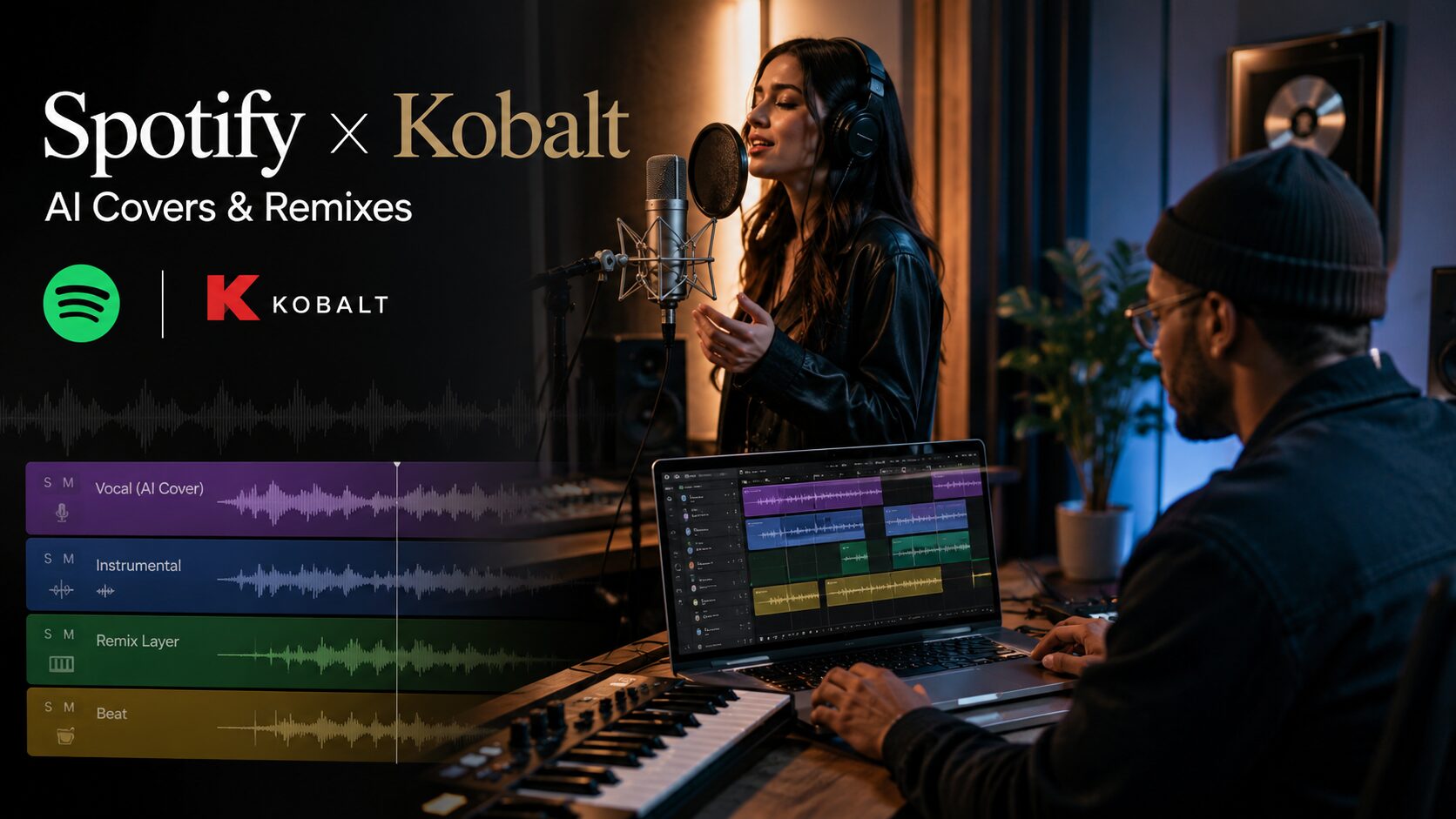
Spotify has signed a new agreement with Kobalt for its upcoming AI-assisted covers and remixes tool. The deal is important because it strengthens the publishing side of the project and brings songwriters more directly into Spotify’s licensed AI strategy.
Spotify is continuing to build the legal and commercial foundations for its future AI music tools. On August 13, the company announced a new licensing agreement with Kobalt, the world’s largest independent music publisher, for its upcoming product that will allow fans to create AI-assisted covers and remixes from songs by participating songwriters.
The tool will be offered as a paid add-on for Spotify Premium users. According to Spotify, the model is built around consent, credit and compensation. The company also says every creation made with the tool will direct listeners back to the original song.
This is a strategically important development. After earlier agreements with Universal Music Group and Merlin, Spotify is now adding one of the most essential missing pieces: publishing rights and songwriter participation. That gives the platform a stronger position as it prepares to launch a user-facing AI music feature without repeating the legal confusion that has surrounded other AI music platforms.
Key Points
| Company | Spotify |
|---|---|
| New partner | Kobalt |
| Announcement date | August 13, 2026 |
| Tool type | Licensed AI-assisted covers and remixes |
| Access model | Paid add-on for Premium users |
| Core principles | Consent, credit and compensation |
| Main strategic value | Adds publishing rights and songwriter support |

Photo: Pexels
Kobalt Brings the Publishing Side Into Focus
The most important aspect of this agreement is not just the name Kobalt. It is what Kobalt represents.
Any AI tool that allows users to create new versions of existing songs must deal with more than the sound recording. It must also account for the underlying composition, which includes the rights of songwriters and publishers.
That is where Kobalt becomes essential. As the world’s largest independent music publisher, Kobalt gives Spotify stronger coverage on the publishing side of the equation. This matters because a remix or cover may involve a recording, but it begins with a song.
Without publishing participation, an AI remix product risks looking incomplete or legally fragile. With Kobalt on board, Spotify gains added credibility in its effort to present the tool as a properly licensed system rather than a risky experiment.
Editorial Insight
Spotify is not just building an AI feature. It is building a rights-cleared music product. That is why publisher agreements like this one matter as much as label deals.
Spotify Is Building This Product Step by Step
The Kobalt deal follows earlier agreements that already pointed in the same direction.
Spotify previously announced licensing deals with Universal Music Group and Merlin for the same future tool. Those agreements helped secure support from major recorded music rights holders and a broad independent label network.
Kobalt adds another vital layer by bringing songwriters and publishing rights more directly into the project.
Taken together, these deals reveal a clear strategy. Spotify is gradually assembling the licensing structure needed to launch AI-assisted fan creation within a large streaming platform. Rather than rushing a product into the market and resolving disputes later, the company is trying to build the commercial framework first.
This approach clearly contrasts with the turbulence experienced by other AI music services, where lawsuits and licensing disputes often followed the public launch instead of preceding it.

Photo: Pexels
Consent, Credit and Compensation
Spotify has chosen a very deliberate formula to define the project: consent, credit and compensation.
These three ideas are at the center of almost every current debate around AI and music rights.
Consent means that songwriters and artists will not be automatically included. Participation will be voluntary, giving rightsholders the ability to decide whether they want their music involved in this new creative format.
Credit matters because attribution is essential when users create derivative versions of existing songs. Spotify says every creation made with the tool will direct users back to the original track, helping preserve a visible link between the source work and the new version.
Compensation is commercially the most important point. Spotify says participating creators will share in the value generated through these licensed covers and remixes. That makes the tool easier to present as a new monetization opportunity rather than a system that simply extracts value from existing catalogues.
In short, Spotify wants this product to look ethically structured as well as legally secure.
A Paid Add-On, Not a Free AI Experiment
Another revealing detail is the business model. Spotify says the tool will be available as a paid add-on for Premium subscribers.
This suggests that the company sees the feature as more than a novelty. It is being positioned as a premium creative service with commercial value of its own.
A paid access model may also help Spotify in two practical ways. First, it creates an additional revenue stream that can help support the licensing structure behind the tool. Second, it introduces a degree of friction that may prevent unlimited casual use at scale.
That matters because fan creation tools can generate enthusiasm, but they can also raise concerns about volume, moderation and rights management. A premium layer may help Spotify keep the experience more intentional and commercially sustainable.
Why This Matters
- Spotify is proving that AI music products can be built with licensing from the start.
- Songwriters are becoming central to the AI remix economy, not an afterthought.
- Publishing rights are now a key part of Spotify’s long-term AI strategy.
- The company is treating fan-made remixes and covers as a real commercial format.
A New Type of Fan Engagement
There is also a broader product vision behind this strategy.
Fan-made covers and remixes have always existed in music culture. What Spotify wants to do is bring that behaviour inside a licensed platform environment, where it can be monetized, tracked and connected directly to the original work.
If successful, this could create a new layer of engagement between listeners and music catalogues. Fans would not only stream songs. They would also interact with them creatively, within boundaries approved by rights holders.
That is potentially valuable for everyone involved. Spotify gains a new premium feature. Fans get new creative tools. Songwriters and artists gain exposure, attribution and a share of the value generated through those interactions.
It also reflects a bigger shift in streaming. Platforms are no longer focused only on delivering access to music. They are increasingly exploring ways to turn music into an interactive product experience.
Why This Looks More Controlled Than Suno or Udio
The contrast with the more chaotic side of the AI music world is impossible to ignore.
Suno and Udio became major names in the sector partly because they made AI music creation instantly accessible. But that rapid growth also came with a wave of copyright disputes, licensing criticism and broader legal uncertainty.
Spotify is clearly trying to avoid that path.
Its method is more deliberate. Instead of launching first and negotiating later, the company is building a licensed ecosystem before introducing the user-facing product. That does not eliminate every future controversy, but it gives Spotify a much stronger starting position.
It also allows the company to frame the tool as a collaboration with the music industry rather than a disruption imposed on it.
What Comes Next
The Kobalt deal is another strong signal that Spotify is moving steadily toward launch, but several key details remain unknown.
The company has not yet given a release date for the feature, nor has it fully explained how the user experience will work in practice. It is also still unclear how large the initial licensed catalogue will be and how wide participation will be at launch.
Even so, the strategic direction is becoming much clearer. Spotify is not experimenting casually with AI covers and remixes. It is building a licensed product system that aims to include labels, publishers, songwriters and users under one commercial model.
That makes this more than a simple partnership announcement. It is another step toward a future where streaming platforms do not only host music, but also offer structured tools for fan creativity.
Conclusion
Spotify’s agreement with Kobalt is a major step in the development of licensed AI music products.
By bringing one of the most important publishing partners into the project, Spotify strengthens the songwriting side of its future covers and remixes tool and makes the product far more credible from a rights perspective.
Most importantly, the deal shows that Spotify is trying to define a model where AI-assisted music creation happens through consent, credit and compensation, not through legal improvisation.
If the platform succeeds, it may help establish what a properly licensed AI remix ecosystem can look like inside global streaming.