
Quick Take
Suno has signed a global strategic alliance with BMG covering recorded music and publishing rights. Participating artists and songwriters will be compensated, and the agreement also settles prior use of BMG repertoire. But behind the positive language around licensing and artist choice, major questions remain about past AI training, compensation transparency, market power and whether licensing deals truly solve the wider problems created by generative music.
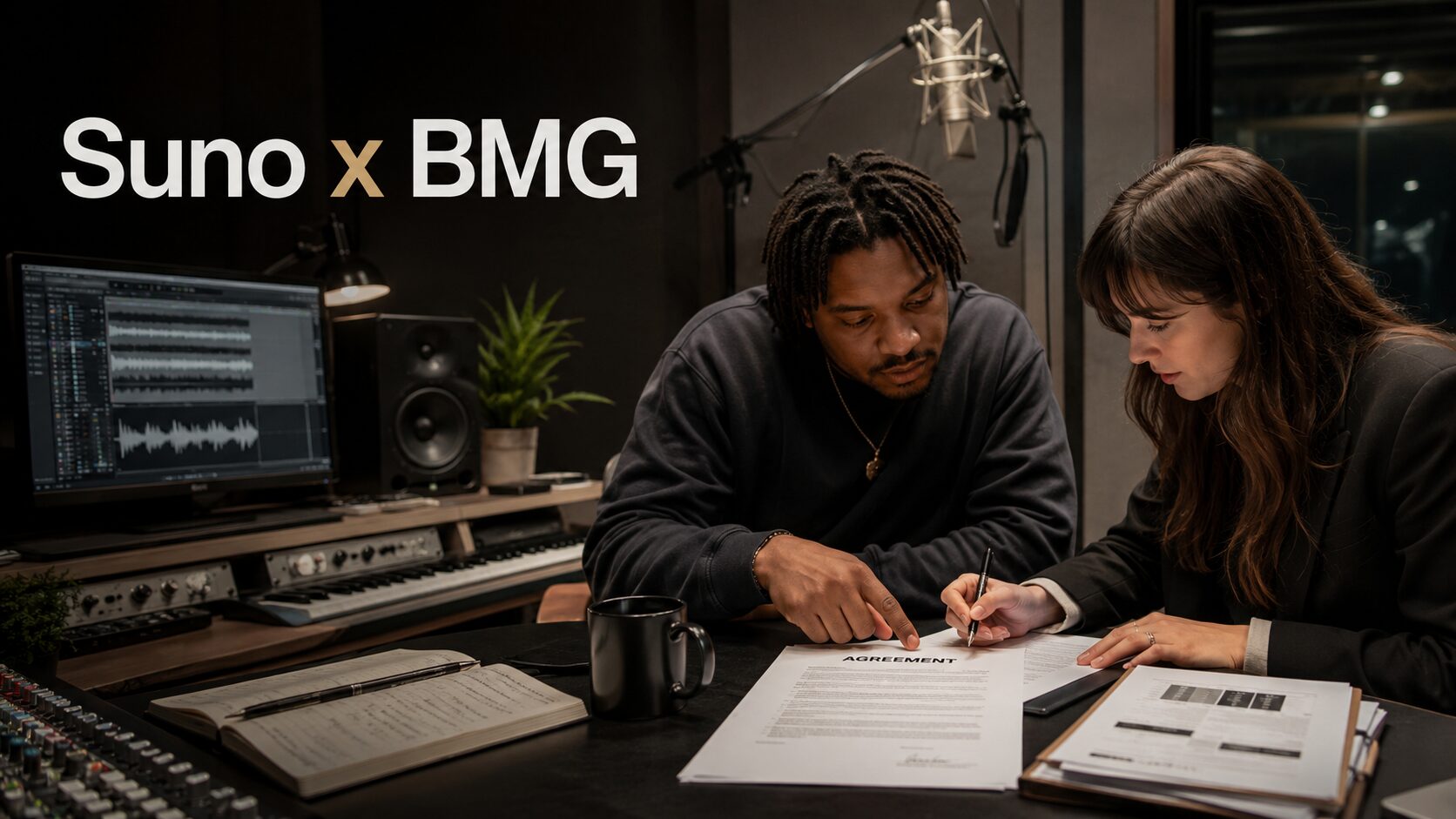
Suno is moving rapidly from courtroom controversy toward formal partnerships with the music industry. On August 12, the AI music company announced a global strategic alliance with BMG covering both recorded music and music publishing repertoire.
The deal will contribute to Suno’s upcoming generation of music models developed with music industry partners. BMG says artists and songwriters who choose to participate will have their rights protected and receive compensation for the use of their music. The agreement also settles prior use of BMG recordings and publishing works.
On paper, this looks like progress. Artists get a choice. Rights holders get paid. Suno gains access to licensed music instead of operating entirely inside the legal uncertainty that defined the early generative AI boom.
But the agreement also raises uncomfortable questions.
How much will creators actually receive? What exactly happened with their music before the deal? And does signing a licensing agreement today erase the controversies surrounding how AI models may have been trained yesterday?
Key Facts
| Companies | Suno and BMG |
|---|---|
| Announcement | August 12, 2026 |
| Rights covered | Recorded music and music publishing |
| Participation | Opt-in for participating BMG artists and songwriters |
| Compensation | Creators who participate are expected to share in the economic value |
| Past use | The agreement settles prior use of BMG recordings and publishing works |
| Future models | Suno is preparing new models developed with licensed music and industry partners |
Photo: Anna Pou / Pexels
From Lawsuits to Licensing Deals
Suno’s relationship with the traditional music industry has changed dramatically.
The company became one of the main targets of copyright litigation after major record companies accused generative music platforms of using copyrighted recordings to train their systems without permission. Warner Music Group later reached a settlement and partnership with Suno, opening the door to new licensed models and opt-in artist experiences. Universal Music Group and Sony Music remain involved in litigation against Suno.
The BMG deal pushes that transformation further.
Suno is increasingly moving from being viewed purely as a disruptive outsider to becoming a technology supplier and commercial partner for parts of the established music industry.
That shift may help create a more legitimate AI music ecosystem, but it also creates a strange situation: some of the same practices that triggered accusations of copyright infringement can eventually become the foundation for commercial licensing negotiations.
Audiartist Analysis
Licensing is unquestionably better than unauthorized use. But an agreement reached after disputed use is not the same thing as obtaining permission before training begins. The sequence matters.
The Most Uncomfortable Detail: Compensation for Past Use
One sentence in BMG’s announcement deserves particular attention.
The agreement does not only cover future activity. It also settles prior use of BMG recordings and publishing works.
That is important because it strongly suggests that the commercial agreement is doing two jobs at once: establishing future licensing terms and resolving questions around earlier use of BMG-controlled material.
What the announcement does not provide is equally important.
- No public amount has been disclosed for the settlement of prior uses.
- There is no detailed public breakdown of which recordings or compositions were involved.
- The announcement does not explain how compensation for historical use is calculated.
- Individual artists and songwriters are not given a public accounting of the value assigned to their works in those past uses.
For creators, that lack of detail matters. A label or publisher may reach a satisfactory commercial agreement, but the people whose music formed the underlying catalogue may still have limited visibility into how that value was calculated.
Opt-In Is Better, But It Does Not Answer Everything
One of the strongest aspects of the BMG agreement is that participation is described as voluntary. Artists and songwriters can choose whether to participate in the new AI opportunities being developed by the companies.
That is a significant improvement over a system where copyrighted catalogues could simply be absorbed into training datasets without meaningful creator control.
But opt-in alone does not answer every question.
Creators still need to know exactly what they are opting into. Does permission cover model training only? Can outputs imitate recognizable musical characteristics? Can names, voices or likenesses be used? Can permission later be withdrawn? What happens to a model that has already learned from a work if an artist leaves the program?
The public BMG and Suno announcements describe strong protections and new economic opportunities, but they do not provide a detailed technical explanation of how every one of these scenarios will be handled.
Photo: Anna Pou / Pexels
Licensing Does Not Automatically Solve the Training Debate
Another problem is the distinction between future licensed models and models that already exist.
Suno says the BMG partnership is connected to its first music model developed with the music industry. The company has also previously announced plans to build new generations of models using licensed music.
This is a positive change, but it does not automatically settle the broader question of how earlier Suno models were created.
Replacing old models with newly licensed ones may improve the legal foundation going forward. It does not necessarily provide the public with a complete history of previous training datasets, which works were used, how often they were represented or how much influence individual recordings had on model behaviour.
That distinction is important. A licensed future should not make scrutiny of the unlicensed or disputed past disappear.
Will Artists Receive Meaningful Compensation?
BMG says participating artists and songwriters will share in the value created by these new AI experiences.
The principle sounds good. The economics remain far less clear.
Neither BMG nor Suno has publicly disclosed detailed royalty rates in the announcement. We do not yet know how compensation will compare with traditional streaming royalties, synchronization licensing, sampling fees or other established sources of music income.
There is also a fundamental question of scale.
If one licensed recording helps train a model that can subsequently generate millions of new pieces of music, how should the value of the original work be measured?
Should creators receive a one-time licensing payment? A recurring training royalty? A share every time a model produces something influenced by their work? Or a combination of those models?
The industry still does not have a universally accepted answer.
The Main Concerns
- Financial transparency: exact creator compensation has not been publicly detailed.
- Past training: the agreement resolves previous BMG uses without publicly explaining the full dataset history.
- Market power: major rights holders can negotiate deals that independent artists may never be able to negotiate individually.
- Attribution: identifying exactly which songs influenced a generated output remains technically difficult.
- Competition: licensed AI could dramatically increase the amount of music competing with human releases.
- Creative identity: licensing a catalogue does not automatically eliminate concerns about imitation of style, sound or artistic identity.
AI Music Could Still Flood the Market
Even properly licensed AI music creates another major problem: volume.
Generative systems can produce music far faster than human musicians can traditionally write, record and release it. Licensing does not change that technological reality.
If AI-generated music becomes legally safer and commercially accepted, the total volume of synthetic releases could increase dramatically.
This matters for independent musicians because streaming platforms already contain enormous catalogues competing for a finite amount of listener attention.
A licensed AI track may no longer carry the same copyright concerns as an unauthorized one, but it can still compete with human musicians for playlist space, recommendation slots, user attention and streaming revenue.
Suno itself has recently announced watermarking, fingerprinting and new download restrictions intended to reduce spam and mass distribution. Those measures acknowledge that large-scale AI music production can create problems even when the technology itself is legitimate.
A Two-Tier Music Industry?
There is another risk that receives less attention.
Large music companies can negotiate directly with AI platforms. They have lawyers, global catalogues, data infrastructure and bargaining power.
An independent songwriter with a few thousand streams does not have the same leverage.
If generative AI licensing becomes dominated by large catalogue deals, the industry could create a two-tier system where major rights holders negotiate sophisticated AI revenue agreements while smaller musicians receive generic platform terms or are excluded entirely.
That would be ironic. Generative AI is often promoted as a democratizing technology, yet its licensing economy could become highly concentrated around companies controlling the largest catalogues.

Photo: Jeremy Enns / Pexels
BMG Is Betting That AI Cannot Simply Be Ignored
BMG’s decision also reflects a pragmatic reality.
AI-generated music is not disappearing. Rights holders therefore face a choice between fighting every platform indefinitely or negotiating systems that give creators some level of control and compensation.
BMG has chosen the second route with Suno.
The company says that artist choice should remain central and that creators must participate in the economic value generated by AI.
There is logic in that position. A regulated, licensed AI ecosystem is probably preferable to an uncontrolled market where copyrighted music is used without permission and creators receive nothing.
But licensing should not become a convenient way to avoid discussing the deeper consequences of generative music.
The Deal Does Not End Suno’s Legal Problems
The BMG agreement also should not be interpreted as a complete resolution between Suno and the wider music industry.
Universal Music Group and Sony Music continue to pursue claims against Suno over alleged copyright infringement, while Germany’s GEMA recently obtained a court victory concerning Suno and protected musical works.
That creates an unusual situation in which Suno is simultaneously a litigation opponent for some major rights holders and a licensed commercial partner for others.
This is likely to become increasingly common as the music industry tries to balance legal enforcement with the possibility of new AI revenue.
From Disruptor to Industry Supplier
The strategic change is nevertheless remarkable.
In a relatively short period, Suno has moved from being discussed primarily as a company threatening existing music rights to becoming a technology partner for Warner Music Group and now BMG.
The direction suggests that the AI music battle may gradually shift away from a simple question of whether generative music should exist.
The next battle may instead be about who controls it, who licenses it and who gets paid.
That could ultimately be even more important.
Conclusion
The Suno-BMG agreement represents genuine progress toward a more structured AI music market. Opt-in participation, licensing and creator compensation are far preferable to the unrestricted use of protected music.
But the deal should not be presented as proof that the difficult questions have been solved.
We still do not know the detailed economics offered to individual creators. We still lack complete transparency around the music used to build earlier models. We still do not know how a future flood of legally licensed AI music will affect human artists competing for attention.
And perhaps most importantly, there is a risk that large corporate licensing agreements gradually transform a controversial practice into an accepted industry standard before creators have fully agreed on what fair compensation should actually look like.
Suno may be becoming more legitimate. That does not automatically mean the underlying problems of AI-generated music have disappeared.