
FILT-R by Tiago Lourenço, also known as TiagoLr or Tilr, is a free open-source filter modulation plugin designed for producers who want rhythmic movement, animated frequency shaping and detailed envelope control inside a DAW. Rather than behaving like a conventional static filter, FILT-R turns cutoff and resonance into programmable modulation targets that can follow the host tempo, respond to MIDI, react to audio transients or move freely at an LFO rate.
The plugin became especially relevant again in July 2026 with version 1.3.0, an update that added 28 filter models from QuadMorphFilter and expanded the collection to 34 filter types. That gives FILT-R a broad sonic range, from familiar low-pass movement and acid-style sweeps to resonant, phasing and morphing effects.

What Is FILT-R?
FILT-R is an audio effect built around an editable modulation envelope. The envelope can control filter cutoff, resonance or both, creating movement that would otherwise require several automation lanes. Producers can draw custom shapes, use tempo-synced patterns, generate sequences, randomize modulation or trigger envelopes from incoming audio and MIDI.
The developer describes FILT-R as the second version of the earlier FLTR-1 JSFX for REAPER. The current plugin is cross-platform and available in VST3 and LV2 formats for Windows, macOS and Linux, with an additional AU version for macOS.
FILT-R is a complete open-source release hosted on the developer’s official GitHub repository, not a temporary giveaway or restricted demo. No subscription, trial period, account registration or license manager is documented.
Why Version 1.3.0 Matters in 2026
Version 1.3.0 is a meaningful update. The addition of 28 filter models expands the total to 34 filter types with different modes and slopes. Earlier updates also added frequency splitting, stereo offset and improved metering response.
These additions make the plugin useful for contemporary production, where filter movement often works as both sound design and arrangement. A sweep no longer needs to be a simple rise before a drop. It can alternate between frequency regions, move differently across the stereo image or create repeated rhythmic accents inside one bar.
This approach suits Afro House, Amapiano, Hardgroove, Hypnotic Techno, UK Garage, Drum and Bass, Alternative Pop and experimental electronic music, all styles where changing texture and syncopated movement can carry as much energy as another melodic layer.
How the Modulation Engine Works
Editable Cutoff and Resonance Patterns
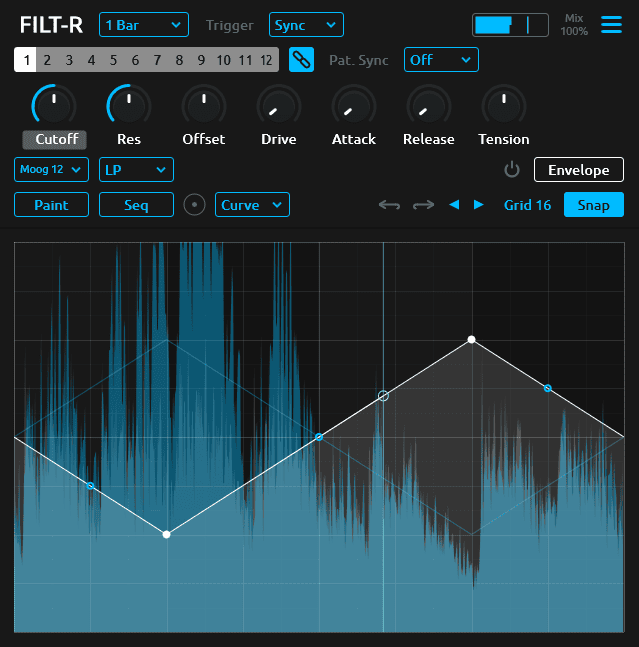
FILT-R provides 12 pattern slots for cutoff and resonance modulation. Patterns are edited in the main graph, where points define movement over time. The plugin supports several point behaviors, including hold, curve, S-curve and stair-style transitions, making smooth sweeps, sharp rhythmic cuts and stepped sequences possible.
Multiple points can be selected, moved, scaled and skewed. When a pattern has the right rhythm but needs more tension or a shorter rise, producers can reshape the selected points instead of redrawing the full envelope.
Paint Mode and Reusable Shapes
Paint mode offers a faster way to build complex modulation. The developer documents 32 editable shapes that can be resized and inserted into the main pattern. They are stored in the plugin settings and shared between instances, allowing producers to build a personal library of pumping curves, triplet sweeps and stutter movements.
This can turn a static pad into a breathing arrangement without adding another automation lane that looks like a seismograph.
Sequencer, Randomization and Synchronization
The built-in sequencer lets users construct modulation sequences and apply randomization. Pattern changes can be synchronized to the host playback position, reducing awkward transitions when switching shapes during a track.
Modulation can run in tempo-synced mode or at an LFO rate in hertz. Attack and release smoothing soften abrupt changes, while pre and post waveform displays provide visual feedback.
Audio and MIDI Triggering
In audio trigger mode, transients can restart the envelope or trigger its cycle. FILT-R includes a simple envelope-following method and a drum-oriented mode based on short-term energy. A sidechain signal can also be used as the trigger input.
A kick can therefore trigger filter movement on a bass or pad, while a percussion loop can drive an evolving pattern on a texture bus. The result can remain connected to the groove without simply copying the volume shape of sidechain compression.
MIDI notes can trigger or restart envelopes, select patterns and control changes from a chosen MIDI channel. This makes FILT-R useful for live switching, programmed transitions and arrangement changes controlled from a MIDI clip.
The Sound of the 34 Filter Models
The original collection includes 303-style, MS-20-style and linear filters, a ladder filter adapted from JUCE, plus analog Sallen-Key and phaser designs based on code from the Vital synthesizer project. Version 1.3.0 adds 28 models from QuadMorphFilter.
Some models suit smooth tonal reduction, while others emphasize resonance, character or more aggressive movement. Drive adds extra intensity, and stereo offset can introduce differences between the left and right channels. Used carefully, it can widen pads and effects. Used carelessly, it can turn a hi-hat loop into an argument between two loudspeakers.
Practical Uses in Modern Production
- Afro House and Amapiano: Add subtle cutoff pulses to pads, shakers, log-drum layers and atmospheric loops.
- Hardgroove and Hypnotic Techno: Build repeating resonant movement on percussion buses, synth stabs and noise layers.
- Hard Techno and Acid: Animate distorted basses, 303-style sequences and transition effects with resonance and drive.
- UK Garage, Jungle and Drum and Bass: Trigger short filter shapes from break transients or reshape sampled loops around the groove.
- Alternative Pop and R&B: Add controlled motion to vocal effects, guitars, keys and background textures.
- Ambient and cinematic music: Use slower free-rate modulation on drones, reverbs and evolving pads.
FILT-R works on individual tracks, buses and effect returns. Drums benefit from short rhythmic envelopes, synths respond well to detailed cutoff and resonance shapes, and reverbs become animated when the plugin is placed after them. On a full mix, conservative settings are recommended because resonant movement can quickly alter the tonal balance.
Workflow and Interface
The main controls remain visible: cutoff, resonance, offset, drive, attack, release and tension sit above the modulation editor. Filter selectors, Paint, Sequencer, curve choice, grid and snapping tools are accessible without opening several pages.
A practical starting point is to choose a filter, set moderate resonance, select a synchronized duration and draw a simple curve. Once the movement works, add drive, stereo offset, audio triggering or more detailed point shapes.
The repository does not document a conventional factory preset browser or a published preset count. The main reusable elements are the 12 pattern slots and editable paint shapes. Producers expecting hundreds of named presets will need to build their own starting points, but FILT-R is clearly designed around direct pattern creation.
Formats, Systems and Download Conditions
- Plugin formats: VST3 and LV2 for Windows, macOS and Linux, plus AU for macOS.
- Current version: FILT-R 1.3.0, released in July 2026.
- Price: Free and open source.
- License: AGPL-3.0.
- Registration: No account or email registration is documented.
- Activation: No license manager or online activation is documented.
- Host requirement: A compatible DAW or audio host supporting one of the available formats.
The macOS build instructions include Intel x86_64 and Apple Silicon arm64. The main repository does not separately publish processor architecture details for Windows and Linux packages.
Mac users should note that the developer describes the macOS builds as unsigned and untested. Depending on the security settings, the quarantine flag may need to be removed manually. CLAP is planned rather than currently available, and no AAX version is documented.
Visit the official FILT-R repository for product information, documentation and source code. The latest packages are available from the official FILT-R Releases page.
License and Commercial Music Use
FILT-R is distributed under the AGPL-3.0 license. The repository does not document a restriction on releasing music created with the plugin. Producers can use it as an effect in a DAW, while anyone planning to modify, bundle or redistribute the software should read the full license terms.
Important Limitations
FILT-R is not a replacement for a corrective parametric EQ. The repository does not advertise linear-phase processing, oversampling options, a standalone application or a large factory preset library.
Extreme resonance, drive and rapid stereo movement should be checked at realistic listening levels. Mac installation may require extra security steps, and the developer openly states that macOS builds are not tested on dedicated hardware.
Final Verdict
FILT-R is one of the more capable free filter modulation plugins available in 2026. Its 34 filter types, editable envelopes, paint shapes, sequencer, randomization, audio triggering, MIDI control, stereo offset and cross-platform formats give it genuine production value.
It is especially useful for electronic producers who want rhythmic frequency movement without drawing endless automation, but it also fits pop, R&B, cinematic and ambient workflows. The interface takes some exploration, the macOS build carries clear caveats and preset hunters may need to create their own library. Even so, FILT-R offers an unusually deep modulation system for a completely free open-source plugin.