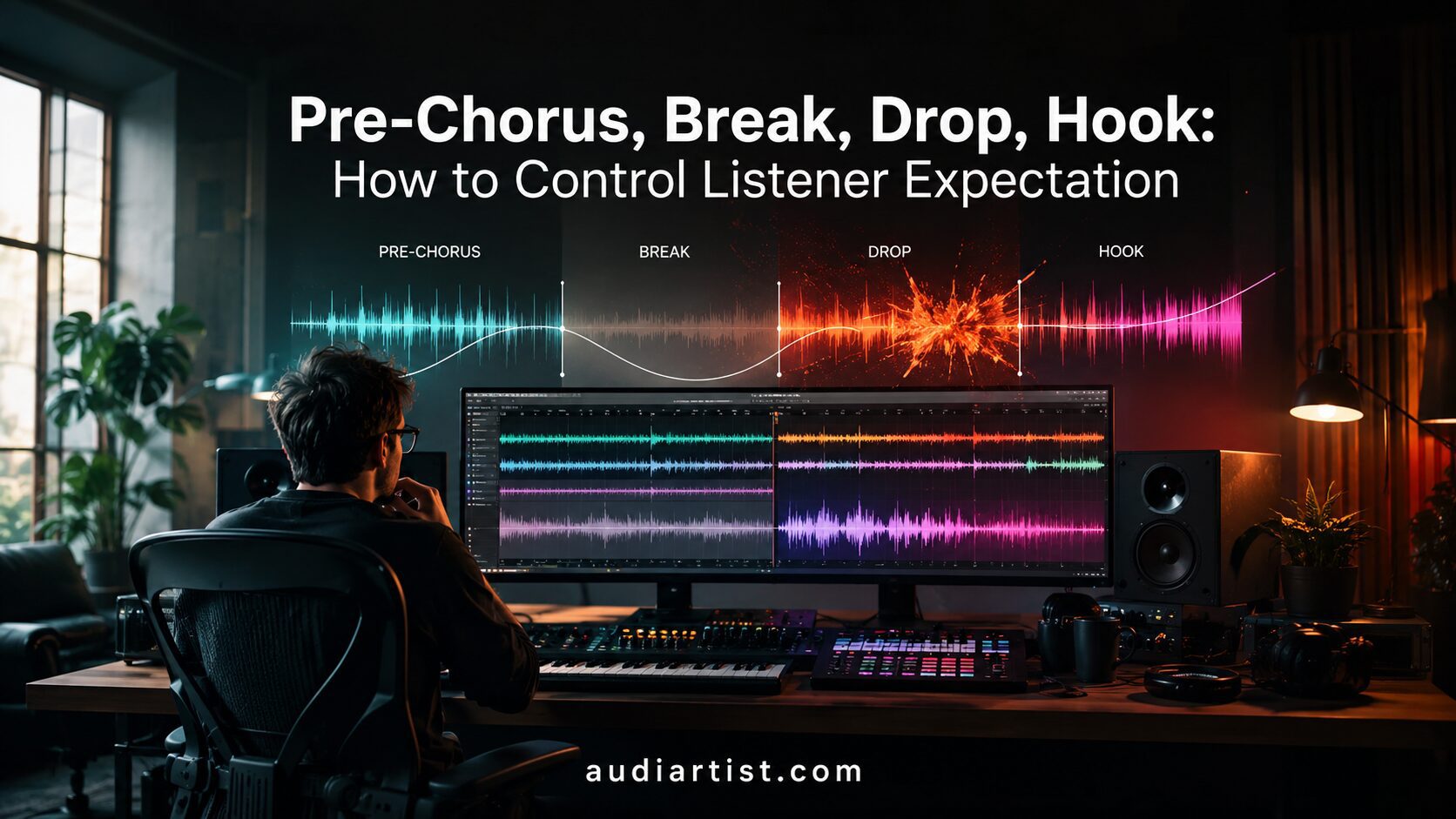

This is where listener expectation becomes one of the most powerful tools in music production.
Beginners often build tracks like they are stacking blocks. Intro, verse, chorus, drop, breakdown, outro. Everything is technically there, but the song does not pull the listener forward. The sections arrive, but they do not feel inevitable. The hook appears, but nobody was waiting for it. The drop hits, but the body was not prepared. The break happens, but the return has no emotional weight.
Controlling expectation means shaping the listener’s attention before every important moment. It means knowing when to promise, when to delay, when to reduce, when to reveal, and when to deliver.
Whether you produce pop, house, afro house, tech house, EDM, trap, hip-hop, lo-fi, synthwave, cinematic music, or experimental electronic music, expectation is the invisible structure that makes a track feel alive. It is the difference between a section change and a musical event.
What Is Listener Expectation?
Listener expectation is the sense that something is about to happen. It is created through repetition, tension, contrast, rhythm, harmony, silence, sound design, arrangement, dynamics, and timing.
When a listener hears a repeated phrase, they expect it to return. When the low end disappears, they expect it to come back. When a filter opens, they expect energy to rise. When drums drop out, they expect impact. When a vocal phrase stops before resolving, they expect the next line to matter.
Music constantly trains the listener in real time.
Every section tells the listener what to expect next. A good producer uses that expectation carefully. Sometimes you confirm it. Sometimes you delay it. Sometimes you surprise the listener. Sometimes you give them exactly what they want, but at the perfect moment.
The Basic Expectation Formula
Most effective arrangements use a simple emotional formula:
- Establish: introduce the musical idea.
- Repeat: make the listener recognize it.
- Change: create movement or tension.
- Delay: hold back the full payoff.
- Release: deliver the hook, drop, chorus, or return.
This formula works because humans enjoy patterns, but they also enjoy change. Too much repetition becomes boring. Too much surprise becomes confusing. The best arrangements balance familiarity and anticipation.
A hook is stronger when the listener has been prepared for it. A drop hits harder when the section before it has created tension. A break feels deeper when the main groove has already established momentum. A final chorus feels larger when the earlier sections have left room for growth.
Why Hooks Fail Without Setup
A hook can be catchy and still underperform if it arrives without preparation. The listener needs to feel that the track is moving toward something. If the hook simply appears after a loop, it may sound like another section rather than the emotional center of the song.
To set up a hook, the arrangement should create desire.
You can create that desire by:
- Introducing a shorter version of the hook earlier.
- Removing the hook before bringing it back fully.
- Using a pre-chorus or build-up to increase tension.
- Reducing the low end before the hook enters.
- Creating a rhythmic pause before the hook.
- Using a vocal or instrumental phrase that points toward the hook.
- Changing brightness, width, or depth before the hook lands.
The hook should feel like an answer. If there was no question before it, the answer feels smaller.
The Pre-Chorus: The Art of Preparing the Lift
The pre-chorus is one of the clearest expectation tools in modern songwriting and production. It sits before the chorus or main hook and raises the emotional pressure.
A pre-chorus does not need to be complicated. Its job is to make the next section feel necessary.
A good pre-chorus can:
- Increase melodic tension.
- Lift the vocal range.
- Reduce or remove the bass.
- Change the chord rhythm.
- Build drum density.
- Open filters gradually.
- Use shorter phrases.
- Create a harmonic suspension.
- Delay the arrival of the main hook.
The pre-chorus should not steal the chorus. It should point toward it.
Think of it as the hallway before the main room. If the hallway is too crowded, the room feels smaller. If the hallway creates direction, the room feels important.
How to Build a Better Pre-Chorus
Start by identifying what the chorus or hook does best. Is it wider? Brighter? Louder? More melodic? More rhythmic? More emotional? More direct?
Then make the pre-chorus contrast with that.
If the chorus is wide, make the pre-chorus narrower. If the chorus has full bass, remove or reduce the bass before it. If the chorus has a strong lead, hold that lead back. If the chorus is rhythmically full, strip the drums down first. If the chorus is bright, filter the pre-chorus slightly darker and open it gradually.
Pre-chorus production ideas:
- High-pass the drums slightly to reduce weight.
- Remove the kick in the final bar before the chorus.
- Raise the vocal or lead phrase in pitch or intensity.
- Automate a filter opening over 8 bars.
- Shorten the bass notes, then mute the bass before the chorus.
- Use a delayed vocal phrase to bridge into the hook.
- Increase reverb send, then cut it when the chorus lands.
The chorus should feel like the release of the pre-chorus, not just the next part of the timeline.
The Break: Removing Energy to Create Meaning
A break is not simply a moment where things stop. A break is an arrangement decision that changes the listener’s perspective.
Breaks can create intimacy, suspense, emotional contrast, breathing room, or dramatic reset. In dance music, a break can make the drop feel stronger. In pop, it can highlight a vocal. In hip-hop, it can create space before the next verse or hook. In cinematic music, it can shift the emotional scene.
A weak break feels like the track got tired. A strong break feels intentional.
To make a break effective, decide what it is supposed to do:
- Give the listener space.
- Highlight a vocal or melody.
- Remove low-end pressure.
- Create contrast before the return.
- Change the emotional color.
- Build suspense.
- Reset the groove.
Do not remove elements randomly. Remove them with purpose.
How to Make a Break Feel Powerful
The strength of a break depends on what came before and what comes after. A break after a weak section may feel empty. A break after a strong groove can feel dramatic.
Try these moves:
- Remove kick and bass completely for 4 or 8 bars.
- Leave one emotional element, such as vocal, pad, piano, or lead.
- Use more reverb or delay to create distance.
- Make the break narrower or wider depending on the next section.
- Introduce a filtered version of the hook.
- Let a single phrase repeat and build expectation.
- Use silence before the groove returns.
The break should make the listener miss the energy. When the full section returns, the body should feel the difference.
Useful Tool: Valhalla Supermassive
Valhalla Supermassive is a free delay and reverb plugin that can create huge spaces, dreamy echoes, long tails, and cinematic atmosphere. It is especially useful for breaks, pre-drop moments, emotional transitions, and hook preparation.
Use it for: breakdown depth, delay throws, vocal tails, atmospheric build-ups, transition space, emotional pauses.
Expectation tip: Send the final word, lead note, chord stab, or snare hit before a break into Supermassive. Let the tail bloom into the empty space, then cut or reduce the return when the next section lands. This creates tension and release without needing another generic riser.
Official website
Download Valhalla Supermassive
The Drop: Release Must Be Earned
A drop is not powerful only because it is loud. A drop is powerful because the listener was waiting for it.
If the section before the drop is already full, bright, wide, loud, and bass-heavy, the drop has nowhere to go. It may sound technically bigger, but emotionally it will feel flat.
A drop needs contrast.
Before the drop, consider reducing:
- Low-end weight.
- Drum density.
- Stereo width.
- Brightness.
- Reverb clutter.
- Main hook presence.
- Kick stability.
Then, when the drop arrives, restore the foundation with clarity.
The drop should answer the tension. It should not merely be the loudest section. It should feel like the track finally opens.
How to Build a Drop Without Cheap Tricks
You do not need a giant riser before every drop. You need a clear setup.
Try this 8-bar drop preparation:
- Bars 1 to 2: introduce a filtered version of the hook or chord rhythm.
- Bars 3 to 4: reduce bass energy and increase rhythmic tension.
- Bars 5 to 6: open the filter, add a small drum fill, or repeat a vocal phrase.
- Bar 7: remove the kick or bass.
- Bar 8: use silence, a delay throw, or a short impact.
- Drop: return kick, bass, main groove, and hook with confidence.
The most important moment is often not the drop itself. It is the bar before the drop.
The Hook: Make the Listener Remember
The hook is the musical idea that the listener carries away. It can be a vocal line, synth melody, bass phrase, drum groove, chord stab, sample, guitar riff, piano motif, or even a rhythmic pattern.
A strong hook is usually clear, repeated, and placed where the listener expects emotional payoff.
Hook production is not only about writing a catchy phrase. It is about framing it.
To make a hook stronger:
- Reduce competing melodies around it.
- Give it a clear frequency space.
- Let it appear in smaller form before the full version.
- Repeat it enough for recognition.
- Change its treatment between sections.
- Mute it before bringing it back.
- Support it with arrangement contrast.
The hook should feel like the center of attention. If everything else is shouting, the hook becomes just another sound.
Expectation Through Repetition and Variation
Repetition teaches the listener. Variation rewards them.
If a phrase appears once, it is an event. If it appears twice, it becomes familiar. If it appears a third time with a small change, the listener feels development.
This is one of the simplest ways to control expectation.
Try this structure:
- First appearance: simple version of the hook.
- Second appearance: full hook.
- Third appearance: hook with variation, wider support, or stronger rhythm.
- Final appearance: hook with a small twist, call-and-response, or stripped ending.
The listener gets what they recognize, but not in the exact same shape every time.
Useful Tool: Kilohearts Essentials
Kilohearts Essentials is a free collection of practical effects that can help shape expectation through filter movement, delay, reverb, tape stop, distortion, chorus, phaser, flanger, transient shaping, and other fast creative tools.
Use it for: tape stop moments, filter sweeps, delay throws, distortion rises, hook variation, transition processing.
Expectation tip: Use a Kilohearts filter, delay, or tape stop as a one-time arrangement event. Do not leave the effect running everywhere. A small effect at the right moment creates more expectation than constant movement with no purpose.
Official website
Download Kilohearts Installer
Expectation Through Silence
Silence is one of the most effective expectation tools because it creates instant attention. When sound disappears, the listener automatically anticipates what comes next.
Silence works before:
- A drop.
- A chorus.
- A vocal hook.
- A bass return.
- A final section.
- A major drum re-entry.
- A new melodic idea.
A silence can be one beat, half a beat, one bar, or a longer dramatic break. The length depends on genre and energy level.
In club music, a short silence before the drop can create physical impact. In pop, a small gap before a vocal hook can make the phrase feel more important. In lo-fi, a subtle pause can make the groove feel intimate. In cinematic music, silence can create emotional gravity.
Silence is not empty. Silence is the listener holding their breath.
Expectation Through Low-End Control
Low end creates physical expectation. When the kick and bass disappear, the body waits for them to return. When they come back cleanly, the track feels larger.
Use low-end control before major moments:
- Remove bass before the chorus.
- Mute the kick before the drop.
- High-pass the drums during a build-up.
- Let the bass return before the full drums for tension.
- Cut low end during the break.
- Bring the full low end back with the hook.
This technique works because the listener feels the absence physically. A bass return can be more powerful than a loud riser if the setup is clear.
Expectation Through Harmony
Harmony can create expectation without any sound effect. A chord progression can feel unfinished, suspended, unresolved, or ready to open.
Useful harmonic expectation tools include:
- Suspended chords before resolution.
- Holding one chord longer before the chorus.
- Removing the bass note to create uncertainty.
- Using a pre-chorus chord that points toward the hook.
- Changing chord rhythm before the drop.
- Delaying the expected resolution by one bar.
In melodic music, harmonic expectation can be more powerful than production effects. The listener may not know the theory, but they feel the tension.
Expectation Through Rhythm
Rhythm can also prepare the listener. Drum fills, snare rolls, hat density, percussion changes, and groove reduction all tell the body that a new section is coming.
Rhythmic expectation ideas:
- Increase hi-hat activity before the hook.
- Use a small snare fill at the end of 16 bars.
- Remove percussion before a vocal entry.
- Repeat a drum figure before the drop.
- Use a kick stop before impact.
- Shift the clap or snare feel in the pre-chorus.
The goal is not to overplay. The goal is to make the section change feel natural.
Useful Tool: Ableton Learning Music
Ableton Learning Music is an interactive browser-based educational platform that teaches the basics of beats, basslines, melodies, harmony, and song structure. It is useful for understanding how musical parts create expectation and how arrangement sections work together.
Use it for: song structure, beats, basslines, melody, harmony, beginner arrangement practice, interactive learning.
Expectation tip: Use the song structure and playground sections to experiment with removing and adding parts. Notice how expectation changes when a bassline disappears, a melody enters late, or drums return after a reduction.
Official website
Open the interactive playground
Section Contrast: The Secret Behind Strong Payoff
A section feels powerful when it contrasts with the previous one. This is the most important expectation principle in arrangement.
Contrast can be created through:
- Density.
- Brightness.
- Width.
- Low-end weight.
- Rhythm.
- Melody.
- Harmony.
- Reverb and delay.
- Silence.
- Vocal intensity.
If the pre-chorus and chorus feel too similar, the chorus may not lift. If the build-up and drop are both full, the drop may not hit. If the break and verse share the same energy, the break may not feel meaningful.
Ask one question before every major section:
What changes here?
If the answer is unclear, the listener may not feel the moment.
Using Loudness to Understand Expectation
Expectation is not only about loudness, but loudness can reveal section relationships. If every part of the track has the same density and perceived loudness, the arrangement may feel flat.
A hook does not always need to be dramatically louder, but it often needs to feel more open, more present, or more intense. A breakdown may need lower loudness and lower density. A drop may need stronger low-end return and clearer transients.
Useful Tool: Youlean Loudness Meter
Youlean Loudness Meter is a free loudness metering tool that helps producers read LUFS, loudness range, and true peak values. It can be useful for comparing sections and understanding whether the track has enough dynamic contrast.
Use it for: section loudness comparison, loudness range, export checks, dynamic contrast, true peak monitoring.
Expectation tip: Compare your pre-chorus, hook, break, and drop. If they all feel and measure almost the same, the arrangement may need stronger contrast before the mix stage.
Official website
Download Youlean Loudness Meter
Expectation by Genre
Pop
Pop relies heavily on pre-chorus tension and hook payoff. The vocal should often lead the expectation. Use melodic lift, lyric repetition, bass reduction, and cleaner chorus framing.
House and Tech House
Expectation often comes from groove evolution, filter movement, low-end removal, vocal chops, drum fills, and bass return. The drop does not need to be overloaded, but it must feel physically earned.
Afro House and Organic House
Use percussion call-and-response, vocal chants, melodic fragments, warm breakdowns, and gradual energy return. Avoid transitions that feel too synthetic if the track’s identity is organic.
Trap and Hip-Hop
Expectation often comes from 808 pauses, snare or hat fills, vocal cuts, sample filtering, and hook repetition. The hook should feel clear and immediate when it lands.
Lo-Fi
Expectation is usually more subtle. Use small drum drops, chord changes, filtered textures, soft transitions, and emotional repetition. The payoff can be intimate instead of huge.
Synthwave
Use delayed leads, arpeggio filtering, gated reverb, tom fills, pad expansion, and cinematic section contrast. The listener should feel a visual journey as much as a musical one.
Cinematic and Ambient Music
Expectation may unfold slowly through harmonic tension, texture movement, silence, evolving reverb, and dynamic swells. The payoff can be emotional rather than rhythmic.
The 20-Minute Listener Expectation Exercise
Open one unfinished track. Choose one major section change, such as verse to chorus, build-up to drop, break to return, or intro to groove. Spend 20 minutes improving expectation without adding more than one new sound.
Minute 1 to 4: Define the Payoff
What should the listener feel when the next section arrives? Bigger, deeper, wider, heavier, more emotional, more intimate, more energetic?
Minute 5 to 8: Reduce the Previous Section
Remove bass, reduce drums, narrow the stereo field, filter chords, or mute the hook. Give the next section room to matter.
Minute 9 to 12: Add Tension
Use rhythm, harmony, filter movement, delay throw, repetition, or silence. Do not add clutter. Add direction.
Minute 13 to 16: Strengthen the Release
Make the next section clearer. Bring back low end, open brightness, focus the hook, or widen support elements.
Minute 17 to 20: Compare
Listen to the original transition and the new version. The improved version should feel more inevitable, not just louder.
The Listener Expectation Checklist
Before calling a section finished, ask:
- Does the listener know something is coming?
- Is the hook properly prepared?
- Does the pre-chorus create lift?
- Does the break have a clear purpose?
- Does the drop feel earned?
- Is there enough contrast between sections?
- Does the low end leave and return with meaning?
- Is silence used at least once as tension?
- Does repetition create familiarity?
- Does variation prevent boredom?
- Is the payoff clear?
If the answer is no, the section may need better expectation control, not more layers.
Common Expectation Mistakes
Giving Away the Hook Too Early
If the full hook appears immediately and never leaves, it may lose power. Tease it, remove it, then bring it back with purpose.
Making Every Section Too Full
A full pre-chorus can make the chorus feel smaller. A full build-up can weaken the drop. Leave room for arrival.
Using the Same Transition Every Time
One riser can help. The same riser before every section becomes predictable. Use silence, rhythm, harmony, filtering, and delay as alternatives.
Ignoring the Bar Before the Payoff
The final bar before a chorus or drop is often the most important setup moment. Shape it carefully.
Confusing Loudness With Release
A payoff does not only need volume. It needs contrast, clarity, timing, and emotional purpose.
Final Thoughts: Make the Listener Want the Next Moment
Great arrangement is not just the order of sections. It is the control of desire.
A pre-chorus makes the hook feel necessary. A break makes the return feel powerful. A drop hits harder when the body has been waiting for the low end. A hook becomes memorable when the arrangement frames it clearly. Silence creates suspense. Repetition creates recognition. Variation creates reward.
Before adding another sound, ask what the listener expects. Then decide whether to confirm it, delay it, or surprise them.
The best tracks do not simply move from section to section. They lead the listener through a series of promises and payoffs.
That is how you control expectation.