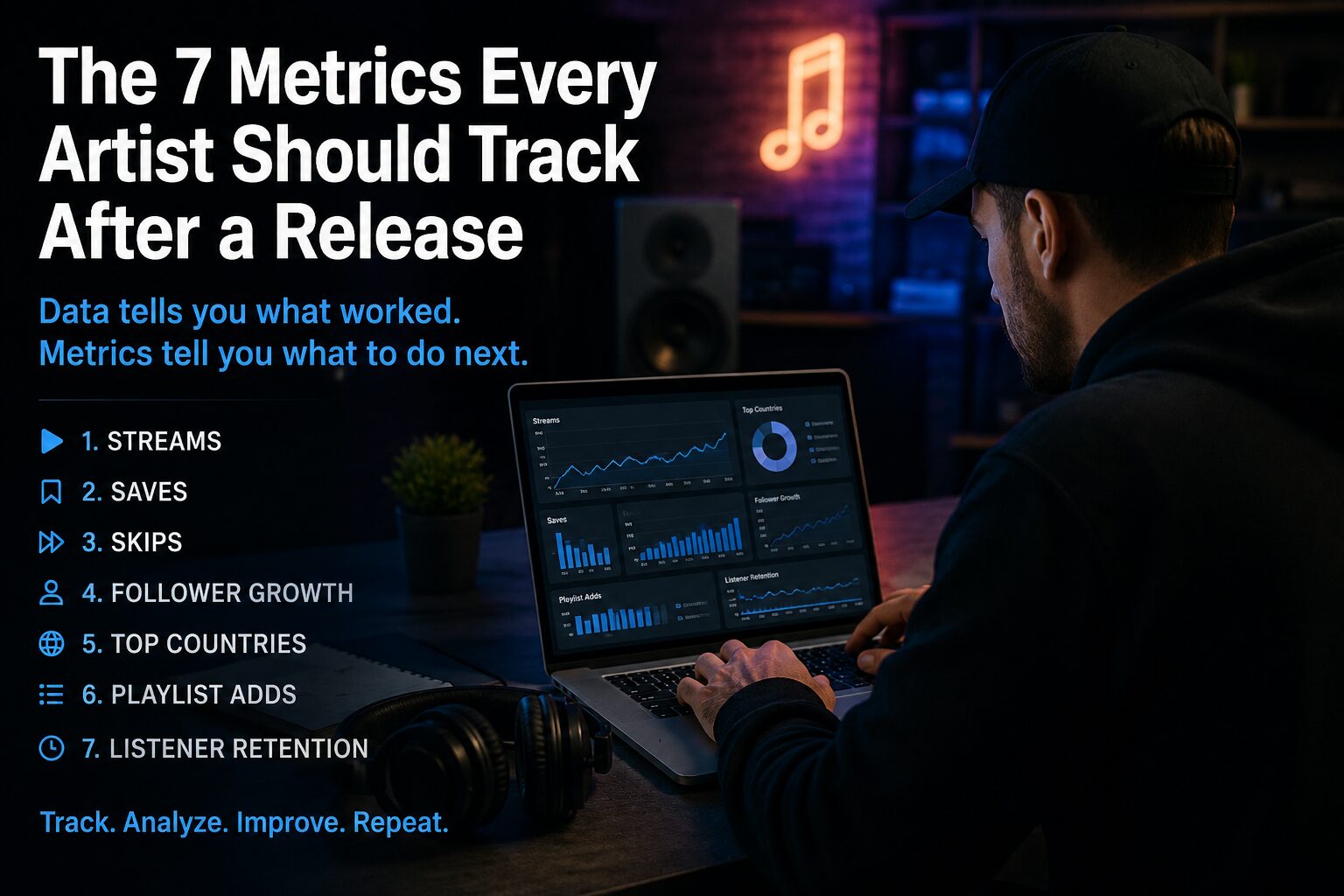

The 7 Metrics Every Artist Should Track After a Release
A new release can make an artist feel busy, visible, and hopeful. But after the first wave of posts, playlist screenshots, messages, and streaming notifications, one question matters more than the noise: what actually worked?
The artists who improve fastest are not always the ones with the biggest launch. They are the ones who know how to read what happens after the launch. They understand that music promotion is not guesswork dressed in nice graphics. It is a cycle of release, observation, adjustment, and sharper execution.
That is why every independent artist should build a simple post-release tracking system. Not a complicated spreadsheet that feels like homework, but a clear way to understand what the audience is doing once the song is out in the world. The right metrics can turn a release from an emotional gamble into a strategic lesson.

Why Artists Need More Than Stream Counts
Stream counts matter. They show reach, momentum, and consumption. They can help an artist understand whether a track is traveling beyond the immediate circle of friends, followers, and early supporters. But they are not the full story.
A song can generate streams without creating real interest. It can appear on a playlist, get played passively, and disappear from memory seconds later. Another song can generate fewer streams but more saves, stronger retention, more profile visits, and better long-term listener behavior. On paper, the first song looks bigger. Strategically, the second song may be healthier.
This distinction is crucial for independent music promotion. Artists do not only need attention. They need useful attention. A listener who saves the track, follows the artist, adds the song to a personal playlist, watches a video twice, or searches for the artist later is more valuable than a passive stream with no afterlife.
The goal of release analytics is not to reduce creativity to numbers. The goal is to understand how the music is being received, where it is finding traction, and what should happen next. Data does not replace instinct. It sharpens it.
1. Streams: The Starting Point, Not the Final Verdict
Streams are the first metric most artists check, and for good reason. They show how many times the track has been played. They give a quick sense of movement. They help measure the scale of the release compared to previous songs.
But streams need context. A thousand streams from listeners who leave immediately, save nothing, and never return do not mean the same thing as a thousand streams from listeners who replay the song, add it to playlists, and follow the artist profile. The number may be identical. The value is not.
Artists should compare streams across several time windows. The first 24 hours reveal the strength of the launch audience. The first 7 days show early campaign traction. The first 30 days reveal whether the song has life beyond the release announcement. A sudden spike can be exciting, but a stable curve can be more meaningful.
The best question is not simply, “How many streams did the song get?” A better question is, “Where did those streams come from, and did they lead to anything deeper?”
2. Saves: The Signal That Listeners Want the Song Back
Saves are one of the strongest signs of genuine listener interest. When someone saves a track, they are not just hearing it. They are making a small personal decision to keep it. That action matters.
A strong save rate suggests that the song has replay value. It means listeners may want to hear it again in their own time, outside the original playlist, post, or promotional context. For artists trying to build long-term growth, saves can be more valuable than a temporary spike in streams.
This metric is especially important after playlist exposure. A playlist can bring attention, but saves reveal whether that attention became attachment. If a track receives a lot of playlist streams but very few saves, the placement may have delivered passive listening rather than real connection. If saves rise during the playlist period, the song probably reached a more aligned audience.
Artists should track saves after 7, 14, and 30 days. If the save rate remains healthy, the track may deserve more content, more pitching, or a second promotional wave. If saves are weak, the artist may need to review audience targeting, song positioning, or the content used to introduce the track.
3. Skips: The Uncomfortable Metric That Tells the Truth
No artist enjoys looking at skip behavior. It can feel personal, especially when the song took months to write, produce, mix, master, and release. But skips are not insults. They are signals.
If listeners skip the track quickly, something may not be connecting in the opening moments. The intro may be too long for the audience. The track may be placed in the wrong playlist context. The promotional clip may have promised a different energy than the full song delivers. The genre targeting may be too broad. The first seconds may simply need to be stronger in the next release.
Skip data should never be interpreted in isolation. Some genres naturally require patience. A cinematic ambient track will behave differently from a club-ready house track. A lo-fi instrumental will not have the same opening pressure as a vocal pop single. Context matters.
Still, repeated skip patterns deserve attention. If listeners consistently leave early, the artist should study the beginning of the song, the chosen teaser clip, and the type of audience being targeted. Sometimes the problem is not the song itself, but the way it is introduced.
4. Listener Retention: The Difference Between Curiosity and Connection
Listener retention shows whether people stay with the track. It is one of the most useful metrics because it measures behavior beyond the click. A listener may press play out of curiosity, but retention reveals whether the music keeps them there.
Strong retention suggests that the arrangement, mood, hook, vocal, groove, or emotional arc is doing its job. Weak retention may indicate that the track loses energy too quickly, takes too long to develop, or reaches the wrong listeners.
This metric is particularly useful for artists who promote music through short-form video. A 15-second clip may create curiosity, but the full track must still hold attention. If video views are high but listener retention is weak, there may be a gap between the social media moment and the actual song experience.
Artists should look for the point where listeners leave. Do they disappear during the intro? After the first chorus? Before the drop? During a long instrumental section? These patterns can inform future songwriting, editing, remixing, and content selection.
5. Follower Growth: Did the Song Sell the Artist, Not Just the Track?
A release does not only promote a song. It promotes the artist behind it. That is why follower growth matters.
If listeners follow after hearing a track, it means the release created curiosity beyond one song. They want to know what comes next. That is a powerful signal, because artist growth depends on turning casual listeners into reachable listeners.
Follower growth should be measured across streaming platforms, social media, YouTube, mailing lists, and any direct fan channels the artist uses. The strongest campaigns usually create movement across more than one place. A song may drive Spotify profile follows, Instagram visits, YouTube subscribers, or email signups depending on the campaign path.
If a release generates streams but no follower growth, the artist should ask whether the branding is clear enough. Does the profile look professional? Is the bio updated? Are links easy to find? Is there a clear visual identity? Does the listener understand what kind of artist they have discovered?
Music opens the door. Artist identity keeps people inside.
6. Top Countries and Cities: Where the Song Is Really Landing
Territory data can reveal opportunities that artists would never guess from their local environment. A track released from France may find early traction in the United States, Brazil, Germany, Mexico, the Netherlands, Italy, or the United Kingdom. A niche electronic song may resonate in one city more than another. A lo-fi track may travel quietly through study playlists in unexpected markets.
These numbers are not just interesting. They can guide promotion. If a song performs well in a certain country, the artist can test localized content, target ads more precisely, pitch regional blogs, contact local curators, or collaborate with artists from that scene. If the same territory appears across several releases, it may become a priority market.
Artists should also compare territory data with engagement. A country that produces many streams but few saves may not be as valuable as a country with fewer streams and stronger listener behavior. Once again, quality matters.
Music promotion becomes more efficient when artists stop promoting everywhere in the same way. Territory data helps them focus energy where the music is already finding ears.
7. Playlist Adds: The Difference Between Exposure and Ownership
Playlist adds are a crucial metric, but they need to be read carefully. There are different kinds of playlist activity, and each one carries a different meaning.
Editorial playlists can create visibility and credibility. Algorithmic playlists can show platform-level testing and listener compatibility. Independent playlists can introduce the track to niche audiences. Personal listener playlists may be smaller, but they are often one of the strongest signs of genuine connection.
When a listener adds a song to a personal playlist, the song has entered their world. It is no longer only part of a campaign. It has become part of a mood, routine, memory, or personal soundtrack. For independent artists, that kind of behavior is extremely valuable.
Artists should track how playlist adds evolve after release day. A song that keeps being added to personal playlists after the first wave may have long-term catalog potential. A song that only performs during one playlist placement may depend more on external exposure.
The real question is whether playlists are simply playing the song, or whether listeners are taking ownership of it.
Bonus Metric: Link Clicks and Conversion
Many artists promote a song heavily but never check whether their links are converting. This is a serious mistake. A post can get likes, a story can receive views, and a reel can create attention, but if listeners do not reach the track, the campaign leaks energy.
Link clicks help measure interest. Conversion shows whether that interest becomes listening. If many people click but streams do not rise, the landing page may be confusing, the platform options may not match the audience, the call to action may be weak, or the link may create too much friction.
Artists should test different messages around the same song. A generic “out now” may perform poorly, while a more emotional or specific line may drive better clicks. The difference can be dramatic. People rarely click because a song exists. They click because something gives them a reason to care.
Every release should have a clear path from discovery to listening. If that path is messy, even good content can lose potential listeners before they hear the music.
How to Read Metrics Without Losing Your Mind
Analytics can help artists make better decisions, but they can also create anxiety. Refreshing dashboards every hour does not improve a release. It only makes the artist more reactive.
A healthier approach is to check metrics at specific moments. Day 1 gives a first launch signal. Day 7 reveals early engagement. Day 14 shows whether momentum is continuing. Day 30 offers enough distance to make strategic decisions. This rhythm keeps the artist informed without turning the release into a daily emotional rollercoaster.
It is also important to compare each release against the artist’s own history, not against superstar numbers or unrealistic viral stories. The goal is progress. Did this release generate more saves than the previous one? Did retention improve? Did one country grow? Did follower conversion increase? Did the content perform better? Did the pitch become more accurate?
Growth is often visible in small patterns before it becomes visible in big numbers.
Turning Data Into Action
Metrics are only useful if they lead to decisions. A release report should end with a clear conclusion. Should the song receive a second push? Should the artist create more content around the strongest hook? Should playlist pitching continue? Should the next single target a different audience? Should the artist improve the opening section of future songs? Should the visual identity become clearer?
The best artists do not collect data as decoration. They use it to make sharper moves.
If saves are strong but reach is low, the song may need more exposure. If streams are high but saves are weak, the campaign may be attracting the wrong listeners. If video views are strong but streams are flat, the link journey may need work. If one territory is responding, promotion can become more focused. If listener retention is weak, future arrangements may need more immediate impact.
Every metric should lead to a question. Every question should lead to an action.
The Artist Who Measures Learns Faster
Independent music careers are rarely built through one perfect release. They are built through repetition, correction, and better decisions over time. Each song teaches something. Each campaign reveals something. Each listener action leaves a clue.
The artists who track the right metrics are not trying to become cold analysts. They are protecting their creativity from guesswork. They are learning how their music moves in the real world. They are discovering which audiences respond, which stories connect, which visuals work, and which songs deserve more attention.
A release is not finished when the song goes live. It is finished when the artist has learned everything the campaign can teach.
Streams show movement. Saves show attachment. Skips show friction. Retention shows connection. Followers show artist interest. Territories show opportunity. Playlist adds show ownership. Together, these metrics turn a release into a map.
For independent artists, that map can make the next release stronger, smarter, and far less dependent on luck.