Orbiter Handpan: A Free Physically Modelled Handpan VST
Play expressive metallic percussion with eight scales, velocity-sensitive physical modelling, MPE support and a creative resonator effect.
Orbiter Handpan is a free virtual acoustic instrument developed by Tolkku AI Oy. Instead of playing a collection of recorded samples, it uses physical modelling to recreate the resonant behaviour of a handpan in real time.
The instrument can produce soft meditative tones, brighter metallic strikes and long evolving resonances. It is suitable for Ambient, Organic House, Afro House, cinematic composition, meditation music and experimental sound design.
Orbiter Handpan is available as an individual instrument plugin and as a separate audio-effect resonator. Both are included with the free Orbiter desktop installer.
Completely free: Orbiter is available without payment for Windows, macOS and Linux. The developer requests an email address to deliver the desktop download link and occasional update notifications.
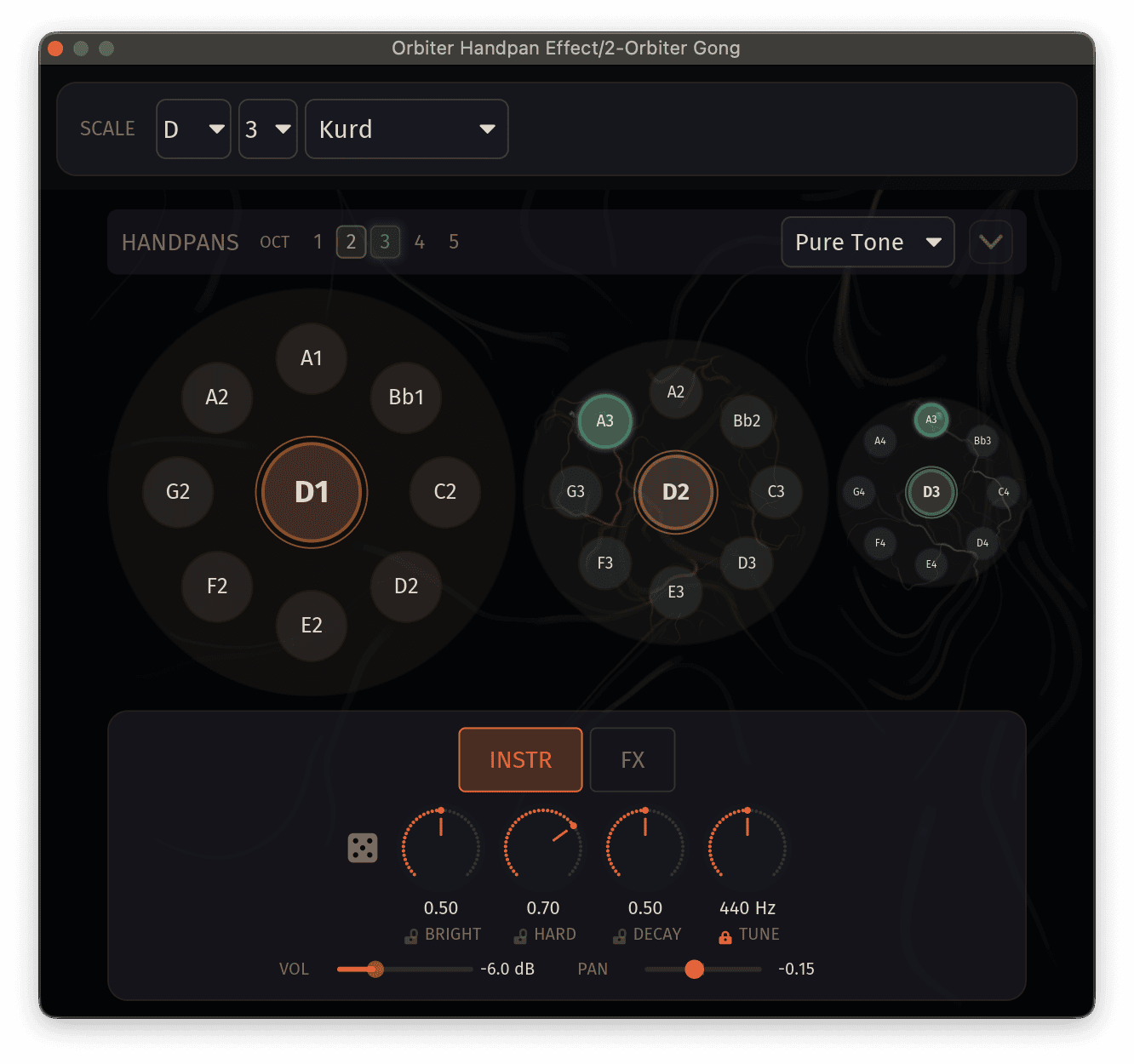
What Is Orbiter Handpan?
Orbiter Handpan is a modal-synthesis instrument inspired by the acoustic structure of a real handpan.
Each tone field is generated from six vibrational modes arranged in slightly detuned pairs. The small difference between paired frequencies creates the shimmering movement and beating commonly associated with handpan sustain.
The model also includes a Helmholtz cavity resonator. This represents the resonance produced by the hollow metal body of the instrument and adds warmth beneath the brighter metallic partials.
Main advantage: Because the sound is generated through physical modelling, notes can respond continuously to velocity, tuning, decay and timbral changes instead of switching between a small number of fixed samples.
Based on Measured Handpan Acoustics
The synthesis model is based on measured acoustic behaviour, including the characteristic relationship between a handpan note’s fundamental, octave and compound fifth.
This 1:2:3 harmonic structure helps create the recognisable metallic but tonal quality of the instrument.
Orbiter is not intended to reproduce one specific physical handpan perfectly. Its controls can move the instrument beyond realistic behaviour by extending decay, transposing the complete model or changing the brightness much more dramatically than would be possible on a fixed acoustic instrument.
Physical modelling benefit
The plugin retains the character of acoustic metal percussion while allowing changes that would normally require purchasing several differently tuned handpans, which is financially elegant and considerably easier to store.
Eight Handpan Scales
Orbiter Handpan includes eight factory scale modes. Each mode can be combined with any of the twelve root notes, giving producers more flexibility than a physical handpan built around one permanent tuning.
- Kurd
- Celtic Minor
- Amara
- Hijaz
- Integral
- Pygmy
- Annaziska
- Hijaz Compact
The central Ding provides the root or bass note. The surrounding tone fields follow the interval structure of the selected scale.
Kurd, Celtic Minor and Amara work well for reflective minor-key material. Hijaz provides a more distinctive interval structure, while Pygmy can be effective for meditative and rhythm-focused compositions.
Automatic Scale Mapping
Incoming MIDI notes are filtered according to the active handpan scale. Notes outside the selected scale can either be remapped to the nearest available tone or silenced.
Remap: Off-scale MIDI notes are moved automatically to the closest tone available in the current scale.
Silence: Notes that do not belong to the selected scale are ignored completely.
This makes the instrument accessible for producers who want to improvise melodic patterns without constantly checking the scale. More experienced musicians can still program the desired notes directly in the piano roll.
Velocity-Sensitive Performance
Orbiter Handpan responds to MIDI velocity. Softer notes produce a warmer and gentler tone, while stronger strikes introduce a brighter and more pronounced attack.
This dynamic response is important for creating natural handpan performances. Assigning the same velocity to every MIDI note can make even a sophisticated physical model feel mechanical.
Performance tip: Use lower velocities for repeating background notes and stronger values for the Ding, melodic accents and important transitions.
Main Sound Controls
Brightness: Adjusts the low-pass frequency from a dark 500 Hz tone to a much brighter 20 kHz response.
Decay: Changes the sustain length from approximately one quarter to four times the standard duration.
Reverb: Controls the balance between the direct model and the integrated room ambience.
Transpose: Moves the complete instrument between minus 24 and plus 24 semitones.
Fine Tune: Adjusts tuning by up to 50 cents in either direction.
Volume: Controls the final output level between minus 60 dB and plus 6 dB.
These controls make it possible to move from a short and muted percussion sound to a bright, long and atmospheric instrument.
Up to 16 Voices of Polyphony
The plugin supports between one and sixteen simultaneous voices. Higher polyphony allows several notes to overlap naturally while their resonances decay.
This is useful for rolling patterns, sustained atmospheric performances and layered handpan chords. Lower polyphony can create tighter rhythmic results and reduce the number of overlapping tails.
CPU tip: Reduce the polyphony when programming very fast patterns or using several Orbiter instruments in the same project. Long decay and sixteen overlapping voices can build a small metallic weather system surprisingly quickly.
MPE and MIDI Controller Support
Orbiter Handpan supports standard MIDI velocity, sustain pedal control and MIDI Polyphonic Expression.
MPE-compatible controllers can send separate pitch bend, pressure and timbre information for individual notes. This makes it possible to bend or reshape one handpan note without changing every other note currently playing.
- Per-note pitch bend
- Per-note pressure
- CC74 timbre control
- Sustain pedal support through CC64
- MIDI channel selection
- MIDI CC assignment
- Full DAW automation
Built-In Reverb, Delay and Drive
The plugin includes controls for sending the instrument into Orbiter’s reverb and delay processing.
A Drive parameter adds subtle saturation to the model output. It can introduce more harmonic edge and help the handpan remain audible inside a denser arrangement.
All available parameters can be automated from the DAW. Producers can gradually increase brightness, decay, reverb or drive during transitions and breakdowns.
Mixing reminder: Long decay and heavy reverb can sound beautiful in isolation but may obscure drums, vocals and bass. Reduce the ambience before reaching automatically for another equalizer.
Orbiter Handpan Resonator Effect
The free installer also provides Orbiter Handpan Resonator, a separate audio-effect plugin.
Instead of being triggered only by MIDI, the resonator uses audio from a DAW track to excite the same physical handpan model. A drum loop, vocal, guitar or percussion track can therefore generate sympathetic handpan-like resonances.
Dry/Wet: Blends the original source with the generated handpan resonance.
Input Drive: Adjusts the level entering the resonator between minus 12 dB and plus 36 dB.
Stereo Mode: Chooses between mono-summed excitation and independent true-stereo processing.
The effect does not track the musical pitch of the incoming signal. The selected scale determines the resonance frequencies, while the spectral content of the source determines which modes respond most strongly.
Using the Resonator Creatively
Drum loops: Transform percussion into tuned metallic patterns while preserving part of the original rhythm.
Vocals: Create shimmering resonances around spoken phrases, breaths or sustained notes.
Guitar: Add handpan-like sympathetic tones behind plucked or muted performances.
Synthesizers: Turn simple plucks and sequences into more organic resonant textures.
Effect sends: Place the resonator at 100% wet on an auxiliary bus and blend it beneath several tracks.
Best Uses
Organic House: Layer melodic handpan patterns with percussion, deep bass and atmospheric pads.
Afro House: Use the brighter scales and rhythmic patterns as melodic percussion above tribal drums.
Ambient music: Extend decay and reverb for slow, spacious and meditative compositions.
Cinematic scoring: Create mysterious metallic motifs, ritual textures and emotional transitions.
Lo-fi production: Reduce brightness and process the result with tape effects or gentle saturation.
Sound design: Use the resonator effect on recordings and loops to generate less conventional acoustic textures.
Standalone Orbiter Application
The desktop installer also includes the complete standalone Orbiter application. It combines the Handpan with physically modelled Gong and Singing Bowl instruments.
The standalone version includes a generative sequencer and cross-instrument sympathetic resonance. Playing one instrument can excite the physical model of the others.
The complete generative environment is not loaded as one plugin inside the DAW. The installer instead provides six individual plugins: three instruments and three resonator effects.
Important distinction: The Orbiter Handpan VST is a playable instrument. The full three-instrument generative sequencer remains part of the standalone application rather than the individual DAW plugin.
Compatibility
- Current documented version: 0.3.1
- Windows: 64-bit VST3 and CLAP
- macOS direct installer: VST3, CLAP and AUv3
- macOS App Store: AUv3 and standalone only
- Linux: 64-bit VST3 and CLAP
- Standalone application: Included
- Maximum polyphony: 16 voices
- MPE: Supported
- DAW automation: Supported
- Account required: No account required for the browser edition
- Desktop download: Delivered by email
The official documentation does not publish detailed minimum processor, RAM or operating-system requirements. Producers should test the browser version before installing the desktop plugin when compatibility is uncertain.
How to Download Orbiter Handpan
- Open the official Orbiter website.
- Test the handpan directly in the browser if desired.
- Enter an email address in the desktop download form.
- Open the download link sent by Orbiter.
- Select the macOS, Windows or Linux installer.
- Install the standalone application and plugin formats.
- Open the DAW and rescan the VST3, CLAP or Audio Unit folders.
- Load Orbiter Handpan as an instrument plugin.
Final Verdict
Orbiter Handpan is an unusual free acoustic instrument plugin that offers more flexibility than a conventional sample-based handpan library.
Its physical model produces dynamic metallic tones with velocity-sensitive brightness, natural beating and adjustable resonance. The eight scale modes make it suitable for melodic improvisation, while MPE and automation provide deeper performance control.
The included Handpan Resonator effect adds even more creative value by transforming drums, vocals, guitars and synthesizers into tuned metallic textures.
Orbiter is still presented as beta software, so producers should test it carefully before relying on it during an important live session. Even so, its cross-platform formats, expressive engine and free licence make it a highly interesting instrument for Organic House, Afro House, Ambient and cinematic music.
Download Orbiter Handpan for Free
Get the physically modelled handpan instrument and resonator plugins from the official Orbiter website.