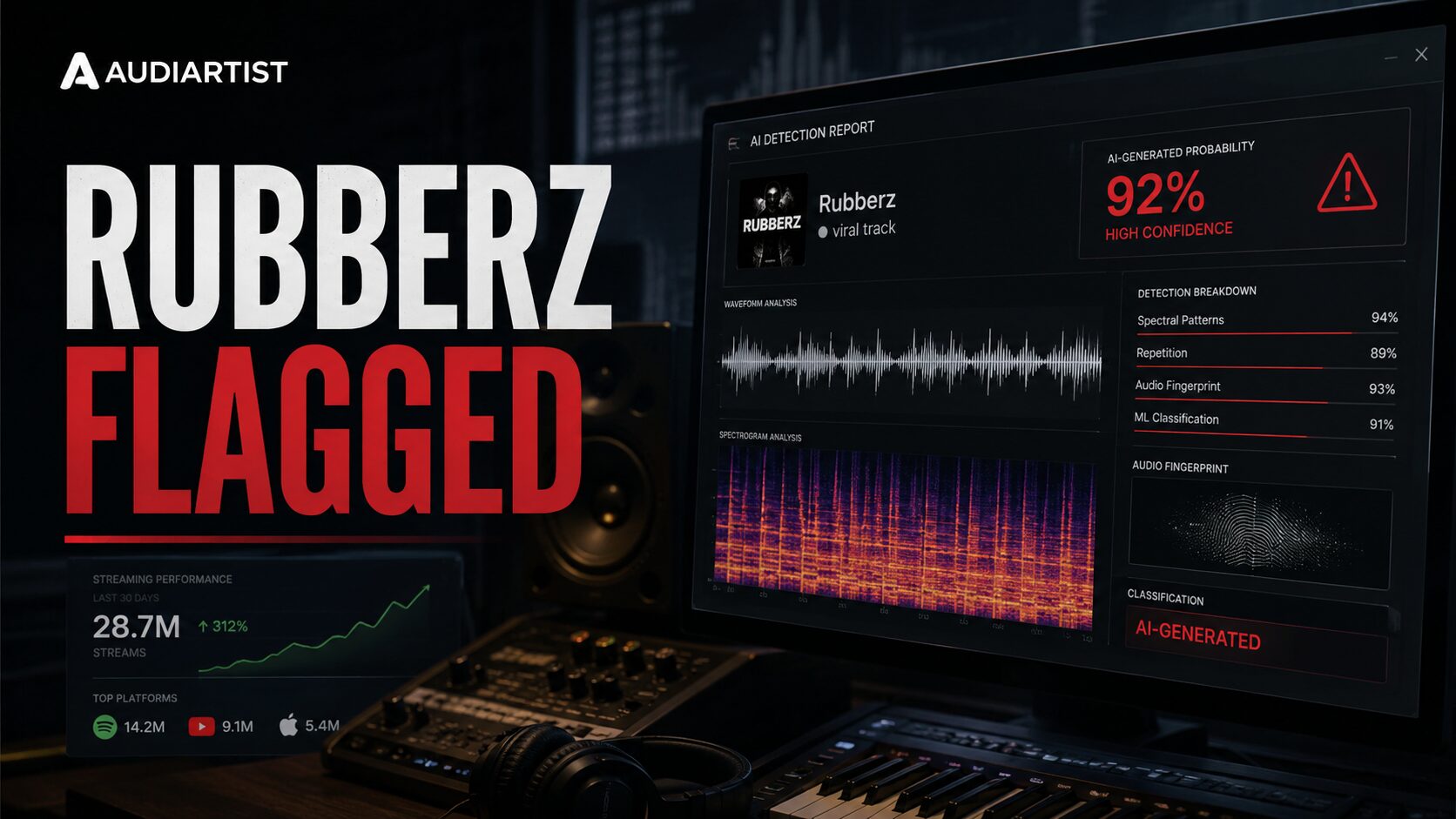

The controversy surrounding “Rubberz” by Fenix Flexin has intensified after new reports revealed that Treblo’s AI music detector is now being presented as open source, while the track continues to be classified as “very likely Treblo.”
The song, which has already gained major commercial visibility, remains at the center of a growing debate over AI transparency in mainstream music. Fenix Flexin and the credited producer have denied using artificial intelligence, and videos have since been shared online to support the claim that the track was created through a traditional recording process.
Even so, Treblo’s detector continues to identify “Rubberz” as highly likely to have originated from its own system. That contradiction has pushed the story beyond online speculation and into a wider industry conversation about trust, authorship and the future of AI music detection.
Key Facts
| Track | “Rubberz” |
|---|---|
| Artist | Fenix Flexin |
| Detection result | “Very likely Treblo” |
| Detector status | Now presented as open source |
| Artist response | AI use denied |
| Main issue | Uncertainty over the true creation process |

The Story Is No Longer Just About One Detection Result
What began as a viral debate over whether “Rubberz” might have been created with AI has now become a broader test case for how the music industry handles detection claims in public.
Treblo, formerly known as Sonauto, is no longer simply presenting a private classification. By releasing its detector as open source, the company is giving the issue a new level of visibility and technical legitimacy, or at least trying to do so.
That move changes the conversation. The question is no longer only whether the track sounds synthetic. It is now also whether developers of generative music tools can convincingly prove that their own systems leave recognizable fingerprints.
At the same time, the public denials from Fenix Flexin and the credited producer mean the story remains unresolved. Their position is clear: the song was not made with AI. Treblo’s position is equally clear: its detector still identifies the track as highly likely to have been created with its model.
This is what makes the “Rubberz” case so unusual: the credited creators deny AI use, while the technology company behind the generator effectively points back at its own system.
Treblo’s Detector Is Now Open Source, But Not Yet Independently Validated
The fact that Treblo now presents the classifier as open source is important. In theory, that should allow outside developers, researchers and analysts to inspect the tool more closely and evaluate how it works.
However, open source status does not automatically equal scientific validation.
The detector may be more transparent than before, but its reliability still depends on independent testing, reproducible benchmarks and real-world evaluation across different genres, production techniques and audio conditions.
This remains one of the key unresolved issues. Treblo’s detector may turn out to be highly accurate, but until external experts verify its performance, the classification of “Rubberz” should still be treated as a serious indication rather than a final proof.
That distinction matters because public AI accusations can affect artist reputations, audience trust and the long-term value of a release.
Videos of a Traditional Recording Process Do Not End the Debate
Part of the recent escalation comes from the circulation of videos that appear to show a conventional recording workflow behind the track.
Those videos are clearly intended to reinforce the idea that “Rubberz” was built through normal studio work rather than full AI generation. But in the current production environment, that kind of evidence does not always settle the issue completely.
A modern song can move through multiple stages of creation. A track might involve a traditional vocal take, human arrangement and studio recording while still using AI at another point in the process. It could include generated stems, AI-assisted transformations, model-based voice shaping or an earlier synthetic draft that was later reworked.
This is why the debate has become more complex than a simple yes-or-no question. “Made with AI” can mean many different things, and audiences are increasingly asking where the line should be drawn.

Could This Be the First AI-Generated Billboard Hot 100 Track?
The CEO of Treblo has suggested that “Rubberz” could become the first AI-generated song to enter the Billboard Hot 100.
That claim is obviously attention-grabbing, but it should be treated carefully.
First, the classification itself has not yet been independently validated. Second, the phrase “AI-generated” can cover very different realities, from fully synthetic compositions to hybrid productions involving both human and machine input.
Even if the detector is correct, the industry would still need to determine exactly what role AI played in the creation of the track. A fully generated song and a partially AI-assisted production do not represent the same artistic or legal situation.
Still, the symbolic weight of the claim is undeniable. If a track associated with a mainstream chart hit is widely believed to have been generated or partially generated by AI, it would mark a significant moment in the normalization of synthetic music within commercial culture.
The Real Issue Is Transparency
The “Rubberz” story continues to resonate because it touches a concern that goes far beyond one song: transparency.
Many listeners are not automatically rejecting AI in music. What seems to create more tension is the possibility that artificial intelligence may play a major role in a hit without clear disclosure.
This is where the case becomes bigger than Treblo, Fenix Flexin or one viral release. It raises a question that the wider industry can no longer avoid: should audiences be told when AI materially contributes to the music they hear?
As detection tools become more visible and chart bodies introduce AI-related rules, transparency is becoming a commercial issue as much as an ethical one. A song’s origin may soon matter almost as much as its chart position.
A hit record can now come with two parallel stories: the one told by the artist, and the one suggested by the machine that claims it helped make it.
Detection Tools Are Entering the Mainstream
Another important lesson from this case is that AI detection is no longer limited to academic research or internal platform moderation.
It is becoming part of mainstream music culture.
When a detector can publicly label a commercially visible song as likely synthetic, the technology starts influencing more than technical analysis. It begins to shape public perception, media coverage and industry debate.
This could have significant consequences for:
- chart eligibility;
- playlist placement;
- artist branding;
- label strategy;
- metadata disclosure;
- copyright and licensing disputes.
If detector claims are trusted, they may become a new form of evidence in commercial music disputes. If they are not trusted, they risk creating confusion and reputational damage.
A Defining Case for the AI Music Era
The “Rubberz” controversy remains unresolved, but it is already becoming one of the most important public case studies in the current AI music era.
It combines all the elements now shaping the industry: a viral commercial release, questions about hidden AI involvement, artist denials, an open-source detection tool and a platform CEO willing to suggest that a historical milestone may already have been reached.
Whether Treblo ultimately proves correct or not, the case reveals how quickly the music world is changing.
Success on the charts no longer guarantees clarity about authorship. A song can now be popular, profitable and professionally released while still leaving audiences uncertain about how much of it came from a human and how much from a machine.

Conclusion
For now, “Rubberz” remains a viral success, the credited creators continue to deny AI use, and Treblo’s detector continues to classify the track as “very likely Treblo.”
The open-source release of the classifier gives the controversy a new dimension, but not yet a final answer.
The most important outcome may not be whether this one song is eventually proven to be AI-generated. It may be that the music industry is entering a period where every major hit could face new questions about process, disclosure and machine involvement.
In the streaming era, songs were judged mainly by reach. In the AI era, they may increasingly be judged by origin as well.