
SLURP Steal Edition by ISIVISI Audio is a free synth plugin built around a synthesis concept that immediately separates it from the usual subtractive and wavetable instruments filling most plugin folders.
Instead of starting with a conventional oscillator-to-filter signal path, SLURP uses three oscillating sources to create rotations across three axes. Those rotations influence one another in multidimensional space before the final movement is projected back into audio. The result is an unusual approach to FM synthesis designed for producers interested in evolving digital tones, experimental leads, strange textures and sounds that do not begin with another familiar virtual analog architecture.
The free version is called SLURP Steal Edition. It is a permanent $0 edition rather than a timed trial, with one voice and a reduced feature set compared with the commercial version. For producers who want to explore the core quaternion synthesis concept before buying the complete instrument, it provides a genuine free entry point.
What Is SLURP Steal Edition?
SLURP is a digital synthesizer developed by ISIVISI Audio and based on a synthesis approach the developer describes as quaternion oscillation.
The instrument uses three independent oscillating sources associated with the X, Y and Z axes. Instead of treating those oscillators only as conventional audio generators, SLURP converts their movement into rotations.
Each axis influences the others, creating a multidimensional interaction before the final positions are projected back into the audio domain and combined into a waveform.
That concept gives SLURP a very different identity from a standard subtractive synth. There is no familiar workflow built entirely around two oscillators, a low-pass filter and a modulation envelope. The central idea is movement and interaction between rotating sources.
A Free Lite Edition With the Core Synthesis Concept
SLURP Steal Edition is the free version of the instrument.
It is important to distinguish it clearly from the complete commercial edition. The free version is limited to one voice, includes only part of the available oscillator selection and does not include the modulation system found in the full version.
The commercial edition expands the instrument to 16 voices, unlocks all oscillators and includes the built-in modulators.
For the free version, the main attraction is therefore not maximum polyphony or an enormous modulation system. It is access to the central SLURP synthesis engine and its unusual rotational approach to sound generation.
Three Oscillating Sources in a Rotational System
The foundation of SLURP is a system of three oscillating sources.
These sources create rotations associated with the X, Y and Z axes. The rotations then manipulate one another before being projected into an audible waveform.
This is where SLURP moves away from more conventional FM synthesis.
Traditional FM workflows are often described through carriers, modulators, ratios and algorithms. SLURP presents its synthesis engine through spatial movement and interacting rotations.
The underlying result is still digital synthesis capable of producing complex harmonic relationships, but the interface encourages producers to think about motion and interaction rather than simply choosing a familiar operator algorithm.
A Visual Approach to Experimental FM Synthesis
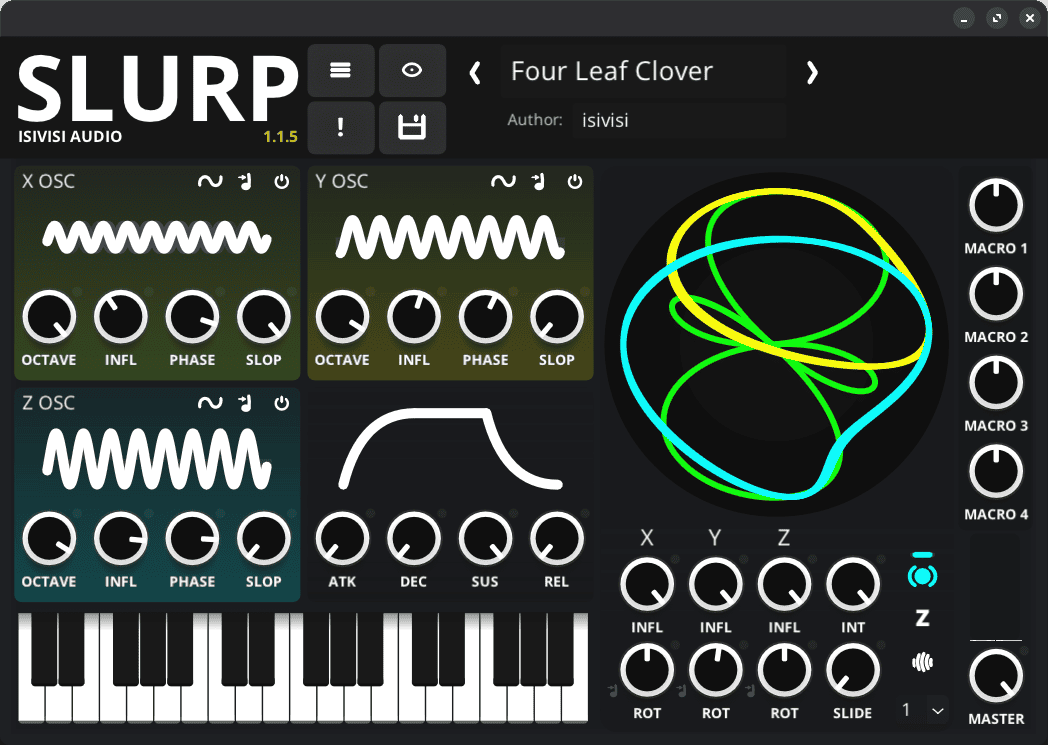
The large visual display in the SLURP interface is more than decoration.
It represents the interaction and movement of the three rotational axes, giving the producer visual feedback while the synthesis parameters change.
This can be particularly useful with an unconventional synthesis engine. When a system does not behave like a familiar analog synth, visual feedback can help connect parameter changes with the resulting movement.
For sound designers, the workflow becomes partly exploratory. Adjust a source, change its influence or rotation behavior and observe how the visual relationship changes while listening to the resulting timbre.
You do not need to understand quaternion mathematics to use the synth. The practical goal remains the same as with any instrument: move controls, listen carefully and keep the sounds that work.
X, Y and Z Oscillator Sections
The interface divides the three main sound sources into X, Y and Z oscillator sections.
Each source contributes to the rotational system and can influence the final projected sound.
This creates a synthesis workflow in which the relationship between sources matters as much as the individual oscillator selection.
One source may create the foundation of the movement while another introduces more complex interaction. Changing phase, influence or rotational behavior can alter the final harmonic result significantly.
For producers accustomed to FM synthesis, this can provide a fresh way to approach digital timbre design without simply reproducing the architecture of another classic six-operator synth.
Influence and Rotation as Sound Design Controls
SLURP exposes controls related to the influence and rotation of its different axes.
These parameters affect how the three sources interact inside the synthesis engine.
Small changes can alter the relationship between the oscillating sources, which in turn changes the waveform projected back into audio.
This makes SLURP particularly suitable for exploratory sound design. Instead of selecting a finished waveform and then shaping it only with a filter, the waveform itself emerges from the interaction between moving sources.
That can produce tones that feel more animated and less static before additional effects are added.
A Monophonic Free Synth With a Clear Purpose
The Steal Edition is limited to one voice.
That means it should be approached primarily as a monophonic instrument rather than a free polyphonic pad machine.
This limitation is important, but it also gives the free version a clear role.
Monophonic synthesis works naturally for:
- Bass sounds
- Lead sounds
- Sequences
- Experimental melodies
- Drones
- Sound effects
- Digital percussion
- Resampling material
Producers who need large chords and full polyphonic performance will need the complete version or another instrument.
Four Macro Controls in the Updated Free Edition
The updated Steal Edition includes the macro feature introduced with the redesigned SLURP interface.
Macros can make a complex synth more practical in real music production because several useful movements can be accessed from a smaller number of performance controls.
For producers, this can be valuable after finding an interesting patch. Instead of constantly returning to several individual parameters, macro controls can provide a more immediate way to create movement and variation.
The free edition still does not include the complete modulation system of the paid version, so the macros should not be confused with full access to the commercial edition’s modulators.
ADSR Envelope Control
The interface includes a standard ADSR envelope section with Attack, Decay, Sustain and Release controls.
This allows the amplitude behavior of the sound to be shaped for different musical roles.
A fast attack and short decay can create more percussive digital tones. Longer attack and release settings can move the sound toward drones and evolving textures.
Because the Steal Edition is monophonic, envelope settings can play an important role in determining whether the instrument behaves like a sharp lead, a sustained bass or a more atmospheric sound source.
Slide for Monophonic Performance
SLURP includes a Slide control that is particularly relevant to the monophonic workflow of the free edition.
Sliding between notes can add movement to leads, basses and experimental melodic lines.
This can be especially effective when the oscillator interactions already generate a complex digital tone. Smooth note transitions can create sounds that feel less like static keyboard patches and more like continuous electronic gestures.
Preset Browser and Sound Recall
The interface includes preset browsing and saving controls.
This is useful with an experimental synthesizer because successful settings can emerge through exploration rather than careful planning.
When a useful sound appears, saving it immediately is usually wiser than trusting yourself to remember the exact combination of controls later. Producers know how that story ends.
Presets can also help users learn the instrument by examining how existing sounds respond to parameter changes.
What Does SLURP Sound Like?
SLURP is best approached as an experimental digital synthesizer rather than an instrument designed to imitate one specific piece of analog hardware.
Its rotational FM concept can be useful for creating sounds with complex movement and digital harmonic character.
The free edition is particularly suited to monophonic material such as leads, basses, sequences and sound design elements.
Depending on the settings, producers can explore cleaner digital tones or push the interactions toward stranger and more complex timbres.
The instrument can also become valuable as a source for resampling. A short performance can be recorded, edited and processed through additional effects to create entirely new production material.
Using SLURP for Electronic Music Production
Experimental synthesis does not have to remain experimental for the sake of being strange.
SLURP can be used inside practical electronic music arrangements when the sound is given a clear role.
A monophonic patch can become a bassline. A brighter digital tone can function as a lead. A slowly moving sound can sit underneath a track as a texture.
The advantage of using an unusual synthesis engine is that the resulting timbres may occupy a different space from more familiar virtual analog and wavetable sounds.
This can help an arrangement develop a stronger sonic identity without adding more layers.
Using SLURP for Bass Sounds
The one-voice architecture of Steal Edition makes bass an obvious application.
Producers can create a patch, adjust the envelope for the desired response and use Slide to introduce movement between notes.
Because the core synthesis engine can generate complex harmonics, the resulting bass does not need to rely entirely on external distortion to become interesting.
As always, the final sound should be judged inside the mix. Complex digital harmonics can be exciting in isolation but may need careful level and frequency management alongside drums and other instruments.
Using SLURP for Leads
Monophonic leads are another natural use case.
The rotational interaction between the three sources can create movement inside sustained notes, while Slide can make transitions between pitches more expressive.
For techno, experimental electronic music, IDM, ambient and cinematic production, this can produce lead sounds that feel less predictable than another standard saw wave through a resonant filter.
Using SLURP for Drones and Textures
Longer envelope settings can push SLURP toward drones and sustained textures.
A single note can become source material for further processing with reverb, delay, granular effects or distortion.
Because the original waveform is generated through interacting rotations, the source may already contain internal movement before external effects are applied.
This makes SLURP potentially useful for ambient production, experimental scoring and cinematic sound design.
Resampling SLURP Into New Material
One of the most productive ways to use an unusual synthesizer is to record it.
Create a longer performance while changing parameters, then bounce the result to audio.
The recorded material can then be:
- Chopped into one-shots
- Turned into a sampler instrument
- Reversed
- Pitch-shifted
- Processed with granular effects
- Layered with drums
- Used as cinematic texture
- Distorted and resampled again
This workflow removes the pressure to create a perfect playable preset. The synth becomes a generator of raw material.
What Is Missing From the Free Version?
SLURP Steal Edition is intentionally limited compared with the commercial version.
The most important differences are clear:
- The free edition has one voice instead of 16
- Only part of the oscillator selection is included
- The built-in modulators are not included
- The complete commercial feature set requires the paid version
These limitations mean Steal Edition should be considered a genuine free lite version rather than the complete SLURP synthesizer given away at no cost.
That distinction matters. The free edition provides access to the core synthesis concept, but users who need polyphony and deeper modulation will eventually reach its boundaries.
Free Version Versus the Full Edition
The free Steal Edition is priced at $0 and offers the core SLURP instrument in a reduced configuration.
The commercial version adds 16-voice polyphony, the complete oscillator set, built-in modulators and access to the full commercial feature set.
For producers who are curious about the synthesis concept, the free edition makes sense as the first step.
There is no need to buy the complete version simply to discover whether the rotational workflow fits your music.
Plugin Formats and Operating System Compatibility
SLURP is available in several modern plugin formats:
- VST3
- CLAP
- AU
- Standalone application
The official system requirements list:
- Windows 8 or later
- macOS 10.15 or later
- Linux
- Intel x64 processors
- AMD x64 processors
- ARM64 on Mac
- Approximately 10 MB of disk space
Users need a compatible host for the plugin format they choose.
Windows, macOS and Linux Downloads
The official Itch.io page provides separate free Steal Edition downloads for Windows, macOS and Linux.
The Windows version is available as an installer, while dedicated macOS and Linux packages are also provided.
This cross-platform support is particularly welcome for a free experimental synth, as Linux producers are often left admiring the screenshots from outside the window.
Installation and Registration
The Steal Edition files are provided through the official SLURP Itch.io page.
Users should download the version corresponding to their operating system and follow the installation process supplied with that build.
The public product page does not present the free edition as a subscription or time-limited trial.
Download SLURP Steal Edition from the official ISIVISI Itch.io page
License and Usage
ISIVISI distributes its software under an end-user license agreement.
The developer permits users to install and use copies of the software for personal and business use.
The software itself may not be resold, hosted, transmitted or otherwise commercially exploited contrary to the terms of the license.
Users who need detailed legal clarification should consult the current official EULA before relying on assumptions about redistribution or modification rights.
Visit the official SLURP product page
Official Audio Examples
The official SLURP website includes audio examples demonstrating material created with the synthesizer.
Listen to the official SLURP audio examples
Who Should Use SLURP Steal Edition?
The free version is particularly relevant for:
- Electronic music producers
- Experimental musicians
- Sound designers
- Ambient producers
- IDM producers
- Techno producers
- Cinematic composers
- Linux musicians looking for free synth plugins
- Producers interested in unusual FM synthesis
- Musicians looking for a free CLAP synthesizer
Important Limitations
The monophonic architecture is the biggest limitation of the Steal Edition.
Producers cannot use the free version as a full 16-voice polyphonic instrument. The reduced oscillator selection and lack of built-in modulators also separate it clearly from the paid edition.
The currently available free Steal build is based on version 1.1.5, while the commercial version has continued to receive later updates.
This means users should not assume that every feature or improvement mentioned for the latest paid release is present in the free edition.
Why Unusual Free Synth Plugins Matter
The free synth market already contains many excellent subtractive, wavetable and analog-inspired instruments.
Another competent two-oscillator synth can still be useful, but originality becomes increasingly valuable when producers already have dozens of conventional options.
SLURP matters because its core idea is different.
The instrument asks producers to think about oscillation as rotation and spatial interaction. Even when the mathematics remain invisible to the musician, that conceptual shift can lead to different sound design decisions.
Free music production software is most interesting when it gives producers access to a workflow they did not already have.
Final Verdict
SLURP Steal Edition is a distinctive free VST3 synth for producers who want to explore an unconventional form of FM synthesis without buying the complete instrument first.
Its three-axis quaternion oscillation system gives the synth a clear identity, while the updated interface, visual feedback, ADSR envelope, Slide control, presets and macro controls provide enough structure to turn experimentation into usable sound.
The free edition is deliberately limited. One-voice operation, a reduced oscillator selection and the absence of the full modulation system mean it cannot replace the complete commercial version.
That does not make it a disposable demo. For monophonic basses, leads, drones, sequences and experimental resampling, the Steal Edition provides genuine access to SLURP’s unusual synthesis concept at no cost.
For producers tired of opening another synth that looks suspiciously like the previous fifteen, SLURP is a refreshing detour into stranger digital territory.