
Artificial intelligence is flooding music streaming platforms with an unprecedented number of new releases, but a large-scale academic study suggests that almost none of them are attracting a meaningful audience.
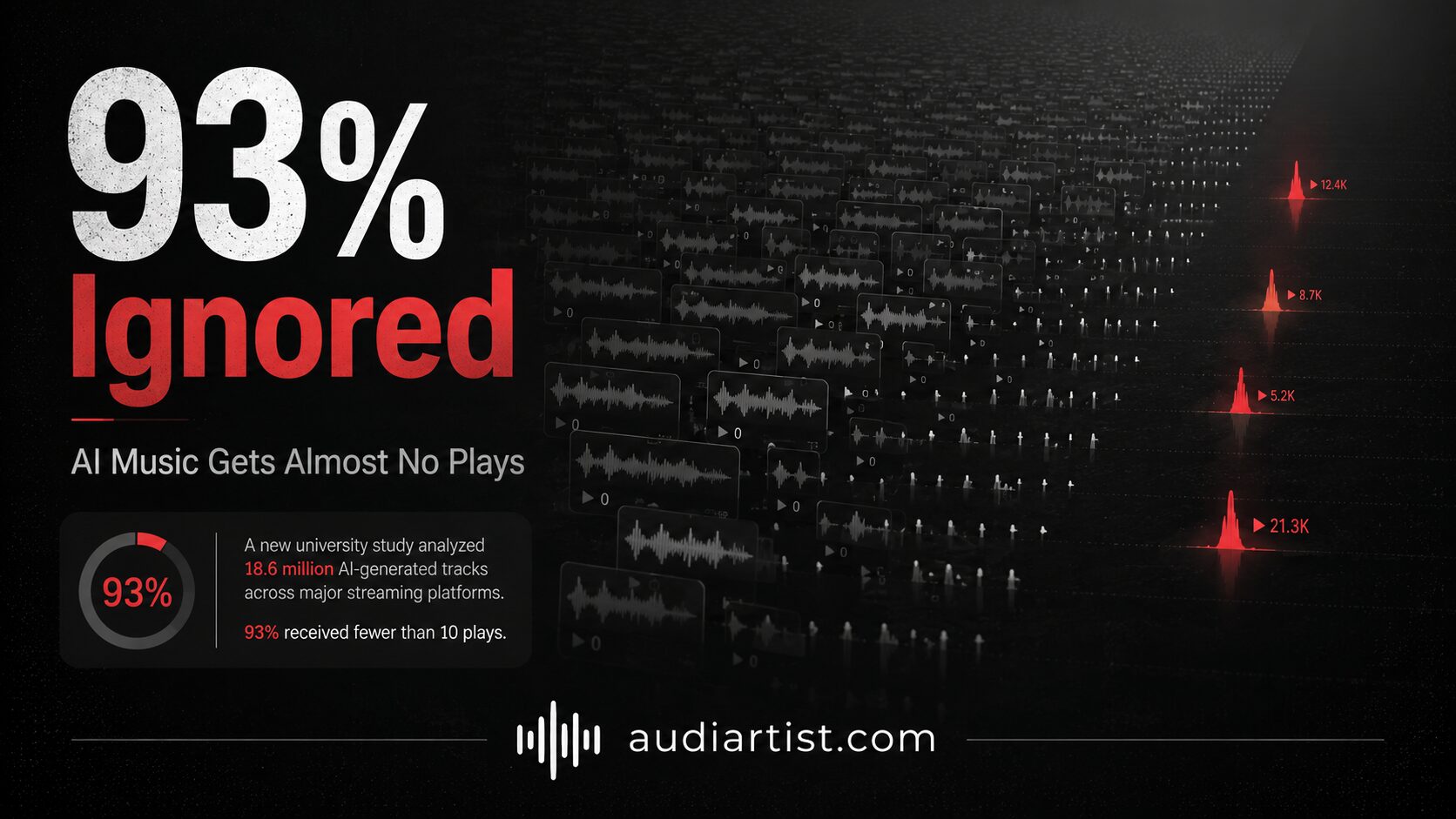
According to the research paper “An Empirical Analysis of AI Slop in Music Streaming,” 93% of the AI-generated tracks identified by the researchers received fewer than 1,000 plays after their release.
The result challenges the idea that generative music is rapidly replacing human artists in listeners’ daily habits. AI tools may be producing songs at industrial speed, but the ability to generate unlimited content has not created unlimited attention.
The supply of synthetic music is exploding. Demand, for now, is barely moving.
What the 93% Figure Really Means
The headline figure requires some context.
The researchers found that 93% of the AI-generated tracks in their dataset had accumulated fewer than 1,000 Spotify plays since release. By comparison, 64% of the human-made tracks examined during the same analysis remained below that level.
Spotify does not provide an exact public play count for songs below 1,000 streams. The study therefore classifies those recordings as having negligible engagement, but some may have received no plays while others may have attracted several hundred.
The researchers also compared a fixed selection of AI-generated and human-created music during the five months from January 1 to May 31, 2026.
During that period, 92.7% of the AI tracks received fewer than 1,000 plays. The equivalent figure for human-made music was 67.5%.
The difference became even more visible at higher levels of popularity. Only 0.1% of the AI-generated tracks reached at least 100,000 plays during the five-month period, compared with 1% of human recordings.
At the level of ten million streams, approximately 0.0002% of AI tracks reached the threshold, compared with 0.02% of human-made songs.
AI music can therefore produce occasional breakout releases, but the probability of any individual synthetic track becoming successful remains extremely low.
A Large-Scale Analysis of Spotify
The study was conducted by researchers Stanley Wu, Josephine Passananti, Viresh Mittal, Wenxin Ding, Haitao Zheng and Ben Y. Zhao.
Rather than relying on a small survey or a selection of viral examples, the team examined a large Spotify metadata database containing information associated with 256 million tracks.
After removing duplicates through International Standard Recording Codes, the researchers identified approximately 185 million unique recordings. They then cross-referenced Spotify tracks with music labelled as AI-generated by Deezer.
The team also constructed a recommendation network containing 33 million Spotify tracks and approximately 3.5 billion connections between songs.
This allowed the researchers to examine not only how many AI-generated recordings existed, but also how often listeners played them and how frequently Spotify’s recommendation systems connected them with other music.
The methodology has limitations. The Spotify metadata did not come directly from Spotify, and the identification process depended partly on Deezer’s ability to detect and label synthetic recordings.
AI tracks that escaped detection would not have been counted. The results should therefore be interpreted as an estimate rather than a complete inventory of every AI-generated song available on Spotify.
The paper is also currently available as a preprint, meaning its methods and conclusions may still be revised following academic review.
Even with those limitations, the scale of the dataset provides one of the most detailed examinations yet of how generative music behaves inside a major streaming ecosystem.
AI Music Is Growing Faster Than Its Audience
The study found that AI-generated music represented less than 1% of weekly Spotify releases in January 2024.
By the beginning of November 2025, that proportion had reportedly increased beyond 40%. During the final complete week covered by the dataset, the researchers identified 202,046 AI-generated releases, compared with 238,646 human-created tracks.
The researchers estimated that AI-generated recordings already represented approximately 5.1% of Spotify’s entire catalogue.
However, their presence inside the platform’s core recommendation network was much lower, at approximately 1.2%.
This gap is central to the study’s conclusion.
AI music is becoming increasingly common as uploaded content, but it remains far less prominent among the recordings that Spotify connects to active listening and discovery.
Uploading a song makes it available. It does not make it wanted.
The “Spray and Pray” Strategy
The researchers describe the behaviour of some AI music publishers as “spray and pray.”
The strategy consists of generating enormous numbers of tracks across multiple genres, distributing them as widely as possible and hoping that a small number eventually attract enough streams to cover the cost of the entire operation.
This model differs from the traditional release process followed by most musicians.
A human artist may spend weeks or months writing, recording, mixing and promoting a single release. A generative AI subscriber can create hundreds or thousands of songs during the same period, often for a relatively small monthly fee.
Each individual recording has little chance of succeeding. The publisher attempts to compensate for that weakness through volume.
The approach resembles email spam. Most messages fail, but the cost of sending them is so low that even a tiny response rate can make the operation profitable.
In music streaming, one unexpected playlist placement, viral video or artificially inflated track can potentially finance thousands of unsuccessful uploads.
Not Every Use of AI Is “Slop”
The researchers are careful to distinguish between AI-generated music and what they define as AI slop.
Not every musician using artificial intelligence is attempting to flood streaming platforms. AI tools can assist with sound design, production, restoration, arrangement, mixing and other parts of a legitimate creative workflow.
The study did not attempt to judge the artistic quality of every recording. Instead, it used publishing frequency as a practical indicator of mass production.
An AI artist releasing at least 30 tracks per month was classified as a potential slop producer. Only 2.7% of the AI artists in the dataset met that threshold.
However, this small group released more tracks than all the other AI artists combined.
This concentration shows why the problem cannot be understood simply by counting the number of people using generative tools. A relatively small number of high-volume accounts can produce enough material to transform the overall composition of a streaming catalogue.
Human Artists Build Stronger Listener Relationships
The study also examined what happens after an artist produces a successful track.
For human musicians, the median number of daily streams generated by subsequent releases increased approximately sixteenfold after their first major hit.
For AI artists, the increase was only fivefold.
This suggests that listeners are less likely to develop a lasting relationship with an AI music identity after discovering one successful song.
A human artist’s breakthrough can encourage fans to explore earlier releases, follow the profile and return for future music. A synthetic hit may generate streams without producing the same loyalty.
This difference matters because sustainable music careers depend on more than isolated plays.
Artists build value through recognisable voices, stories, performances, communities and evolving catalogues. Listeners do not simply consume songs. They often connect with the people and cultural context behind them.
Generative music can reproduce a convincing sound. Reproducing a meaningful artistic relationship is considerably more difficult.
AI Tracks Are Rarely Recommended Alongside Human Music
The recommendation analysis revealed another unusual pattern.
According to the researchers, 84% of human-created tracks in the recommendation network did not connect to any identified AI-generated music.
AI tracks, by contrast, were much more likely to recommend other AI tracks. Approximately 93% of them connected to at least one other synthetic recording.
Each AI track recommended an average of 36 other AI tracks, representing almost 40% of its recommendation connections.
Some of this clustering may result from similarities between songs created by the same small group of generative models. Tracks produced with similar systems may share vocal textures, arrangements, production characteristics or audio signatures.
However, the result also suggests that AI music may be developing inside a partially isolated recommendation ecosystem rather than spreading evenly across mainstream listening.
The catalogue is growing rapidly, but much of it appears to be circulating among other synthetic releases rather than reaching human music audiences organically.
Only a Small Minority Generates Meaningful Revenue
The researchers estimated that only 7.15% of the AI-generated tracks in their analysis produced enough streams to qualify for monetization.
Even within this more successful group, 76.5% earned less than ten dollars during the period studied.
Only 1,632 AI tracks, approximately 0.27% of the identified synthetic catalogue, were estimated to have generated more than $1,000.
These numbers demonstrate the extreme inequality of the model.
Most AI-generated music earns nothing. A tiny minority attracts enough attention to generate potentially meaningful income.
The problem is that the cost of failure has become extraordinarily low.
The researchers calculated that a high-volume creator using a generative subscription and an unlimited distribution plan could theoretically produce and release thousands of tracks for only a few cents per recording.
When production becomes almost free, a failure rate of more than 90% may still be economically acceptable.
Researchers Tested Eleven Independent Distributors
To examine how easily synthetic music could enter streaming services, the researchers created 88 fully generated tracks using Suno, Udio, DiffRhythm and ACE-Step.
They developed several fictional artist identities and submitted eight songs through each of eleven independent music distributors.
The releases were intended for major platforms including Spotify, Apple Music, Deezer, Amazon Music, YouTube Music and Tidal.
Five of the distributors selected for the experiment publicly stated at the time that they would not distribute fully AI-generated music.
Despite those policies, four of the five approved every synthetic recording submitted by the researchers.
Across the complete experiment, only 15 of the 88 tracks were rejected. The two distributors responsible for the rejections did not identify the songs as AI-generated and instead referred generally to internal platform requirements.
Only Amuse and LANDR identified some of the submissions as synthetic. Neither detected all eight tracks.
The results indicate that written policies have limited value when distributors cannot consistently determine how a recording was created.
Distributors Are the First Line of Control
Artists cannot normally upload music directly to Spotify or Apple Music. They must deliver releases through an approved distributor.
This makes distributors one of the most important control points in the music streaming economy.
They manage metadata, audio formatting, rights declarations, royalty collection and delivery to digital services. They also have the ability to examine suspicious uploads before they reach public catalogues.
The study suggests that this control is currently inconsistent.
All eleven distributors required users to confirm that they controlled the rights to the submitted music. However, their definitions of ownership and acceptable AI use varied considerably.
The only broadly consistent rule concerned the unauthorized imitation or impersonation of existing artists.
Some distributors permitted fully generated music. Others rejected it in principle but failed to recognise it during review. Several accepted large quantities of synthetic material without requiring meaningful disclosure.
This creates an environment in which responsible artists face uncertainty while industrial uploaders can exploit gaps between policy and enforcement.
AI Detection Remains Imperfect
The researchers also evaluated four technical methods designed to identify AI-generated audio.
The most accurate system was based on a Fourier analysis method similar to technology developed by Deezer. Under normal testing conditions, it achieved accuracy above 99%.
However, performance declined when the synthetic audio was modified.
The research team reported that processes including MP3 compression, pitch shifting, added reverb and audio reconstruction could cause generated songs to bypass detection.
After receiving the findings, Deezer told the researchers that it was working to improve the robustness of its system.
This demonstrates the difficulty of relying exclusively on automated detection.
As detection systems improve, generative platforms and high-volume uploaders may adapt their audio in response. The result could become a continuous technical contest between identification and evasion.
Detection will remain important, but it may need to be combined with identity verification, upload limits, metadata disclosure and economic measures that make mass production less profitable.
Deezer Data Shows the Same Supply and Demand Gap
The study’s conclusions are consistent with figures recently published by Deezer.
In June 2026, Deezer received an average of approximately 90,000 fully AI-generated tracks per day. On peak days, synthetic recordings represented more than half of all new music delivered to the platform.
Despite this enormous upload volume, Deezer says fully generated music accounts for only 1% to 3% of total listening activity.
The platform also reported that up to 85% of the streams attached to fully AI-generated music during 2025 were fraudulent.
Deezer excludes detected synthetic tracks from editorial playlists and algorithmic recommendations. It has also announced plans to remove AI-generated releases associated with streaming fraud and tracks that receive no streams for at least six months.
The comparison reinforces the central lesson of the Spotify study: the quantity of uploaded music should not be confused with genuine popularity.
Catalogue Saturation Still Affects Human Artists
The fact that most synthetic tracks receive almost no engagement does not mean they are harmless.
Every uploaded release requires storage, processing, metadata management, moderation and potential fraud analysis.
An expanding catalogue can also make discovery more difficult for legitimate independent musicians. Human artists must compete for search visibility, playlist consideration and recommendation space inside platforms receiving vast numbers of automated submissions.
Even when AI tracks fail to attract listeners, they can still create administrative and technical pressure throughout the distribution system.
The greatest risk may not be that audiences suddenly abandon human music. It may be that industrial production makes it harder for listeners to locate authentic artists among millions of disposable recordings.
The Industry May Need to Increase Friction
Generative technology has reduced the cost of producing music. Subscription distribution has reduced the cost of releasing it.
Both developments have legitimate benefits for independent artists. Affordable tools and unlimited distribution have allowed musicians to bypass traditional gatekeepers and reach global audiences.
However, systems designed to support productive human creators can also be exploited by accounts releasing hundreds or thousands of synthetic tracks.
The researchers propose several potential responses, including:
- charging higher fees to accounts uploading unusually large volumes;
- introducing progressive per-track distribution costs;
- limiting the number of tracks an artist can release within a specific period;
- requiring stronger identity verification;
- applying consistent disclosure standards for fully generated music;
- combining automated detection with behavioural analysis.
Each option carries risks.
Higher costs could also penalize prolific human musicians, experimental producers, archive labels and companies managing large catalogues. Upload limits might restrict legitimate projects. Identity checks could create privacy concerns or exclude artists in certain countries.
The challenge is therefore to target industrial abuse without rebuilding the expensive barriers that digital distribution originally removed.
AI Music Has a Production Problem, Not a Demand Revolution
The study does not prove that listeners will never embrace synthetic music.
Generative models will improve, and future AI artists may develop stronger identities, more coherent catalogues and more effective marketing strategies.
Individual AI-generated songs have already accumulated millions of streams. Some listeners may care more about the final recording than the process used to create it.
However, current evidence does not support the idea that generative music has fundamentally transformed audience demand.
AI’s most visible effect is currently found on the supply side. More tracks can be created, packaged and distributed than ever before.
The listening side remains stubbornly human. People have limited time, established preferences and emotional connections to particular artists.
A platform can host 100 million additional songs. It cannot create 100 million additional hours in the listener’s day.
93% Failure Can Still Create a Successful Spam Economy
The apparent failure of most AI music could ultimately become the reason mass production continues.
When creating and distributing each track costs almost nothing, publishers do not need every release to succeed. They only need a tiny percentage to generate enough streams to finance the next wave.
This is why the study compares AI slop with traditional spam campaigns.
Almost every message can fail while the overall operation remains profitable. In streaming, almost every song can disappear without an audience while one unexpected success pays for thousands of unsuccessful uploads.
The music industry therefore cannot rely on listeners simply ignoring poor-quality content.
The button marked “skip” protects the listener from an unwanted song. It does not protect the catalogue, the royalty system or the artists forced to compete inside an increasingly automated market.
AI Can Generate Music, but It Cannot Manufacture Interest
The most important conclusion from the study is not that AI music is incapable of producing successful tracks.
It is that production and popularity remain two completely different achievements.
Generative technology has solved the problem of creating enormous quantities of listenable audio. It has not solved the problem of making people care.
Ninety-three percent of the identified AI tracks remained below 1,000 plays. Only a tiny minority generated substantial revenue, and synthetic music remained underrepresented inside Spotify’s main recommendation network.
Meanwhile, human-created songs produced stronger engagement, more repeat listening and a greater chance of building momentum after a successful release.
AI may be able to publish music 24 hours a day. Fortunately, the listener still decides what deserves the next three minutes.