Drive in my head by Rust Romance: A Free Saturation VST for Subtle Analog Character
Drive in my head by Rust Romance is a free saturation VST plugin designed for producers who want analog-style weight without turning every track into obvious distortion. Instead of chasing fuzz, clipping or dramatic overdrive, it models the character of an op-amp line-driver stage, giving clean digital sources a more physical sense of thickness, movement and tone.
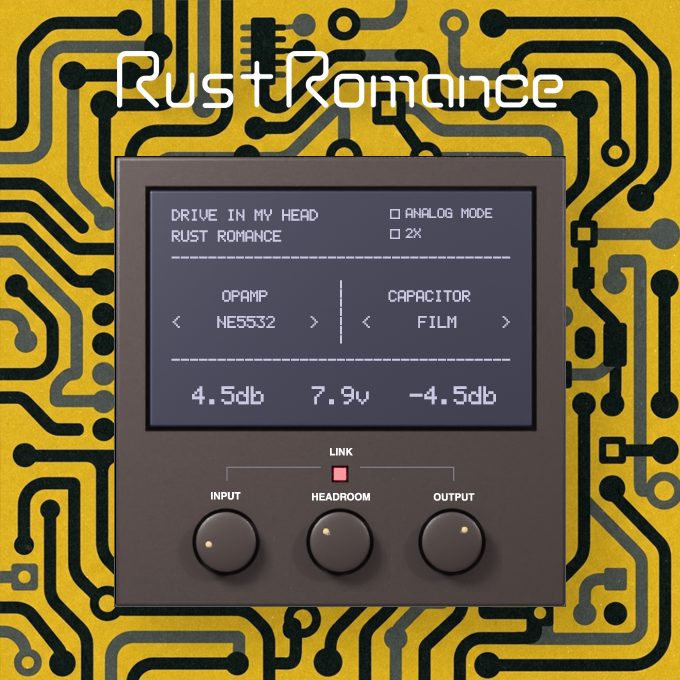
The plugin is built around fifteen op-amp models, five coupling capacitor types, an Analog Mode and a 2X stage option. It is available as a VST3 plugin and standalone application for Windows and macOS, with a free license key sent by email for first-launch activation.
What Is Drive in my head?
Drive in my head is a physically modelled op-amp line-driver plugin. Its purpose is not to behave like a traditional distortion pedal or a one-knob saturator. It is closer to placing a clean digital signal behind an analog amplification circuit and letting the small imperfections of that circuit change the feel of the sound.
That makes it useful for producers who work with virtual instruments, sample-based drums, synths, vocals, DI sounds and clean loops that feel too flat or too “inside the computer.” The plugin adds character in a subtle way, which is often more useful in a real mix than a dramatic effect that sounds impressive for five seconds and then starts eating the furniture.
Official website: Visit the Drive in my head page on Rust Romance
Download: Download Drive in my head from Rust Romance
Core Concept
The plugin is based on a simple idea: the op-amp gives the signal its character, and the capacitor shapes the room around that character. In practice, this means users can choose different modeled amplification stages and output capacitor types to change the weight, top end, asymmetry and perceived depth of the source.
Drive in my head is built to add subtle compression, bandwidth shaping, analog-style drift and circuit behavior rather than obvious distortion. It is a tool for tone placement, not a plugin that announces itself with a flaming skull on the master bus.
This makes it especially interesting for in-the-box production, where tracks can sometimes sound clean but emotionally flat. A small amount of modeled analog line-stage behavior can help sounds sit together more naturally.
Main Features
- Free saturation VST plugin from Rust Romance
- Physically modelled op-amp line-driver circuit
- Fifteen op-amp models with different electrical behaviors
- Five coupling capacitor types
- Analog Mode for subtle rail ripple and input offset drift
- 2X mode for passing the signal through a second linked stage
- WDF circuit-modeling approach
- Input, Headroom and Output controls
- VST3 plugin format
- Standalone application
- Windows and macOS support
Sound and Creative Direction
Drive in my head is designed for subtle analog coloration. The sound direction is not brutal, dirty or exaggerated. It is about weight, tone, movement and small imperfections that make clean sources feel less static.
On a synth, it can make the sound feel less plastic. On sample-based drums, it can add weight and a more believable sense of circuitry. On keys, guitars or vocals, it can gently shift the tone without forcing the track into a heavy saturation sound.
The plugin will appeal most to producers who like hardware-style gain staging, console coloration, lo-fi shaping, subtle preamp behavior and mix glue that does not scream for attention.
Fifteen Op-Amps
The op-amp section is the main personality center of Drive in my head. The plugin includes fifteen models: NE5532, NJM4558DD, NJM4560DD, NJM4580DD, TL072, OPA2604, OPA627, API2520, SE5532, BA283, LM358, LM741, TDA2030, CA3080 and LM13700.
Each op-amp changes the sound differently. Some models are closer to hi-fi studio behavior, while others lean toward cheaper, older or more colored circuit character. This allows the same source to become cleaner, thicker, softer, darker, rougher or more vintage without using a traditional EQ curve.
For producers, this is the most interesting part of the workflow. Instead of thinking only in terms of “more distortion” or “less distortion,” users can choose the kind of electronic stage the signal appears to pass through.
Five Coupling Capacitors
After the op-amp stage, the signal passes through a coupling capacitor. Drive in my head offers five capacitor options: None, Film, Oil, Electrolytic and Aged Electrolytic.
None keeps the output direct. Film is the cleaner option. Oil introduces a more vintage tilt. Electrolytic softens the top end more clearly. Aged Electrolytic pushes the sound toward older consumer-electronics character, useful for lo-fi, retro, dusty or worn textures.
This section is especially useful when a sound is technically fine but emotionally too clean. A capacitor choice can soften the brightness, reduce sterile top-end behavior or add an aged feeling without needing a full chain of tape, vinyl and EQ plugins.
Analog Mode
Analog Mode adds slow, subtle imperfections to the modeled circuit. It introduces power-rail movement and input offset drift, allowing the tone to breathe gently over time rather than remaining perfectly static.
The result is intentionally subtle. It is not an LFO effect, chorus or modulation trick. It is closer to the tiny instability that real analog electronics can introduce when a signal passes through a physical circuit.
This can be especially useful on sustained synths, pads, keys, soft drums and textures that otherwise feel frozen inside the DAW.
2X Mode
2X mode sends the sound through a second linked copy of the selected op-amp and capacitor stage. It does not behave like a simple gain boost. Instead, it doubles the amount of coloration from the same selected circuit behavior.
This is useful when the effect feels too subtle in a dense mix. A single stage may be enough on vocals or keys, while 2X can help drums, synths or loops hold onto more analog character after compression, EQ and arrangement layers are added.
WDF Circuit Modeling
Drive in my head uses a Wave Digital Filter approach, with circuit behavior modeled from the structure of the op-amp stage rather than a simple static saturation curve.
That matters because many saturation plugins are essentially fixed waveshapers with a tone control. Drive in my head aims for a more circuit-oriented response, where bandwidth, saturation recovery, feedback behavior, rail clipping and tonal asymmetry come from the modeled stage.
For producers who care about subtle texture, this can feel more organic than a basic distortion curve. The difference is not always dramatic in solo, but it can become meaningful inside a mix.
Compatibility and Technical Requirements
Drive in my head is available as a VST3 plugin and standalone application for Windows and macOS. The plugin requires a one-time license key activation, even though it is free. The key is sent by email after the user gets the product through the Rust Romance website.
- Plugin type: saturation and analog character effect
- Format: VST3
- Standalone application: included
- Operating systems: Windows and macOS
- Price: free, listed at €0
- Activation: free license key required on first launch
- Audio demo: no dedicated official demo confirmed
Who Should Use Drive in my head?
Drive in my head is made for producers who want subtle tone shaping rather than dramatic distortion. It is a strong fit for mixing, beatmaking, electronic production, lo-fi work, synth processing and analog-style coloration inside a DAW.
- Electronic producers who want synths to feel less sterile
- Beatmakers adding weight to sample-based drums
- Mixing engineers looking for subtle line-stage character
- Lo-fi producers who want aged capacitor tone
- Home studio users working fully in-the-box
- Sound designers shaping soft analog movement
- Producers who want a free saturation VST with detailed circuit choices
Production Scenarios
On drum loops, Drive in my head can add thickness without destroying transients. Try a cleaner op-amp first, then move toward more colored models if the drums still feel too flat.
On synth bass, use the Headroom and Output controls carefully. The plugin can add weight, but the low end still needs discipline. The bass region is not a buffet, even if every plugin wants a plate.
On pads and keys, the Oil or Aged Electrolytic capacitor options can soften the top end and create a more worn character. This can work well for ambient, lo-fi, synthwave, cinematic and downtempo production.
On vocals, keep the effect subtle. A gentle op-amp stage can help the vocal sit in the mix, but too much coloration can push the performance into a boxy or overly softened place.
On a mix bus, use Drive in my head with caution. Small moves can add cohesion, but heavy settings can change the balance of the entire track. Regular bypass checks are essential.
Download and License Details
Drive in my head is available from the official Rust Romance product page. It is listed as a free product at €0. Users need to go through the product page and receive a license key by email for first-launch activation.
The Rust Romance terms state that products are licensed digital software, not sold as ownership of the software itself. The terms also restrict sharing, redistribution or resale of license keys and downloaded software.
For normal music production use, the plugin is intended as an audio effect inside a DAW or as a standalone processor. Users should not redistribute the installer, resell the software, share license keys or attempt to reverse-engineer the product.
Official page: https://rust-romance.com/product/drive-in-my-head/
Terms: Read the Rust Romance Terms and Conditions
Production Tips
Start with the input level low enough to hear the character before the plugin starts feeling too pushed. This is not a loudness plugin, and louder can trick the ear quickly.
Compare op-amps on the same source before touching any other processor. The whole point is to hear how the modeled amplification stage changes the signal’s weight and top end.
Use capacitor selection as a tone decision. Film is cleaner, Oil and Electrolytic are softer, and Aged Electrolytic is better for worn, vintage or lo-fi textures.
Try Analog Mode on sustained material. Pads, drones, synth chords and long samples will reveal the slow movement more clearly than short percussion hits.
Use 2X only when the single stage disappears in the mix. It is useful, but not every sound needs to pass through the same circuit twice, unless the track has specifically requested more electrical drama.
Industry Context
Free saturation plugins are common, but many of them focus on broad categories: tape, tube, console, clipper or generic analog warmth. Drive in my head takes a more component-based route by focusing on op-amps and output capacitors.
This is interesting because modern producers often want analog behavior without always wanting obvious coloration. A subtle line-stage style processor can be useful in many places across a mix, especially when digital sources need a little more presence, softness or physicality.
The plugin also shows how freeware tools are becoming more specialized. Instead of offering another general-purpose saturator, Rust Romance focuses on a specific type of circuit character and gives users several ways to tune it.
Final Verdict
Drive in my head by Rust Romance is a thoughtful free saturation VST for producers who want analog character without heavy distortion. Its fifteen op-amp models, five capacitor choices, Analog Mode and 2X stage make it more detailed than a basic one-knob saturation tool.
The plugin is especially useful for virtual instruments, sample-based drums, synths, lo-fi textures, subtle mix coloration and in-the-box production that needs more physical character.
For producers looking for a free saturation VST, a free analog character plugin or a subtle op-amp line-driver effect for Windows and macOS, Drive in my head is a strong and original download from Rust Romance.