
AI-generated music is creating a new type of streaming fraud: fake releases can be attached to the profiles of real musicians, misleading fans, contaminating artist catalogues and potentially diverting attention and revenue away from legitimate creators.
For musicians, the threat from generative AI is no longer limited to machines creating competing songs. Increasingly, the problem is identity.
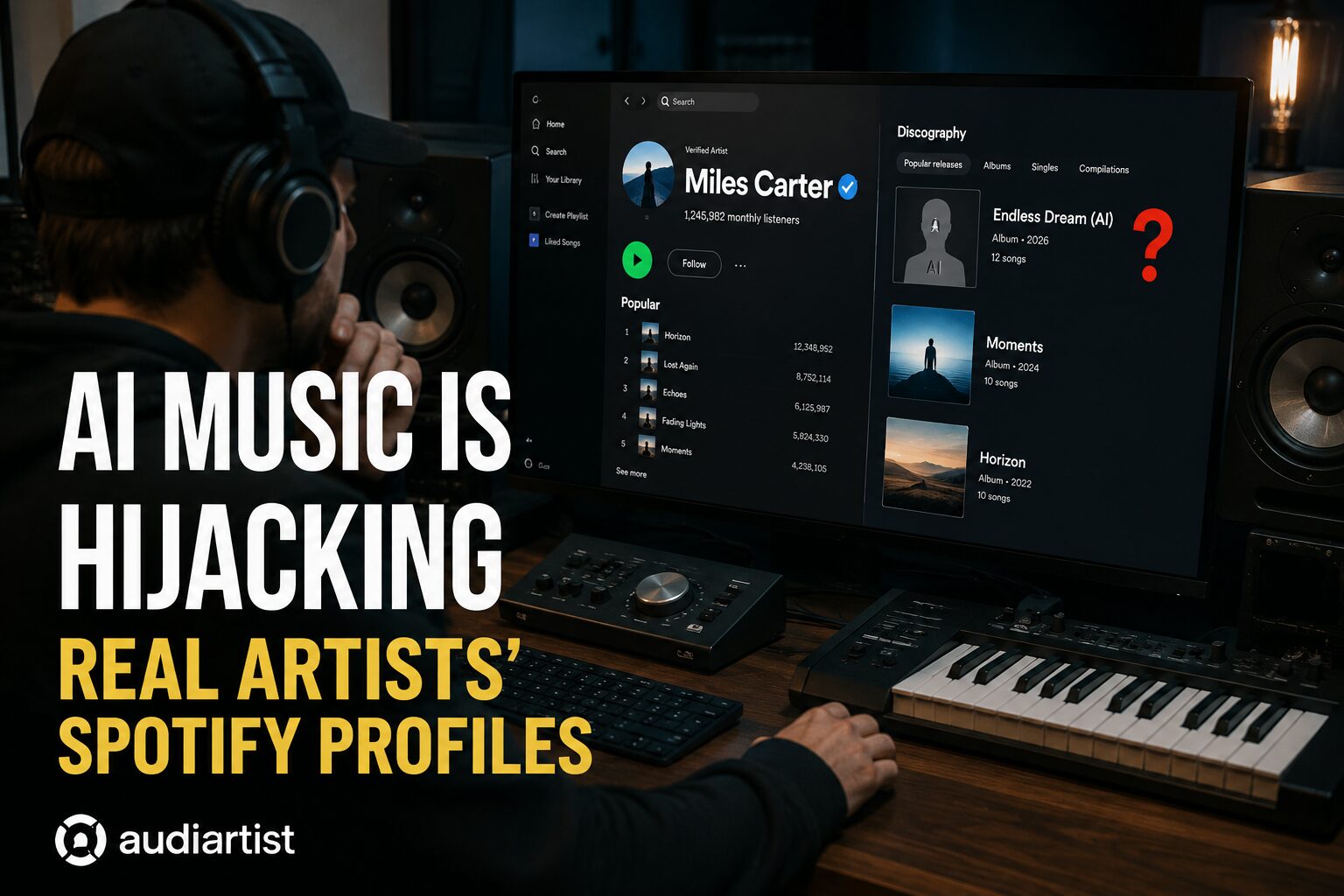
AI-generated tracks can be distributed under the name of an existing artist and, when metadata or distribution systems fail, appear directly on that artist’s legitimate streaming profile.
To a listener, the result can look completely authentic: a familiar artist name, an official-looking profile and a brand-new release sitting alongside the artist’s genuine catalogue.
Except the real artist may have had absolutely nothing to do with it.
A recent report from The World and Deutsche Welle has again highlighted the problem of AI-generated music hijacking the identities of working musicians. The issue has become serious enough that artist organizations and streaming services are developing new tools specifically designed to stop fraudulent releases before they reach fans.
Key Facts
| Problem | AI-generated or fraudulent music attached to legitimate artist identities |
|---|---|
| Potential damage | Catalog contamination, fan confusion, reputational harm and diverted revenue |
| Who is affected? | Independent and established artists across streaming services |
| Spotify response | Artist Profile Protection, Verified by Spotify and stronger identity controls |
| Industry concern | AI makes fake music dramatically faster and cheaper to produce at scale |

Photo: Anna Pou / Pexels
A Fake Release Can Look Completely Real
The mechanics of the problem are disturbingly simple.
Music distribution has become extremely accessible. Independent musicians can upload a track through a distributor and send it to Spotify, Apple Music, Amazon Music and other platforms without dealing directly with each service.
That accessibility has transformed independent music for the better. But the same infrastructure can be exploited.
A fraudulent uploader can submit music using the name of an existing artist. If the metadata is incorrectly matched to the legitimate profile, the new release may appear alongside that artist’s genuine music.
Sometimes this happens because two musicians genuinely share the same name. In other cases, Spotify says malicious actors can deliberately attach music to another artist’s identity. AI has made the problem worse because generating large quantities of convincing audio is now extraordinarily easy.
The Dangerous Difference
AI-generated music on its own is one debate. AI-generated music deliberately released under somebody else’s identity is another. At that point, the issue is no longer simply about technology or creativity. It becomes impersonation and potentially fraud.
Fans May Not Realize Anything Is Wrong
This type of attack is particularly effective because listeners naturally trust the structure of a streaming platform.
If a new album appears under an artist’s official Spotify profile, most fans have little reason to question whether it is genuine.
They may assume the musician has changed direction, experimented with a new genre or simply released something unexpected.
That can damage an artist’s reputation even if the fraudulent track generates almost no money.
A singer-songwriter could suddenly appear to have released generic electronic music. A rock artist could find an instrumental ambient album attached to their catalogue. An artist known for carefully produced recordings could wake up to discover dozens of low-quality AI tracks carrying their name.
The damage is not purely financial.
An artist’s profile is part of their identity.
Discography, artwork, release history, credits and sound all contribute to the relationship between an artist and their audience. When an unauthorized release appears there, it can corrupt that relationship almost instantly.
Benedict Cork Experienced the Problem First-Hand
British singer-songwriter Benedict Cork became one of the artists publicly associated with the growing problem earlier this year.
After Cork shared a clip of an unfinished song online, an imitation appeared shortly afterwards. He was eventually able to have the material removed, but the incident demonstrated how quickly generative technology can transform a small piece of publicly shared music into something that competes with the original creator.
The Music Managers Forum later cited Cork as a victim of AI streaming fraud when it released guidance for managers and independent musicians.
His experience points to a much bigger problem.
Artists have always had to deal with piracy and unauthorized copying. Generative AI changes the scale.
Instead of somebody merely redistributing an existing recording, a bad actor can now generate new material that imitates an artist’s identity, attach it to streaming metadata and potentially repeat the process thousands of times.
Photo: Vollume / Pexels
More Than 135,000 Suspected Fake Tracks
The scale becomes clearer when looking beyond individual cases.
In May, the UK’s Music Managers Forum published a five-point guide designed specifically to combat AI streaming fraud and online artist identity theft.
The organization said managers were increasingly reporting cases in which their clients’ artist profiles had been hijacked or abused.
According to the MMF, Sony Music had reportedly requested the removal of more than 135,000 tracks from streaming services in March where this type of digital identity hijacking had occurred.
That number illustrates why this cannot be dismissed as a handful of technical mistakes.
Generative AI changes the economics of fraud.
A person no longer needs a recording studio, session musicians or even significant musical ability to create hundreds of plausible tracks. The cost of manufacturing content has collapsed.
Once creation becomes nearly unlimited, weak points in distribution metadata become much more valuable to exploit.
Independent Artists Are Particularly Vulnerable
A major artist backed by a global record company has lawyers, managers, label representatives and direct relationships with streaming services.
An independent artist may have none of those resources.
If a fraudulent album appears on a smaller artist’s profile, that musician may have to identify the distributor, contact the streaming platform, document ownership, prove that the release is fraudulent and then repeat the process across several different services.
The MMF warns that resolving these cases can be both difficult and time-consuming, particularly for artists who do not have major-label legal support.
Audiartist Analysis
AI has not created the metadata problem. Wrong releases have appeared on artist pages for years. What AI changes is scale: someone can now manufacture an almost unlimited supply of fake music cheaply enough to turn an old streaming weakness into an industrial fraud opportunity.
Spotify Admits AI Has Made the Problem Worse
Spotify itself has acknowledged this point.
When the company introduced Artist Profile Protection in March, it explained that music had long been incorrectly assigned to artist pages across streaming platforms, but that the growth of easily generated AI tracks had made the problem worse.
The company’s response is unusually direct.
Artists participating in the current beta can activate Artist Profile Protection in Spotify for Artists. When music is delivered to Spotify carrying their artist name, they receive an email notification.
They can then approve or reject eligible releases before they appear on their profile.
- If the artist approves the release, it appears normally.
- If the artist rejects it, the release will not list them or appear on their Spotify profile.
- If the artist does nothing, the release is also prevented from appearing under their profile.
Spotify additionally assigns participating artists a unique artist key that can be shared with trusted distributors. Releases delivered with that key can be automatically pre-approved.
There Is One Important Limitation
Spotify’s system can protect a Spotify profile, but it cannot control what happens elsewhere.
The company explicitly warns artists that rejecting a suspicious release on Spotify does not necessarily stop the same music from appearing on other streaming services. Artists may still need to contact their label or distributor.
This exposes one of the fundamental weaknesses of today’s distribution ecosystem.
An artist does not have one global digital identity. Their catalogue is replicated across Spotify, Apple Music, Amazon Music, YouTube Music, Deezer, Tidal and numerous regional services.
A fraudulent release can therefore become a multi-platform problem almost instantly.
Verified by Spotify Adds Another Layer
Spotify has also introduced Verified by Spotify, a separate identity system designed to indicate that an artist profile has been reviewed and meets the platform’s authenticity standards.
The verification process considers sustained listener engagement, compliance with Spotify’s policies and signals showing that a real artist exists both on and outside the platform, such as touring activity, merchandise or linked social profiles.
Spotify says profiles primarily representing AI-generated or AI-persona artists are not eligible for this verification under its current criteria.
Spotify reported that at launch its verification work covered more than 99% of artists that listeners actively search for, representing hundreds of thousands of profiles, with independent musicians making up the majority.
Combined with Artist Profile Protection and the recently announced AI Persona badge, Spotify is clearly moving toward a streaming environment where identity itself becomes a formal part of platform security.
Photo: Sherman Trotz / Pexels
The Problem Is Bigger Than Spotify
Spotify deserves attention because of its enormous role in global streaming, but this is not exclusively a Spotify problem.
The distribution system that enables music to reach Spotify often sends the same release simultaneously to multiple digital platforms.
If fraudulent metadata enters that pipeline, an artist can find themselves fighting the same fake release across several services.
This is why stronger verification at the distribution stage may ultimately be as important as protection at the streaming-platform level.
Waiting until fake music has already reached an artist’s public profile is fundamentally reactive.
The more effective long-term solution would be to make it much harder for an unauthorized party to associate a release with an established artist identity in the first place.
What Artists Should Watch
- Unexpected releases appearing under your artist name.
- Changes in Release Radar or catalogue statistics that you cannot explain.
- New artwork or tracks that you did not deliver.
- Fraudulent copyright claims involving your own recordings.
- Duplicate or imitation artist profiles using your branding.
- Unusual royalty or streaming activity linked to unfamiliar tracks.
AI Turns Artist Identity Into Valuable Data
The deeper concern is that modern musicians increasingly exist as collections of digital signals.
A public artist profile contains a name, image, biography, voice, songwriting style, catalogue, artwork, audience and reputation.
Generative AI can reproduce or approximate several of those elements almost instantly.
That means protecting a recording is no longer enough.
Artists increasingly need protection for their digital identity.
The next generation of music fraud may not involve stealing a finished master recording. It may involve creating an entirely new song, giving it your name, attaching it to your audience and convincing algorithms that it belongs there.
The Fight Is Moving From Copyright to Identity
Much of the legal debate around AI music has focused on training data: whether companies were allowed to use copyrighted recordings to build generative models.
That question remains extremely important.
But profile hijacking introduces another issue that may be easier for both artists and listeners to understand.
If you did not create, authorize or release a song, it should not appear as yours.
The technology used to make the fraudulent track is almost secondary at that point.
The industry is therefore entering a phase where protecting music will increasingly mean protecting names, voices, images, metadata and artist profiles alongside conventional copyrights.
Conclusion
AI music impersonation exposes one of streaming’s most uncomfortable vulnerabilities.
The platforms that made global distribution accessible to millions of independent musicians also created an open infrastructure that can be manipulated by people acting in bad faith.
Generative AI dramatically increases the potential scale of that abuse.
Spotify’s Artist Profile Protection is an important response because it moves verification earlier in the release process. Verified profiles and clearer AI identity labels add further safeguards.
But streaming services and distributors will need to go further.
Artists should not have to constantly police their own profiles to prove that music appearing under their names is not theirs.
The next major fight over AI music may not simply be about who owns a song. It may be about who owns an artist’s identity.