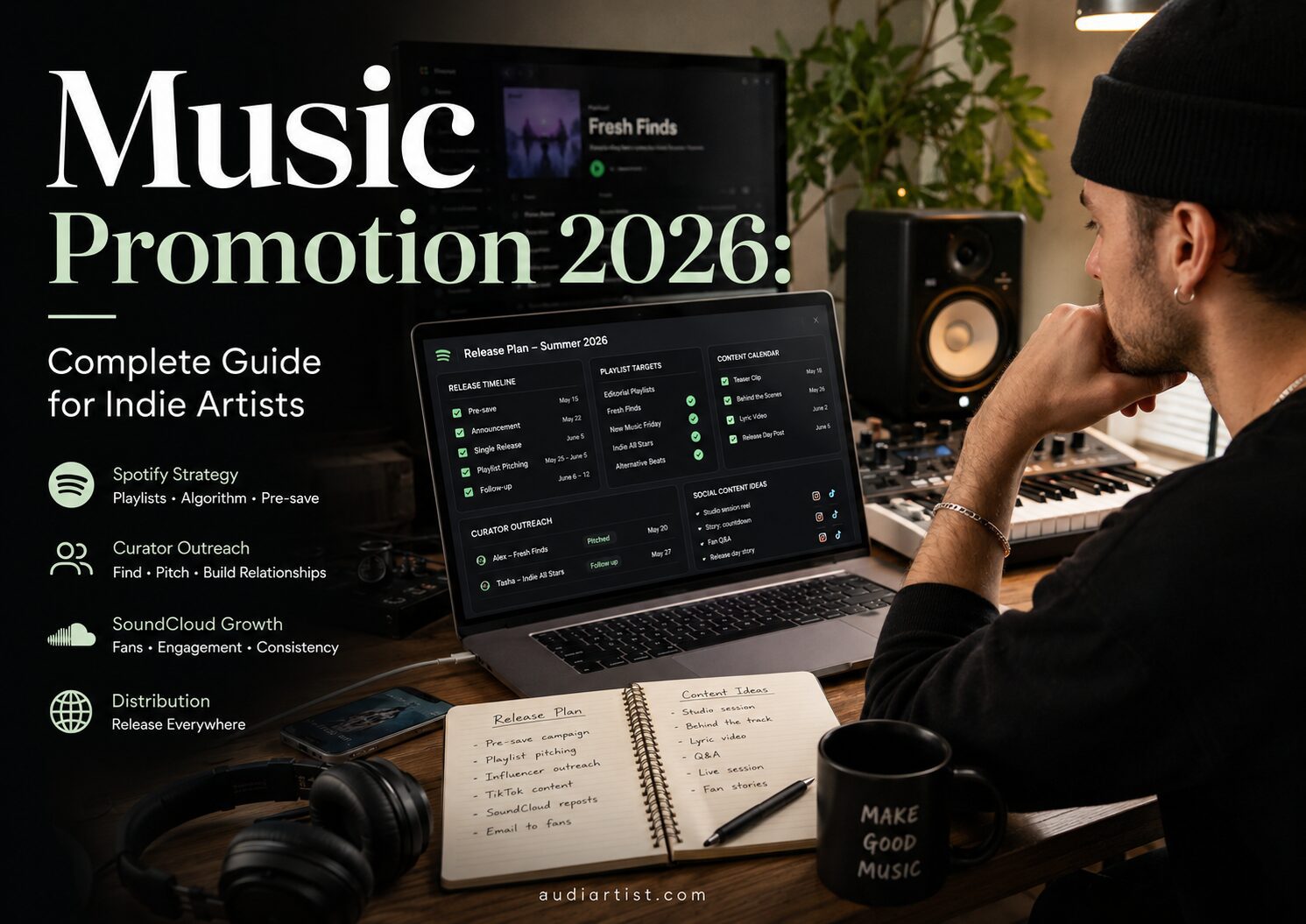

This complete guide brings together the most useful music promotion resources from Audiartist’s Music Promotion section, with a practical focus on distributors, Spotify, curator platforms such as DailyPlaylists, PitchPlaylists and Playlist Panda, plus SoundCloud growth tools such as RepostExchange.
Whether you are releasing your first single or managing a growing catalog, the goal is the same: build a promotion system that creates real listeners, not fake numbers.
Why Music Promotion Has Changed
The modern independent artist is not only a songwriter, producer or performer. Today, an artist often becomes the creative director, distributor, playlist researcher, content strategist, social media editor, data analyst and campaign manager behind every release.
This shift is explained clearly in The New Indie Artist Workflow: From Home Studio to Global Audience, which shows how music now travels through a complete chain: production, release preparation, distribution, playlist pitching, visual content, audience engagement and follow-up promotion.
The artists who grow are rarely the ones who only release more music. They are the ones who build a repeatable system around every song. That system starts before release day and continues long after the track is online.
Start With Distribution: Your Release Needs a Real Foundation
Before promotion begins, the track needs to be properly distributed. A distributor sends music to platforms such as Spotify, Apple Music, Deezer, YouTube Music, Amazon Music and many other digital stores. It also helps manage metadata, royalties, release timing and sometimes additional tools such as YouTube Content ID or pre-save links.
For independent artists comparing options, Free Music Distributors in 2026: Best Free & Cheap Options is one of the most useful starting points. It explains how free and low-cost distribution has evolved, why revenue-share models still exist, and why the best distributor depends on your budget, catalog size and release rhythm.
Artists who want a broader comparison can also read Free Music Distribution 2026: Best Cheap Distributors, which looks at platforms such as DistroKid, TuneCore, Amuse, LANDR, CD Baby, UnitedMasters and other budget-friendly services.
The key decision is not simply “which distributor is cheapest?” It is “which distributor fits the way I release music?” An artist releasing one single per year does not have the same needs as a producer dropping tracks every month. A lo-fi beatmaker, an Afro House artist, a rapper and a cinematic composer may all need different levels of speed, control, royalty transparency and platform reach.
For a deeper look at one of the most popular options, DistroKid: The Digital Music Distributor Empowering Independent Artists offers a focused overview of the platform and its role in independent music distribution.
Can You Release Music Without a Distributor?
For artists who are not ready to use a distributor, direct-upload platforms can still be useful. SoundCloud, Bandcamp, YouTube and other creator-first platforms allow artists to publish music directly, build a community and test audience reaction before committing to a full DSP campaign.
The article Streaming Platforms You Can Use Without a Distributor in 2026 explains this approach in detail. It is especially useful for artists who want to release quickly, share demos, test alternative versions, upload DJ edits, publish visualizers, or build a niche audience before investing in a larger rollout.
This does not mean artists should ignore traditional streaming platforms. It means direct-upload platforms can become part of the promotional journey, especially when they are used with intention.
Spotify Promotion: Build the Profile Before Chasing the Playlist
Spotify remains one of the central platforms for music discovery. But successful Spotify promotion is not only about landing on playlists. It begins with the basics: claiming your Spotify for Artists profile, uploading strong visuals, writing a clear biography, choosing the right artist image, preparing release metadata, pitching unreleased music on time, and understanding your audience data.
A strong starting point is Best Online Tools for Music Promotion: Free & Paid, which includes Spotify for Artists as a key tool for independent musicians. Spotify data can help artists understand where listeners are coming from, which songs are retaining attention, and which regions or playlists deserve more focus.
Spotify playlist pitching should be treated as a professional step, not a desperate button click. The platform allows artists to pitch unreleased music through Spotify for Artists, but timing matters. A track should be delivered early enough to give editors time to review it properly. The pitch should include genre, mood, instruments, culture, language, marketing plans and a clear reason why the song fits its audience.
For long-term Spotify visibility, artists should also read Why Playlists Still Matter for Independent Artists in 2026. The article explains why playlists remain important, not as magic machines, but as discovery environments where songs can meet listeners in the right context.
Playlist Promotion: Fit Matters More Than Follower Count
Many artists make the same mistake when pitching playlists: they chase the biggest follower number instead of the best fit. A small but active playlist in the right genre can be more valuable than a large, unfocused playlist filled with passive listeners.
This is where Playlist Pitching in 2026: What Curators Really Want From Independent Artists becomes essential reading. Curators are not only looking for good songs. They are looking for music that fits the identity, tempo, mood, audience and quality level of their playlist.
A playlist pitch should be short, targeted and respectful. Artists should include one direct streaming link, a short description of the track, the genre, the mood, and why it fits the playlist. Curators do not need an autobiography longer than a prog rock concept album. They need a reason to press play.
For artists who want to understand playlist promotion as a long-term strategy, Playlist Promotion Strategy: How to Win the Curator Game explains how playlist proof, curator relationships and consistent follow-up can turn isolated placements into a broader promotional structure.
DailyPlaylists: Free Playlist Submission With Real Targeting
DailyPlaylists remains one of the most accessible tools for artists who want to submit music to Spotify curators without paying for placement. It allows musicians to browse playlist opportunities, submit tracks by genre, and reach curators who are open to new music.
Audiartist provides a dedicated submission page through Submit Your Music for Free With DailyPlaylist. This page is especially useful because it organizes Audiartist playlist opportunities by genre, including Afro House, EDM, Dance, House, Rap, Urban, Lo-fi, Rock, Pop, Synthwave, Cinematic, Classical, Latin and more.
DailyPlaylists works best when artists submit with precision. Sending a dark techno track to a sunny pop playlist is not strategy, it is musical telepathy without consent. The stronger move is to choose playlists where the track naturally belongs.
A good DailyPlaylists workflow looks like this:
- Choose one strong track, not your entire catalog.
- Identify the most accurate genre and mood.
- Submit only to playlists that genuinely fit the song.
- Keep the message short and professional.
- Track responses and learn which curators understand your sound.
PitchPlaylists: Reaching Curators With a More Direct Approach
PitchPlaylists is another useful platform for artists who want to connect with playlist curators. The Audiartist article PitchPlaylists.com: The Smartest Way to Reach Real Spotify Curators presents it as a music submission platform designed to connect independent musicians with Spotify playlist curators.
For artists, the advantage is clear: instead of sending random messages across social networks, they can use a platform built around music submission and playlist discovery. This creates a cleaner pitching environment, especially when the artist already knows the track’s genre, energy level and audience.
PitchPlaylists should not be used as a lottery ticket. It works best when integrated into a full release campaign: Spotify pitch, social content, curator outreach, short videos, newsletter, and consistent follow-up. Playlist pitching is one part of the machine, not the entire engine.
Playlist Panda: A Structured Route to Curator Reviews
Playlist Panda has become a relevant option for independent artists looking for a more organized way to submit music to playlist curators. The Audiartist review Playlist Panda: A Smarter Way for Independent Artists to Submit Music for Reviews and Playlist Placement explains how the platform helps artists send music to curators, receive reviews and potentially secure placements when the track fits the curator’s direction.
The most important word here is “fits.” No serious curator platform should be treated as a guarantee machine. The goal is not to force a track into playlists. The goal is to place the right music in front of the right ears.
Playlist Panda can be useful for artists who want a more professional submission environment, especially when they are tired of random emails, unclear Instagram DMs, and promotional services that promise too much. A real curator relationship is built on trust, genre alignment and quality control.
SoundCloud Promotion: RepostExchange and Community Growth
SoundCloud still matters, especially for electronic music, hip-hop, remixes, demos, DJ edits, underground scenes and early-stage fan discovery. For artists who want to grow SoundCloud plays without relying on fake traffic, RepostExchange is one of the most interesting tools.
The Audiartist article RepostExchange: Boost Your SoundCloud Plays With Community Promotion explains how the platform works. Artists earn credits by listening to and reposting other users’ music, then use those credits to have their own tracks reposted by other members.
This creates a community-based promotional system rather than a paid stream shortcut. It can help a track reach new SoundCloud listeners, especially when the music fits active communities in electronic music, beats, rap, lo-fi, house, techno or experimental genres.
As with every promotional tool, the result depends on the quality of the music and the relevance of the audience. RepostExchange can amplify a good track, but it cannot transform a weak one into a masterpiece. Even the algorithm has limits, thankfully.
Short Videos: The New Front Door of Music Discovery
In 2026, many listeners discover music through short videos before they ever search for the artist on Spotify. TikTok, Instagram Reels, YouTube Shorts and vertical video formats have changed the way songs enter culture.
The article How Short Videos Became the New Music Promotion Engine explains why short-form video is now central to artist promotion. A chorus, a studio moment, a lyric line, a live fragment, a danceable groove or a strong visual identity can stop the scroll long enough to create curiosity.
Artists should not think of short videos as disposable content. They are entry points. A single song can generate multiple video angles:
- A hook-focused clip built around the strongest chorus.
- A behind-the-scenes studio moment.
- A lyric-driven emotional clip.
- A visualizer adapted for Reels and Shorts.
- A performance fragment or DJ-style preview.
- A story explaining the meaning of the song.
For deeper visual strategy, Music Videos in 2026: Why One Clip Is No Longer Enough is also worth reading. One full music video can still matter, but it should now be supported by shorter clips, teasers, vertical edits, behind-the-scenes moments and platform-specific content.
From Single to Campaign: Stop Releasing Songs Like Disposable Content
One of the strongest mistakes independent artists make is treating each release as a one-day event. A single should not live for 24 hours and then disappear into the archive. It should become a campaign.
From Single to Campaign: Why Every Release Needs a Promotion Plan is one of the most important Audiartist articles for any musician building a serious release strategy. It explains why a song needs preparation, story, visual identity, playlist pitching, short video content and post-release activity.
A strong campaign can be divided into three phases:
Before Release
Prepare the distributor upload, Spotify pitch, artwork, press text, short video ideas, playlist targets, curator list, pre-save link and social calendar.
Release Week
Publish the main announcement, share the streaming link, post multiple short videos, contact curators, update bios, send the track to your mailing list and encourage real saves, shares and playlist adds.
After Release
Keep promoting. Share behind-the-scenes content, acoustic versions, remix ideas, DJ clips, lyric videos, playlist updates, listener reactions and performance milestones. A good song deserves more than one post and a nervous refresh of Spotify for Artists.
Curators Are Not Only Playlists
Playlist curators matter, but they are not the only discovery gatekeepers. YouTube channels, radio shows, blogs, Twitch streamers, TikTok creators, Instagram pages and niche communities can all introduce music to new listeners.
Playlist vs Channel vs Radio Show: Which Curator Fits Your Music? helps artists understand the difference between these environments. A club-ready Afro House track may fit a DJ playlist and a radio mix. A cinematic track may work better with a YouTube channel, visual creator or soundtrack-focused blog. A lo-fi instrumental may grow through study playlists, coffeehouse channels and long-form listening environments.
The smart question is not “where can I submit my song?” The smart question is “where does this song naturally create value?”
Why Labels Now Look for Artists Who Already Promote Themselves
Labels still care about talent, but talent alone is no longer enough. In a crowded market, labels increasingly look for artists who already understand their audience, visual identity, release strategy and promotional rhythm.
The article Why Labels Are Looking for Artists Who Already Know How to Promote Themselves explains this shift clearly. A label is more likely to pay attention when an artist can show proof: consistent releases, real engagement, playlist traction, social content, audience data and a clear artistic direction.
Independent promotion is not only about staying independent. It is also about building leverage. When artists understand promotion, they make better decisions, even if a label, manager, distributor or PR partner enters the picture later.
Build a Real Promotion Stack
The strongest independent artists do not rely on one tool. They build a promotion stack, a combination of platforms, content formats and relationships that work together.
A practical music promotion stack in 2026 could look like this:
- Distribution: DistroKid, TuneCore, Amuse, CD Baby, LANDR, UnitedMasters or another distributor that fits your release rhythm.
- Spotify foundation: Spotify for Artists profile, editorial pitch, canvas, artist pick, bio and audience data.
- Playlist submission: DailyPlaylists, PitchPlaylists, Playlist Panda and direct curator outreach.
- Audiartist submissions: genre-based playlist opportunities through Audiartist’s free music submission page.
- SoundCloud growth: RepostExchange and direct community engagement.
- Short videos: Reels, TikTok, Shorts, lyric clips, studio clips and performance fragments.
- Long-term content: artist story, behind-the-scenes material, interviews, blog coverage and newsletter updates.
- Data review: saves, playlist adds, skip rate, listener location, watch time, comments and shares.
This structure helps artists avoid the most dangerous promotional habit: doing everything randomly. Random promotion creates random results. A system creates learning.
Avoid Fake Streams and Guaranteed Placement Promises
Any serious music promotion guide must say this clearly: avoid services that guarantee streams, guaranteed playlist placement or suspiciously fast numbers. Fake streams may look exciting for a few days, but they can damage an artist’s credibility, trigger platform penalties and distort real audience data.
For context, Spotify Faces Class-Action Lawsuit Over Alleged Bot-Driven Fake Streams shows why artificial streaming remains a major issue in the modern music economy.
Real promotion is slower, but safer. It builds listeners who might save the song, follow the artist, share the track, attend a show, submit it to another playlist or return for the next release. Fake streams do none of that. They are digital confetti with a hangover.
The Best Music Promotion Strategy Is Long-Term
The future of music promotion belongs to artists who understand that discovery is no longer linear. A listener might see a short video, hear the song later in a playlist, follow the artist on Instagram, save the track on Spotify, watch a live clip on YouTube, then finally become a real fan weeks later.
This is the core idea behind The Future of Indie Music Marketing: Playlists, Video Content and Direct Fan Connection. Independent music marketing is now a web of signals. No single platform carries the entire campaign. Each touchpoint helps the listener remember the artist.
For independent musicians, this should be encouraging. You do not need to win everywhere at once. You need to build a clear path: strong music, clean distribution, professional Spotify setup, targeted playlist pitching, smart curator relationships, short video content, SoundCloud community growth when relevant, and consistent post-release promotion.
Final Thoughts: Promote Like an Artist, Think Like a Label
Music promotion in 2026 rewards artists who are both creative and organized. The song still matters most. No strategy can replace emotion, originality, groove, songwriting or production quality. But once the music is ready, structure becomes the difference between a release that disappears and a release that keeps moving.
Use a distributor that fits your career. Prepare your Spotify profile properly. Submit to curators with respect and precision. Use DailyPlaylists, PitchPlaylists and Playlist Panda intelligently. Build SoundCloud momentum with tools like RepostExchange when it fits your genre. Turn every single into a campaign. Create short videos that open doors. Keep promoting after release day.
Most importantly, avoid fake promises. Real music growth is built on real listeners, real context and real consistency.
Independent artists do not need to act like major labels in budget. They need to think like labels in structure. That is how a song gets a real chance to travel.