
Start With the Big Picture: Promotion Is Now a System
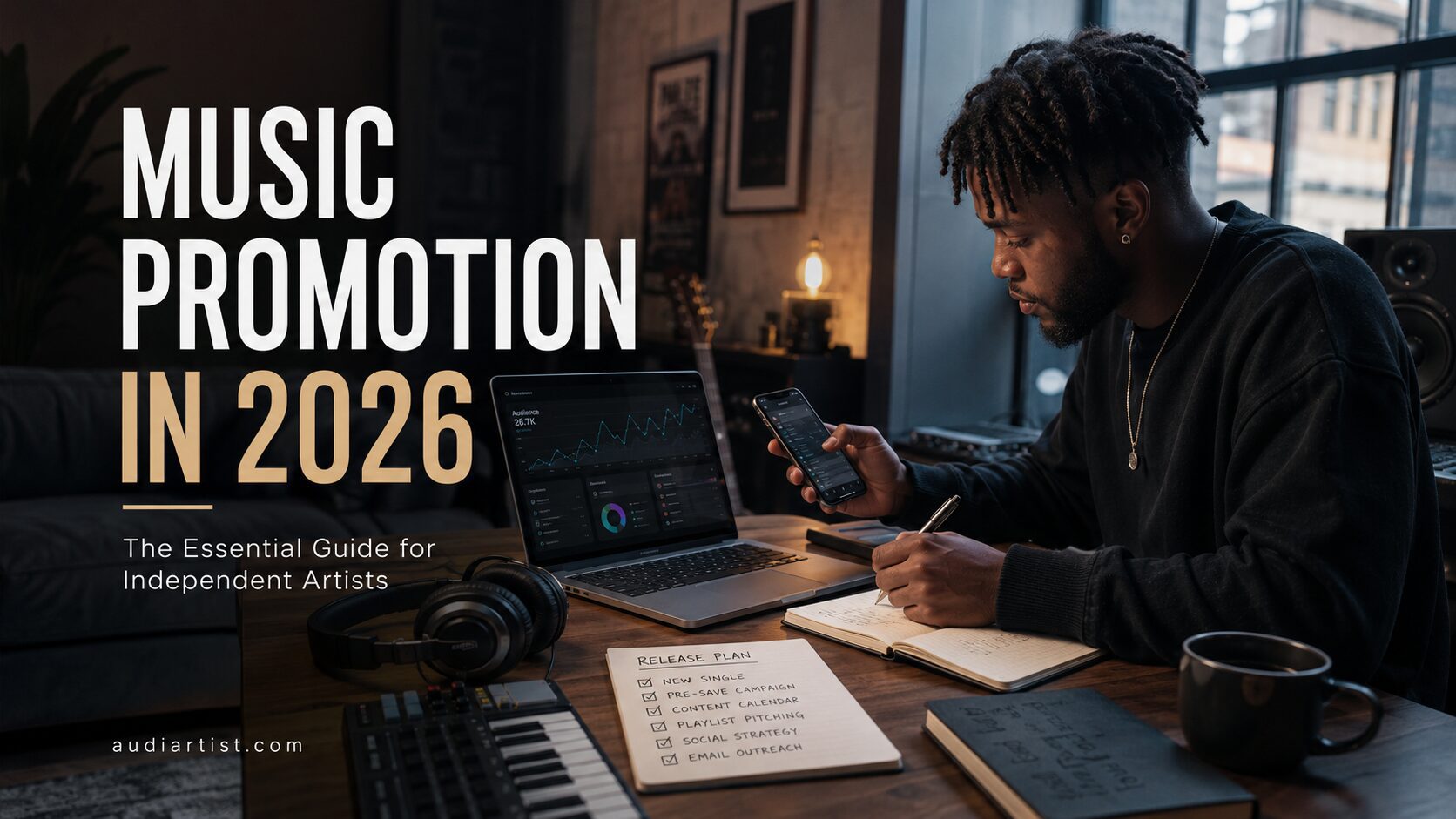
The strongest artists in 2026 are not only releasing music. They are building connected ecosystems around their work. A song can be discovered through a playlist, reinforced by a short video, remembered through a visual identity, explained through behind-the-scenes content, and converted into loyalty through direct fan connection.
That is the central idea behind The Future of Indie Music Marketing: Playlists, Video Content and Direct Fan Connection. This article explains why independent music marketing can no longer depend on one channel alone. Playlists still matter, video content has become essential, and direct fan relationships are more valuable than ever. But each tool only becomes powerful when it supports the others.
Artists who want a complete overview should also read Music Promotion in 2026: The Complete Audiartist Strategy Guide. It acts as a strategic entry point for understanding the modern promotion landscape and why visibility without structure often disappears too quickly.
Turn Every Release Into a Campaign
One of the biggest mistakes independent artists still make is treating a release as a single moment. They upload the track, post the link, wait for reactions, then move on when the first wave fades. That approach wastes the potential of the song.
From Single to Campaign: Why Every Release Needs a Promotion Plan explains why every release should be built like a campaign, not a one-day announcement. The article shows how preparation, storytelling, visuals, content rhythm, playlist pitching, and post-release follow-up all shape whether a track lands with impact or disappears into the streaming ocean.
For artists who often wait too long before posting, Why Most Artists Post Too Late: The Pre-Release Promotion Window Explained is essential reading. Release day should not be the beginning of promotion. It should be the moment when preparation starts paying off. Teasers, context, visual cues, early stories, and audience warming all help a song arrive with more weight.
Promotion should also continue after the first week. Why Artists Should Promote Their Catalog Like New Releases reminds musicians that older songs are not dead assets. A strong catalog can keep working for months or years when artists give listeners new reasons to rediscover it.
Use Playlists as Discovery, Not as a Career Plan
Playlists remain one of the most important discovery tools for independent artists, but they are often misunderstood. A playlist placement can create streams, reach, and social proof. What it cannot do alone is build a fanbase.
Why Playlists Still Matter for Independent Artists in 2026 gives the most balanced view: playlists are still powerful, but only when they are part of a wider strategy. The right playlist can introduce a song to new listeners, but the artist must have a profile, catalog, content plan, and identity strong enough to keep that listener interested.
That idea is pushed even further in Why Playlists Alone Won’t Build Your Music Career. Streams can rise without creating loyalty. A listener can enjoy a song inside a playlist and never remember the artist’s name. The real challenge is to turn passive listening into recognition.
This is where Playlist Placement That Sticks: Turn Streams into Fans becomes especially useful. Getting added is only the first step. Artists need to support the placement with social content, profile updates, smart follow-up, and clear calls to explore more music.
Pitch Curators With Precision and Respect
Playlist pitching is not a numbers game. Sending the same message to hundreds of curators rarely builds meaningful support. In 2026, curators want professionalism, relevance, strong sound quality, and a clear understanding of their playlist identity.
Playlist Pitching in 2026: What Curators Really Want From Independent Artists is one of the most useful articles for artists preparing submissions. It explains why curators are not only listening for a good track. They are listening for fit, clarity, respect, and readiness.
For a deeper relationship-based approach, The Curator Relationship System shows why long-term trust matters more than one isolated placement. Artists who listen to playlists before pitching, communicate clearly, acknowledge support, and reconnect only when the music fits are more likely to be remembered.
Artists should also protect themselves from bad opportunities. How to Spot Fake or Risky Playlists Before They Hurt Your Stats is essential for anyone tempted by suspicious playlist growth, artificial engagement, or unrealistic promises. Fake visibility can damage data, distort audience signals, and weaken the credibility of a release.
Turn Playlist Wins Into Marketing Assets
A playlist placement should not disappear after one screenshot. It can become proof, content, social validation, and a reason to restart the conversation around a song.
Playlist Proof: Turning Placements into Marketing Assets explains how artists can use placements intelligently without turning every update into self-congratulation. A good placement can support press outreach, social storytelling, fan communication, and future pitching, especially when the artist frames it as shared discovery rather than empty bragging.
The best playlist strategy is not about chasing every possible add. It is about reaching the right audience, learning from the results, and using every moment of attention to strengthen the artist’s world.
Build a Short-Video Engine Around the Music
Short videos have become one of the main entry points into music discovery. TikTok, Instagram Reels, and YouTube Shorts can introduce a track to listeners before they ever search for the artist on streaming platforms. But short-form content only works when it serves the music.
How Short Videos Became the New Music Promotion Engine explains why a few seconds can now shape the first impression of a song. The strongest clips are not random. They highlight a hook, a lyric, a production detail, a performance moment, a visual mood, or a story that makes the track easier to remember.
Artists who want to understand platform behavior should read TikTok for Musicians in 2026. It shows why TikTok is no longer only a place for accidental viral moments. It is a discovery engine, a search environment, and a fan-building tool when artists use it with intention.
Behind-the-scenes content also deserves a serious place in the campaign. How to Turn Behind-the-Scenes Content Into Music Promotion That Actually Converts explains how studio moments, demo versions, production choices, video shoots, and creative decisions can become more than filler content. When used properly, they give the audience a reason to care about the process behind the song.
Use Conversation as Promotion
Modern audiences often ignore generic release announcements. They scroll past polished graphics, repeated links, and empty “out now” captions with frightening efficiency. Conversation can cut through that coldness because it feels human.
Comment-Led Promotion: How Artists Use Conversations to Drive Streams explores how artists can use replies, comments, questions, and audience interaction to create real movement around a release. Promotion is no longer only broadcast. It is dialogue.
This does not mean artists should beg for engagement or spam every comment section like a desperate intern trapped in a Wi-Fi router. It means they should create openings for real reactions: asking about lyrics, sharing context, responding to listeners, and making fans feel involved in the release story.
Grow Without Depending Only on Ads
Paid promotion can be useful, but it should not be the only engine behind a music career. Many independent artists need organic systems that can work consistently without draining their budget.
Music Promotion Without Ads: What Still Works Organically in 2026 focuses on the strategies that still matter without paid campaigns: consistent content, direct audience connection, playlist research, smart storytelling, community building, profile optimization, and long-term catalog activation.
Organic promotion is not magic. It is slower, but it can build stronger foundations because it forces the artist to understand their audience, message, and identity. Paid visibility can amplify a weak system, but it cannot replace one.
Think Like a Modern Independent Artist, Not Just a Musician
Today’s independent artist often works like a small creative company. The song may start in a home studio, but the full journey includes production, mixing, mastering, distribution, release planning, visuals, playlist outreach, social content, data analysis, and fan communication.
The New Indie Artist Workflow: From Home Studio to Global Audience captures this reality clearly. It is a useful article for artists who want to understand how the creative process and promotion process now connect. A strong track still matters, but the workflow around it often decides how far it travels.
Artists should also pay close attention to loyalty signals. The Save, Follow, Repeat Loop: Signals That Build Careers explains why saves, follows, repeat listens, and personal playlist adds matter more than raw stream spikes. These signals show that listeners are not just passing through. They are coming back.
Prepare for Breakout Moments Before They Happen
Every artist dreams of a breakout moment, but few are ready when it arrives. A sudden viral clip, playlist spike, influencer use, or press mention can create attention fast. Without a follow-up plan, that attention fades just as quickly.
Post-Viral Strategy: What Artists Should Do in the 10 Days After a Breakout Moment is a practical guide for artists who need to turn a sudden spike into something useful. The key is speed, clarity, and conversion: update profiles, pin the right content, guide listeners to the track, create follow-up posts, capture new fans, and keep the story alive while attention is still warm.
Virality is not a career plan. It is a door opening suddenly. The artists who benefit from it are the ones who already know what room they want people to enter.
The Audiartist Music Promotion Reading Path
For independent artists who want to build a stronger strategy, the best approach is to read the Audiartist Music Promotion category as a connected path:
- Start with the complete strategy guide to understand the global picture.
- Learn how to turn a single into a campaign before your next release.
- Prepare your pre-release window instead of waiting until release day.
- Improve your playlist pitching with sharper, more respectful outreach.
- Use playlists as discovery tools, not as the whole strategy.
- Build short-video content that translates the song visually.
- Use conversations to turn cold attention into human engagement.
- Track real loyalty signals instead of chasing numbers that do not return.
- Keep promoting your catalog so older songs continue working.
- Explore the full Music Promotion category for more guides, analysis, and artist-focused strategies.
Final Takeaway: Stop Chasing Moments, Start Building Momentum
The most important lesson across Audiartist’s Music Promotion section is simple: independent artists should stop treating promotion like a last-minute task and start treating it like a long-term creative system.
A release needs preparation. A playlist placement needs follow-up. A short video needs a destination. A fan needs a reason to return. A catalog needs new life. A curator relationship needs trust. A breakout moment needs structure. Every piece matters because modern music discovery is fragmented, fast, emotional, visual, algorithmic, and deeply human at the same time.
For independent artists, that may sound demanding, but it is also good news. Promotion is no longer reserved for those with the biggest budget. It rewards artists who build clearly, communicate consistently, and understand how each action supports the next.
The artists who grow in 2026 will not be the ones who shout the loudest. They will be the ones who create a system strong enough for listeners to find them, remember them, follow them, and come back.