Free Reverb VST
WET Reverb: A Free 12-Bit Digital Reverb With Vintage Character
Five retro-inspired spaces, early reflections and deliberately limited digital processing for synths, vocals, drums and atmospheric production.
WET Reverb is a free and open-source VST3 effect developed by Ronald Klarenbeek under the WET VST project. It recreates the grainy and slightly restricted character associated with digital rack reverbs from the 1980s.
Instead of aiming for transparent modern space, the plugin processes its reverb signal internally at 24 kHz and 12-bit resolution. This reduces high-frequency detail and introduces a subtle digital texture that can help clean software instruments, vocals and percussion feel less polished.
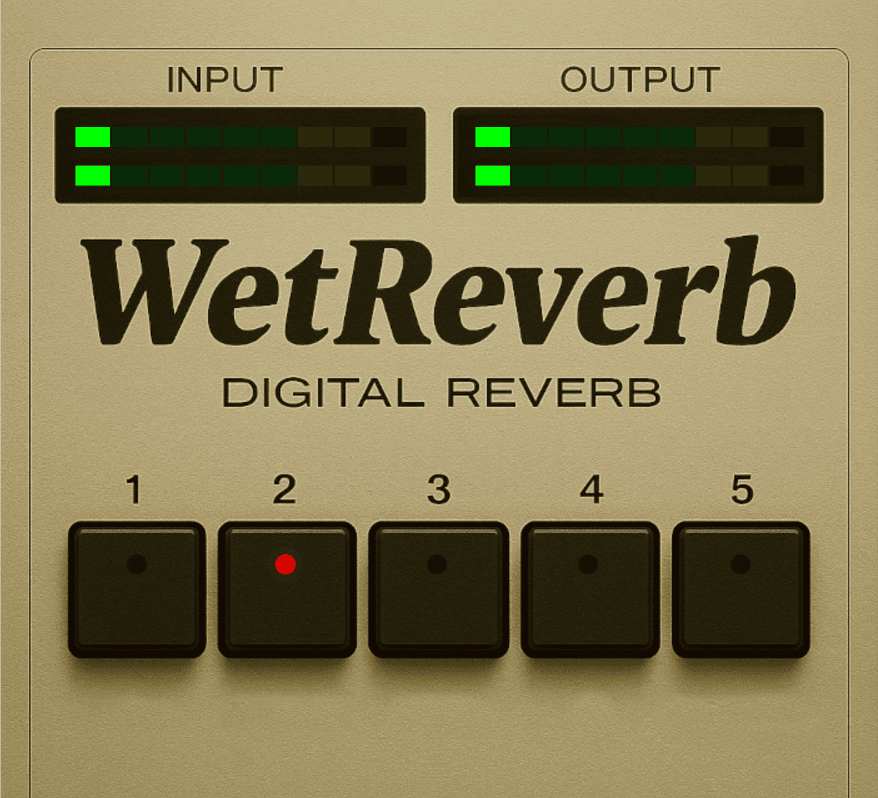
WET Reverb offers five algorithms named Room, Plate, Hall, Cathedral and Cosmos. Each mode uses a different combination of pre-delay, early reflections, parallel comb filters and diffusion stages.
The plugin is completely free, requires no account or license manager and is distributed with its source code under the MIT License.
| Developer | Ronald Klarenbeek, also known as Yonie |
|---|---|
| Plugin type | Vintage digital reverb |
| Current version | 1.0.1 |
| Platforms | Windows, macOS and Linux |
| Plugin format | VST3 |
| Reverb modes | Room, Plate, Hall, Cathedral and Cosmos |
| Internal processing | 24 kHz sample rate and 12-bit quantization |
| Output | 100% wet |
| Price | Free and open source |
Five Distinct Reverb Modes
WET Reverb keeps its interface deliberately simple. Producers choose one of five algorithms instead of adjusting several pages of technical parameters.
Room creates a compact and intimate space with prominent early reflections. It works well on drums, percussion, guitars and sounds that need dimension without a long reverb tail.
Plate delivers a denser and brighter response. It is particularly useful for vocals, snares, synth leads and melodic instruments that need sustain without sounding as though they were recorded inside a physical room.
Hall produces a smoother and wider ambience with a 25-millisecond pre-delay. It can add depth to pads, strings, vocals and atmospheric electronic arrangements.
Cathedral uses a longer pre-delay and more diffuse reflections. It is suitable for cinematic music, ambient textures, dramatic vocals and transitions that need a larger sense of scale.
Cosmos is the most spacious algorithm. Its extended pre-delay and dense diffusion create an ethereal wash suited to drones, pads, sound effects and experimental production.
Authentic 12-Bit Digital Texture
The reverb path operates at an internal sample rate of 24 kHz before being converted back to the host rate. This naturally limits the frequency bandwidth and produces a darker response than most modern high-definition reverbs.
The signal is also quantized to 12 bits with TPDF dither. As the reverb tail decays, the reduced resolution introduces a gentle grain that recalls early digital studio processors.
This character is useful when a clean algorithmic or convolution reverb feels too polished. WET Reverb can make modern wavetable synths, precise drum samples and pristine vocals sit more naturally inside retro, lo-fi or cinematic arrangements.
Early Reflections and Schroeder Diffusion
Each mode includes its own early-reflection pattern. These short delays help define the apparent size and shape of the virtual space before the longer reverb tail develops.
The late reverb uses a Schroeder-style structure built from parallel comb filters followed by series all-pass filters. Different modes change the number of filters, pre-delay time and damping behavior.
This architecture produces a recognizable vintage digital sound rather than attempting to reproduce one real room with photographic precision.
Designed for Auxiliary Sends
WET Reverb outputs only the processed signal. There is no dry and wet mix control inside the plugin.
The recommended workflow is therefore to load it on an auxiliary or effect-return channel. Individual tracks can then be sent to the reverb while the original dry signals remain on their own channels.
This setup provides independent control over the reverb level and makes it easier to place an EQ, compressor, chorus or saturation plugin after the reverb.
The fully wet design is less convenient for direct insert use, but it reflects the workflow of traditional hardware rack effects and keeps the plugin focused.
Stereo Crosstalk and Frequency Shaping
WET Reverb introduces a small amount of signal bleed between its left and right channels. This subtle crosstalk prevents the stereo image from feeling completely isolated and helps recreate imperfections associated with older circuitry.
The processing chain also includes high-frequency damping, an output low-pass filter and an 80 Hz high-pass filter. These fixed stages help the reverb remain dark while reducing unnecessary low-frequency buildup.
On vocals and synths, this frequency shaping can help the reverb stay behind the dry source without requiring immediate corrective EQ.
Best Uses
- Synthwave and retro electronic music
- Lo-fi and early digital textures
- Vocal and snare reverb sends
- Ambient pads and drones
- Cinematic transitions and atmospheres
- Dark reverb for synth leads
- Electronic percussion and drum machines
- Experimental resampling
Compatibility and Installation
WET Reverb is available exclusively in VST3 format.
The Windows build requires a 64-bit installation of Windows 10 or Windows 11. Linux users need an x86-64 system and a DAW that supports Linux VST3 plugins.
On macOS, native Apple Silicon systems require macOS 11 or later. Intel Macs require macOS 10.13 or later.
The download includes builds for all supported platforms in one archive. Users manually copy the plugin into the appropriate VST3 directory and rescan their plugins inside the DAW.
The macOS build is not signed or notarized. Apple may therefore block it until the quarantine attribute is removed using the Terminal instructions provided by the developer.
No account, email registration, subscription, activation code or license manager is required.
Main Limitations
- Available only in VST3 format
- No Audio Unit, AAX, VST2, CLAP or standalone edition
- No internal dry and wet control
- No adjustable decay, size or damping parameters
- No modulation controls
- The five reverb programs use fixed settings
- The macOS build is not signed or notarized
Final Verdict
WET Reverb is a focused free VST for producers who want the darker and grainier character of early digital rack effects without navigating an oversized interface.
Its five algorithms cover compact rooms, dense plates, smooth halls, large cathedrals and atmospheric washes. The 24 kHz processing, 12-bit quantization, early reflections and stereo crosstalk give each mode a clear retro personality.
The lack of adjustable parameters limits its flexibility, but it also makes the workflow immediate. Select a mode, control the return level and continue producing before the reverb tail finishes explaining its modulation matrix.
For synthwave, ambient music, lo-fi production, vocals and electronic drums, WET Reverb is a lightweight and useful open-source effect.