
The launch gives Deezer a sharper role in a debate that is quickly reshaping digital music: how should streaming platforms handle AI-generated content, and how can listeners know whether the music in their playlists was created by humans or machines?
Deezer AI Music Detector Expands the Fight Against AI-Generated Music
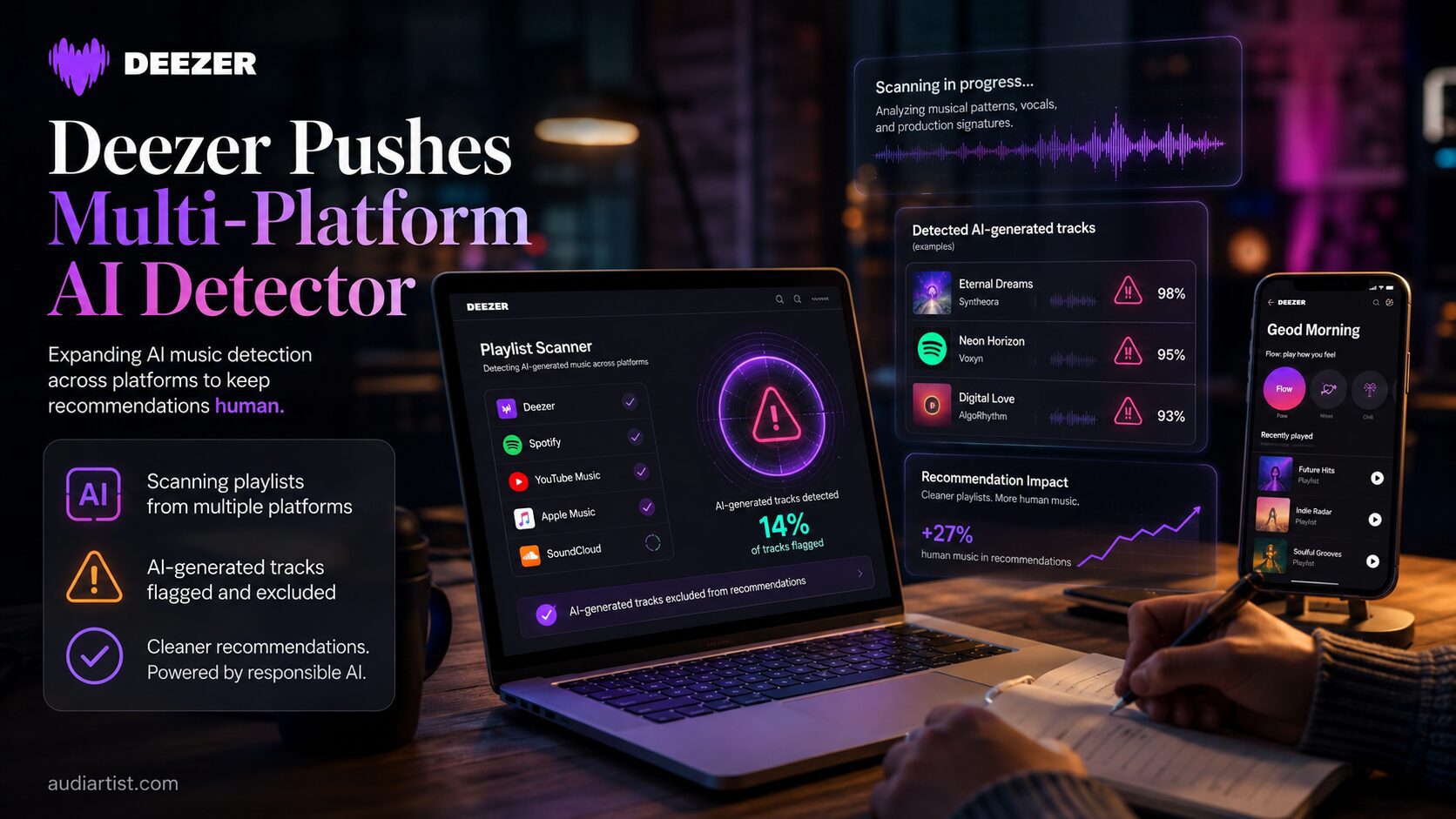
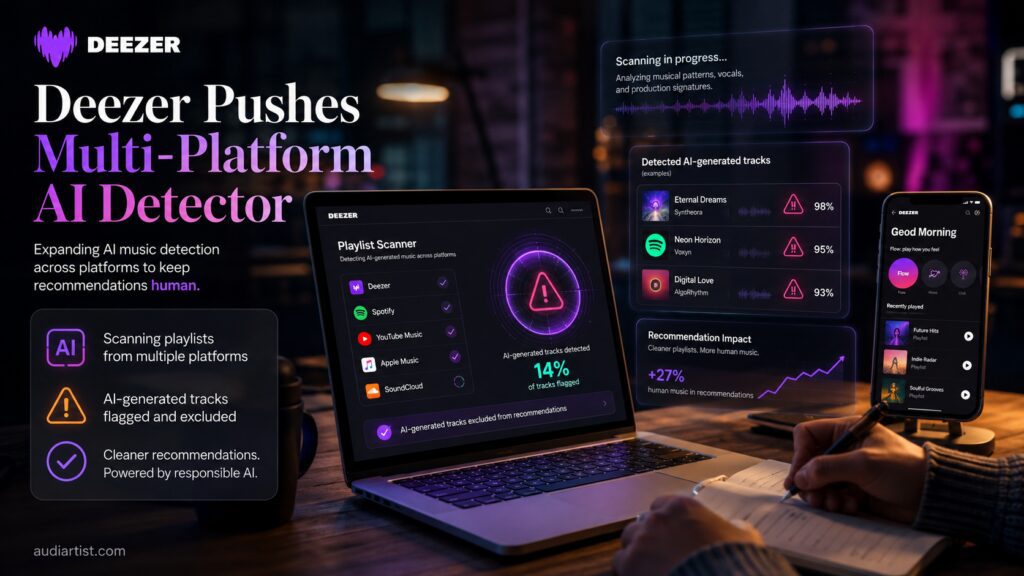
The Deezer AI Music Detector allows users to check playlists for tracks that may have been generated by artificial intelligence. The tool is designed to work across major streaming platforms, giving listeners a way to inspect playlists beyond Deezer’s own ecosystem.
That multi-platform angle is important. AI music is not limited to one service, one distributor, or one catalog. It moves through the same digital supply chain as human-made music, appearing in playlists, algorithmic feeds, search results, and background listening environments. By making the detector accessible outside its own app environment, Deezer is positioning itself not only as a streaming platform, but as a transparency actor in the wider music economy.
The company’s message is clear: AI-generated music is no longer a marginal trend. It has become a high-volume content issue with direct consequences for discovery, royalties, fraud detection, and trust.
A Streaming Industry Flooded by AI Tracks
According to Deezer, almost 75,000 fully AI-generated tracks are now delivered to its platform every day. That figure represents roughly 44% of daily music uploads, a level that signals a major shift in the way streaming catalogs are being filled.
The growth is striking because streaming platforms were built around scale. For years, more music meant more choice, more discovery, and more opportunity for independent artists. AI changes that equation. When synthetic tracks can be generated and uploaded at industrial speed, the catalog itself risks becoming harder to navigate.
For listeners, the problem is transparency. Many people may not know whether a track in a playlist was created by a human artist, a production team, or a generative AI system. For artists, the issue is economic. If mass-produced AI tracks enter the same attention and royalty systems as human-made work, they can increase competition for streams without adding the same creative labor, career development, or cultural context.
Why Deezer Removes AI Music From Recommendations
Deezer says tracks detected as AI-generated are removed from algorithmic recommendations and kept out of editorial playlists. That policy is one of the most aggressive positions taken by a major streaming platform so far.
The decision does not necessarily mean that every AI-generated track disappears from the platform. Instead, it limits the ability of such content to gain visibility through recommendation systems, which are among the most powerful engines in streaming. In practical terms, Deezer is trying to prevent synthetic music from being amplified by its own discovery tools.
This matters because playlists and recommendations are not neutral spaces. They influence listening habits, artist visibility, and royalty distribution. If AI-generated tracks are pushed through the same systems as human-made songs, they can affect how money and attention move across the platform.
Context: Why This News Matters Now
The rise of AI-generated music has become one of the defining conflicts in the modern music business. Generative tools can now produce songs, instrumentals, vocal-style performances, background tracks, and genre-specific material with increasing speed and realism.
That creates opportunities, but also serious risks. Artists and songwriters are asking whether their work has been used to train AI models without permission. Labels and publishers are demanding clearer rules around licensing and attribution. Platforms are under pressure to detect fraud, protect royalty pools, and avoid turning music discovery into an endless feed of anonymous synthetic content.
Deezer’s move arrives as streaming services face a credibility test. The next phase of music streaming will not only be about having the largest catalog. It will also be about proving that listeners can trust what they hear, and that human creators are not being buried under automated uploads.
Industry Impact: What the Deezer AI Music Detector Could Change
The Deezer AI Music Detector could influence how the wider streaming industry handles AI transparency. If users begin expecting visible AI labeling and playlist checks, rival platforms may face pressure to introduce similar tools or explain why they do not.
For playlist curators, the impact could be immediate. Curators who want to maintain human-made music selections may use detection tools as part of their review process. This could become especially important for independent playlists, editorial brands, sync libraries, and music discovery platforms that want to protect their credibility.
For distributors, the pressure may also increase. If streaming platforms become more transparent about AI music, distributors may need stronger upload policies, clearer declarations from artists, and better internal screening before content reaches digital services.
For artists, the tool supports a broader demand for fairness. Human creators are not only competing for streams. They are competing for visibility inside systems that can be flooded with low-cost synthetic tracks. Detection and labeling may become essential parts of protecting the value of human-made music.
What Happens Next
The biggest question now is whether other major streaming platforms will follow Deezer’s lead. Spotify, Apple Music, Amazon Music, YouTube Music, SoundCloud, and Tidal all face the same underlying problem: AI-generated music is entering the supply chain quickly, and users increasingly want clarity.
There is also a technical challenge. AI music detection must evolve as generative tools improve. As models become more realistic, platforms will need stronger systems, better datasets, and more transparent policies to keep up.
The legal and commercial questions are just as important. If AI-generated music continues to grow as a share of daily uploads, the industry will need clearer rules on labeling, monetization, royalties, fraud prevention, and training data. Detection is only the first layer. The larger battle is about how music platforms define value in an era where content can be produced almost infinitely.
Conclusion
Deezer AI Music Detector marks a serious escalation in the streaming industry’s response to synthetic music. By giving users a way to scan playlists and by excluding detected AI-generated tracks from recommendations and editorial playlists, Deezer is drawing a clear line between catalog availability and platform promotion.
The move sends a strong message to the music business: transparency is becoming a competitive issue. In the age of generative audio, platforms will not only be judged by how much music they host, but by how clearly they protect listeners, artists, and the integrity of discovery.
For streaming, the AI music debate has moved beyond theory. It is now inside playlists, recommendations, royalty systems, and user trust. Deezer has chosen to make detection visible. The rest of the industry may soon have to decide whether staying quiet is still an option.