
The case places independent musicians, music platforms, AI developers, and rights holders at the center of a dispute that could help define how copyrighted music is treated in the next phase of generative audio. At issue is not only whether sound recordings were allegedly copied, but whether the descriptive data attached to music, including tags for genre, instruments, mood, and other categories, can become part of the training fuel for commercial AI models.
Jamendo Nvidia AI Lawsuit Targets Alleged Use of Audio Files and Metadata
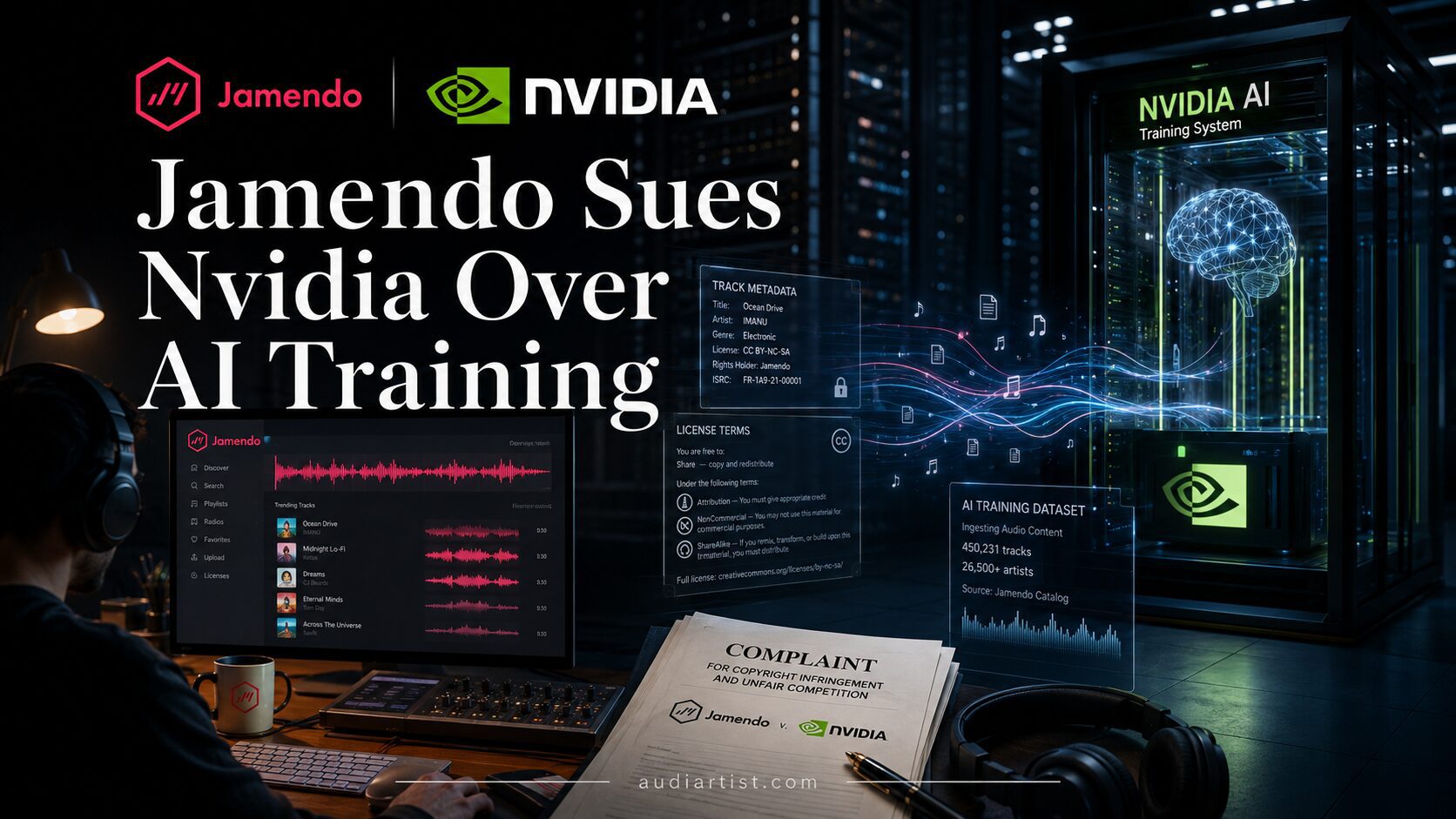
Jamendo, owned by Winamp Group, has filed a lawsuit in California federal court against Nvidia, accusing the chipmaker of using hundreds of thousands of audio files and related metadata from its platform in the development of AI audio systems.
The complaint names two Nvidia projects at the center of the dispute: Fugatto, described as an AI audio generator, and Audio Flamingo, an audio language model designed to interpret and describe sound. Jamendo alleges that its music and data were used without authorization, raising fresh questions about how AI companies acquire, process, and justify the datasets behind generative audio tools.
Nvidia has become one of the most powerful companies in the artificial intelligence economy, largely because its chips are central to AI computing. This lawsuit, however, shifts attention away from hardware and toward the material used to train AI systems. For the music industry, that distinction matters. The debate is no longer only about who builds the technology, but also about whose work makes the technology possible.
Why the Case Matters for Independent Artists
Jamendo has long positioned itself as a platform for independent music and creator-driven licensing. That makes the case especially sensitive for artists outside the major-label system, many of whom rely on platforms, licensing libraries, and direct catalog control to protect and monetize their work.
The lawsuit argues that Jamendo-related content was allegedly used in a way that bypassed authorization and compensation. If proven, the claim would reinforce a central concern shared by many independent musicians: that catalogs built for discovery, licensing, or creative distribution can be repurposed into AI training material without clear consent.
This concern is becoming more urgent as AI music tools grow more capable. Generative audio systems can now create songs, sound effects, voices, instrumental textures, and music-like outputs at speed. For artists and rights holders, the question is no longer abstract. It touches ownership, attribution, royalties, licensing value, and the future role of human-made catalogs in machine-generated music.
The Role of Metadata in the Jamendo Nvidia AI Lawsuit
One of the most important parts of the Jamendo Nvidia AI lawsuit is the reference to metadata. Music metadata is often treated as background information, but in AI training it can become extremely valuable.
Tags describing genre, instrumentation, mood, atmosphere, tempo, and usage context can help machine learning systems understand and classify audio. In practical terms, metadata can teach an AI model how a track should be interpreted, described, retrieved, or recreated in response to a prompt.
That makes the dispute wider than a standard music copyright fight. It raises a difficult question for the streaming and licensing economy: if a platform builds structured music data around independent artists, who controls that data when it becomes useful for AI development?
Context: Why This News Matters Now
The Jamendo Nvidia AI lawsuit arrives during a period of intense legal pressure around AI training. Across music, publishing, film, photography, journalism, and voice work, rights holders are challenging the idea that large-scale copying for AI development can happen without permission or payment.
Music is one of the most exposed sectors because audio models depend on highly detailed creative inputs. A finished track contains performance, composition, arrangement, production choices, mixing decisions, sonic identity, and cultural context. When those elements are absorbed into training systems, creators want to know whether their work is being protected or quietly converted into infrastructure.
The case also lands at a time when platforms are under growing pressure to separate human-made music from AI-generated content. Streaming services, distributors, licensing companies, and artist platforms are all trying to define how AI music should be labeled, monetized, recommended, and regulated.
Industry Impact: What the Case Could Change
If Jamendo succeeds, the lawsuit could strengthen the argument that AI developers need clearer licenses for music datasets, including both audio files and associated metadata. That could affect not only AI companies, but also platforms that store, tag, distribute, or license independent music catalogs.
A ruling or settlement could push the industry toward more formal AI licensing frameworks. These may include opt-in training agreements, dataset audits, revenue-sharing structures, transparency reports, and stronger contractual limits on how catalog content can be used.
For independent artists, the impact could be significant. A stronger legal standard may give creators more control over whether their music can be used to train generative systems. It could also create new licensing opportunities for catalogs that are legally cleared for AI use.
For AI companies, the case adds another layer of legal risk. Generative audio tools are advancing quickly, but the business model behind them may become harder to scale if training data must be licensed more carefully and documented more transparently.
What Happens Next
The lawsuit will now move through the federal court process in California, where Nvidia will have the opportunity to respond to Jamendo’s claims. The case may involve questions about copyright ownership, dataset access, copying, fair use, licensing terms, and the role of metadata in AI training.
Jamendo is seeking damages and a court order that would block Nvidia from using the disputed content. Those demands point to two possible outcomes: financial compensation for alleged past use and restrictions on future use of the catalog.
As with many AI copyright cases, the timeline may be long. Legal battles over training data are technically complex and often require detailed examination of datasets, model development, documentation, and internal processes. Still, the filing itself sends a clear signal to the market: music rights holders are no longer waiting politely at the studio door.
Conclusion
The Jamendo Nvidia AI lawsuit is more than another copyright complaint. It is a test case for the future relationship between independent music catalogs and the artificial intelligence industry.
If courts begin to treat music datasets and metadata as protected assets that require clear authorization, the economics of generative audio could change dramatically. AI companies may need to prove not only what their models can create, but also how those models were trained and whether the creators behind the source material were properly respected.
For artists, platforms, and the wider music business, the message is clear: the next battle over streaming and AI will not only be fought over songs people hear, but over the invisible data systems that teach machines how music sounds, feels, and moves.