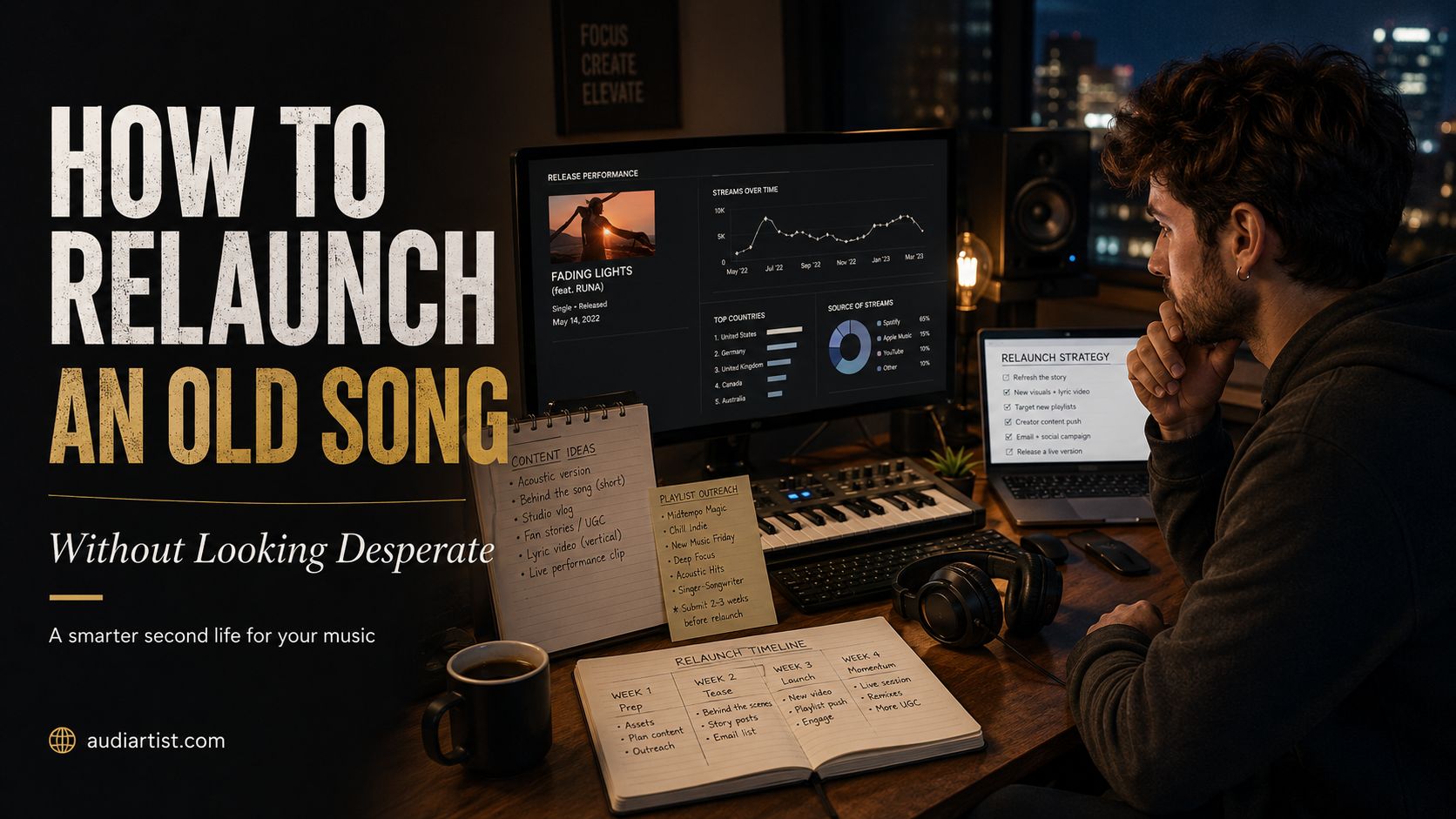

Not every song finds its audience the week it comes out. Some tracks need time, context, timing, and a second chance.
But music does not always move at the speed of the algorithm. A song can miss its moment because the campaign was too small, the visuals were weak, the timing was poor, the artist had no audience yet, or the wrong message was used. A track can also become more relevant later, when a new season, trend, collaboration, video idea, playlist angle, or personal story gives it fresh meaning.
Relaunching an old song is not a sign of failure. Done badly, it can look like an artist begging people to care about something they ignored the first time. Done well, it can feel like a discovery, a rediscovery, or a new chapter in the song’s life. The difference lies in strategy.
The goal is not to pretend the song is new. The goal is to give people a new reason to listen.

Why Old Songs Still Matter
Independent artists often underestimate the value of their existing catalog. Once a track has been released, they mentally place it behind them and treat it as finished history. This is a mistake. A song does not lose its potential simply because the release date has passed. For most listeners, the song is not old. It is only old to the artist.
This is one of the most important mindset shifts in music promotion. An artist may have lived with a track for months, from writing to production, mixing, mastering, artwork, distribution, and launch. By the time it is out, the artist is already emotionally tired of it. But a new listener has none of that fatigue. To them, the track is immediate, fresh, and judged only by the feeling it creates.
The digital world gives songs a longer life than the old release calendar suggests. A track can be discovered through a playlist months later. A short video can revive interest unexpectedly. A sync-style visual can change how people perceive it. A live version can reveal a new emotional layer. A remix can bring it into another scene. A blog article can give it context. A DJ set, podcast, radio show, or user-generated video can make it travel again.
The catalog is not a cemetery. It is an archive of opportunities.
The Difference Between Relaunching and Reposting
There is a major difference between relaunching a song and simply reposting the same link. Reposting says, “Please listen again.” Relaunching says, “Here is a new reason this song matters now.”
A weak relaunch is usually built around repetition. The artist posts the same cover, the same caption, the same streaming link, and the same vague message: “Out now.” The problem is obvious. If that message did not create enough movement the first time, repeating it months later rarely changes anything.
A strong relaunch changes the frame. The song may be presented through a story, a new visual identity, a performance, a seasonal mood, a remix, a stripped-back version, a production breakdown, a listener reaction, or a playlist narrative. The music is the same, but the entry point is different.
This is how successful catalog promotion works. It does not ask the audience to care out of loyalty. It creates a new context that makes the song feel relevant.
Start With a Release Autopsy
Before relaunching an old song, artists need to understand why the original campaign did not reach its full potential. This should not be an emotional exercise. It should be practical, honest, and specific.
The first question is whether the song underperformed because of the music or because of the campaign. Those are not the same thing. A strong track can disappear because the artist had no content strategy, no playlist outreach, no press angle, no short videos, no clear audience, no mailing list, or no follow-up after release day. A weaker track can also receive plenty of promotion and still fail to connect because the hook, production, vocal, arrangement, or message did not land.
The relaunch should begin by reviewing the original data. How many streams did the song receive in the first 7, 14, and 30 days? Did it gain saves? Did listeners skip it quickly? Did one country respond more than another? Did any playlist generate quality engagement? Did one social post perform better than the official announcement? Did people comment on the lyrics, the production, the mood, or the visual?
The answer reveals the best relaunch path. A song with strong saves but low reach may need more exposure. A song with views but few streams may need a better link journey. A song with playlist streams but no engagement may need sharper targeting. A song with strong emotional comments may need a story-driven campaign.
Without this diagnosis, a relaunch is just another guess in a different outfit.
Find the New Angle
The new angle is the heart of the relaunch. It tells the audience why the song is returning now. Without it, the campaign feels forced. With it, the song feels alive again.
There are several powerful angles an artist can use. A seasonal angle works when the song matches a specific time of year, such as summer nights, winter melancholy, autumn nostalgia, club season, festival energy, Halloween atmosphere, or late-night driving. A story angle works when the artist can explain what inspired the song, what changed since its release, or why it still matters personally. A visual angle works when the song gains new life through a cinematic clip, lyric video, studio session, live performance, or music video.
A performance angle can be especially effective. If the original release was built around a polished studio version, a live version can make the track feel human. An acoustic version can reveal vulnerability. A DJ edit can make a house or techno track feel more functional. A vocal-focused clip can highlight emotion that listeners missed the first time.
The key is to avoid pretending nothing happened. The artist should not act as if the song is brand new unless it has been officially re-released, remastered, remixed, or packaged differently. Audiences respect honesty. A phrase like “this track deserved a second life” can feel stronger than another generic release announcement.
Use the Song’s Best Moment, Not the Whole Song
One of the most common mistakes in relaunching old music is trying to promote the entire track at once. In reality, most listeners enter through one moment. It may be the chorus, a drop, a bassline, a vocal phrase, a guitar riff, a lyric, a cinematic swell, a drum break, or a mood-setting intro.
The relaunch should identify the most immediate part of the song and build content around it. This is especially important for short-form video platforms, where the first seconds decide whether people stay. An old song can feel new when the strongest moment is finally presented with clarity.
Artists should listen to the track like a stranger. Where does the energy change? Where does the emotion peak? Which line could become a caption? Which instrumental moment feels visually strong? Which part would work under a behind-the-scenes video, a performance clip, a city shot, a dance sequence, a studio breakdown, or a storytelling reel?
Sometimes the original campaign failed because the wrong part of the song was promoted. The intro may have been too slow for social media. The cover may not have communicated the mood. The teaser may have missed the hook. A relaunch allows the artist to correct that mistake.
Give the Track a Visual Upgrade
A visual upgrade can completely change how an old song is perceived. This does not always mean an expensive music video. It can be a strong editorial photo, a lyric video, a vertical performance clip, a studio session, a cinematic loop, a visualizer, a behind-the-scenes reel, or a new artwork variation.
The important thing is coherence. The new visual world must match the song’s emotional identity. A dark synthwave track needs a different visual language from a lo-fi piano piece, a Latin urban single, an Afro house groove, or a cinematic trailer-style composition. When the visual direction is precise, the song becomes easier to understand before the first note even plays.
This matters because music promotion is increasingly visual. Many listeners discover songs first through an image, thumbnail, reel, story, or short video. If the visual does not create curiosity, the song may never receive a fair listen.
A relaunch is the perfect moment to improve the song’s presentation. If the original artwork was weak, the artist can create new promotional visuals without changing the official cover. If the original campaign had no video, a simple but tasteful visualizer can give the track a new home on YouTube or social media. If the song has a strong emotional story, a documentary-style clip can make it more personal.
The goal is not decoration. The goal is translation. The visual should translate the feeling of the song into something people can understand instantly.
Build a Micro-Campaign Instead of One Post
An old song cannot be relaunched properly with one post. It needs a short campaign, even if the campaign is simple. The mistake many artists make is announcing the relaunch once, seeing limited movement, then deciding that the track is finished. That is not strategy. That is a coin toss.
A better approach is to build a 10 to 14-day micro-campaign. The first post reintroduces the song through the new angle. The second highlights the strongest musical moment. The third tells the story behind it. The fourth uses a short video or visual excerpt. The fifth points listeners toward a playlist, streaming link, or artist profile. The following posts can test variations: another clip, a quote from the lyrics, a production detail, a listener reaction, or a personal reflection.
This kind of campaign gives the audience several entry points. Not everyone reacts to the same message. Some listeners connect through sound. Others connect through story. Some need a visual. Others need social proof. A micro-campaign allows the song to breathe across multiple formats.
The artist should not post the exact same link every day. Each post should add a small piece of meaning. That is what makes the relaunch feel intentional rather than repetitive.
Use Playlists Strategically, Not Desperately
Playlist pitching can be part of a relaunch, but it must be handled carefully. Sending an old song to curators with no context can feel weak, especially if the track is presented as if it just came out. Curators want a reason to care. The artist needs to give them one.
A stronger pitch explains why the song is being pushed again. Maybe it has a new video, a remastered version, a remix, a seasonal relevance, growing listener activity, or a fresh campaign behind it. The pitch should be concise and honest. It should also target playlists where the track genuinely fits.
This is where previous data becomes useful. If the song performed well in a certain mood or territory, the artist can use that information to guide outreach. If listeners saved the track from chill electronic playlists, do not suddenly pitch it to high-energy festival playlists. If the track gained traction in cinematic or emotional contexts, lean into that identity.
Playlist relaunch strategy is not about begging for a second chance. It is about presenting the song with a clearer reason and better targeting than before.
Consider a Remix, Edit, or Alternate Version
Sometimes the best way to relaunch an old song is to create a new version. A remix can move the track into another scene. A radio edit can make it more direct. An extended mix can help DJs. A stripped version can reveal the writing. A live version can bring intimacy. A sped-up or slowed-down version may work in certain social contexts, but it should be used with taste and not as a cheap gimmick.
For electronic artists, alternate versions can be especially powerful. A deep house version, Afro house version, techno edit, lo-fi reinterpretation, cinematic version, or club mix can open the track to a different audience while keeping the original song alive. For singer-songwriters, acoustic sessions, piano versions, or live takes can create a new emotional relationship with listeners.
The important question is whether the new version adds value. A remix should not exist only to extend the campaign artificially. It should reveal a new dimension of the track. If it feels unnecessary, the audience will sense it.
When done well, an alternate version gives the artist permission to talk about the song again without sounding repetitive. It becomes a new chapter rather than a recycled post.
Use the Catalog Effect
Relaunching an old song can also support the wider catalog. Instead of promoting the track alone, the artist can connect it to newer releases, similar moods, or a playlist of their own music. This creates a pathway for discovery.
For example, an artist can say that a new single continues the atmosphere of an older track. A producer can create a mini-playlist around a specific sound: late-night house, cinematic tension, lo-fi nostalgia, synthwave driving music, or emotional pop. A relaunch can also introduce new fans to a song they missed before discovering the artist.
This approach works because listeners often arrive late. Someone who discovers an artist through a new release may enjoy exploring earlier songs if the connection is clear. The artist’s job is to guide that exploration.
The catalog effect is one of the most underrated parts of music promotion. Every new listener is not only a listener for the latest single. They are a potential listener for everything the artist has already created.
Avoid the Desperation Trap
The line between a smart relaunch and a desperate relaunch is mostly about tone. Desperation sounds like guilt, pressure, or frustration. Strategy sounds like confidence, context, and direction.
Artists should avoid captions that complain about poor numbers, blame algorithms, shame listeners for not supporting, or over-explain why the song deserved more attention. That kind of messaging can make the audience uncomfortable. It places emotional pressure on listeners instead of inviting them into the music.
A stronger tone is calm and intentional. The artist can acknowledge that the song is returning with a new visual, a new version, a new story, or a renewed focus. The message should be positive, not needy. It should feel like an invitation, not a rescue mission.
Confidence matters. If the artist presents the relaunch as meaningful, the audience is more likely to perceive it that way. If the artist presents it as a last attempt, the campaign already feels weak.
When an Old Song Should Stay in the Past
Not every song should be relaunched. Some tracks belong to an earlier stage of the artist’s development. The production may no longer represent the current sound. The writing may feel immature. The mix may not meet the artist’s present standard. The visual identity may be too disconnected from the current brand.
Before relaunching, artists should ask whether the song still supports the direction they want to build. If the answer is yes, the track may deserve another campaign. If the answer is no, it may be better to leave it as part of the archive and focus on stronger material.
This decision requires honesty. Relaunching a song only because it exists is not enough. Relaunching it because it still has emotional, artistic, or strategic value is different.
A catalog should not become a museum of everything the artist has ever done. It should become a living body of work, with some songs pushed forward and others allowed to rest quietly.
Turn the Relaunch Into a Learning System
The relaunch should be measured like a new campaign. Artists should track streams, saves, follows, playlist adds, profile visits, video performance, link clicks, comments, shares, and territory changes. The goal is to understand whether the new angle improved the song’s performance.
If the relaunch performs better than the original campaign, the artist has learned something valuable about presentation. Maybe the new visual worked. Maybe the story was stronger than the initial release message. Maybe the song found a better audience. Maybe the hook needed a different clip. These lessons can shape future releases.
If the relaunch does not move the needle, that also matters. It may show that the artist’s energy is better spent on new music. It may also reveal that the song needs a stronger version, better targeting, or more compelling content.
The purpose of a relaunch is not only to revive one track. It is to improve the artist’s understanding of their own audience.
The Best Relaunch Feels Like Discovery
A great relaunch does not feel like an artist digging through the past. It feels like a song finding its proper moment. The campaign gives listeners a fresh door into the music, whether through a story, video, remix, mood, season, live version, or stronger promotional frame.
Independent artists should stop thinking of release dates as expiration dates. A song can live several lives if the artist knows how to create context around it. The first campaign may not be the final word. Sometimes the audience needs a different angle. Sometimes the artist needs better visuals. Sometimes the song needs time to catch up with the right moment.
Relaunching an old song without looking desperate comes down to one principle: never ask people to care again for the same reason. Give them a new reason.
That is how an old track becomes a renewed opportunity. Not by pretending the past did not happen, but by showing why the song still has somewhere to go.
Discover more independent music promotion strategies, artist resources, and playlist insights on Audiartist.