
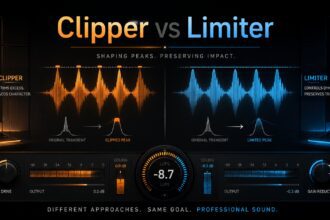
Clipper vs Limiter: How to Get Louder Masters Without Losing Punch
In modern music production, loudness is rarely created by a single plugin. The strongest masters usually result from several controlled stages working together, including arrangement, compression, saturation, clipping and final limiting. Among these tools, the clipper and the limiter are frequently confused. Both can reduce peaks, increase perceived loudness and prevent the signal from exceeding a chosen ceiling. However, they do not process audio in the same way, and using the wrong tool can quickly remove punch, introduce distortion or flatten an otherwise powerful mix. Understanding the difference between a clipper vs limiter is essential for producers working in electronic…

How to Produce Synthwave Music in 2026: Free VST Instruments, Effects and Mixing Tools
Synthwave music production in 2026 is no longer limited to recreating the 1980s with vintage synthesizer presets and gated drums. The genre now combines retro analog character, cinematic composition, modern low-end control and contemporary mixing techniques. You do not need an expensive collection of vintage synthesizers to produce convincing synthwave. A carefully selected group of free VST instruments and effects can cover warm pads, pulsing basslines, bright arpeggios, analog-style drums, tape coloration and polished mixing. This guide explains the history of synthwave, its essential musical elements and the best free VST plugins for producing professional synthwave tracks in 2026. A…
Music Production in 2026: The Complete Guide for Beginners and Experienced Producers
Music production has never been more accessible, but it has also never been more confusing. A laptop can now replace an entire studio, free plugins can compete with paid tools, and a beginner can build a complete track with nothing more than a DAW, a few reliable instruments, and a clear workflow. At the same time, the modern producer faces a new problem: too much choice, too many tutorials, too many plugins, and too many unfinished projects sitting in folders with names like “final version 7 really final”. The truth is simple: great music production does not come from owning…
How to Produce Rap Music in 2026: Free VST Instruments, Effects and Mixing Plugins
Producing rap music in 2026 requires more than choosing an 808, adding a dark piano loop and placing a limiter on the master channel. Modern rap production combines strong songwriting, detailed drum programming, controlled low frequencies, creative sampling and vocal-focused mixing. Whether you produce Boom Bap, Trap, Drill, Lo-Fi Hip-Hop, Cloud Rap or more experimental styles, a complete professional workflow can now be built with free VST instruments and effects. This guide covers the history of rap music, the essential elements of a modern beat and some of the best free plugins for rap production in 2026. A Short History…
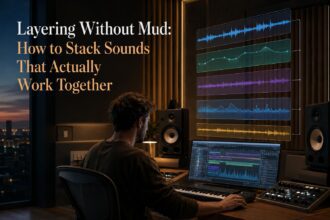
Layering Without Mud: How to Stack Sounds That Actually Work Together
`Layering is one of the fastest ways to make a production sound bigger, richer, wider, deeper, and more professional. It is also one of the fastest ways to destroy a mix before the mix even begins. Every producer eventually discovers the temptation. The kick feels weak, so another kick is added. The snare lacks body, so another snare joins the meeting. The lead feels thin, so three synths are stacked together. The pad sounds emotional, but maybe it needs a second pad, then a texture, then a shimmer layer, then a reversed atmosphere, then something “cinematic” because apparently every chord…
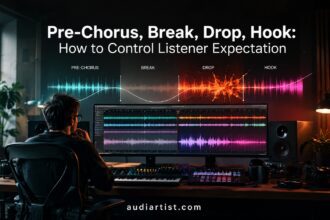
Pre-Chorus, Break, Drop, Hook: How to Control Listener Expectation
A strong track does not only sound good. It knows how to make the listener wait.That waiting is not empty time. It is tension. It is curiosity. It is the quiet pressure before a hook lands, the reduced section before a drop hits, the pause before the chorus opens, the breakdown that makes the return feel bigger. Great production is not just about what happens. It is about when it happens, how long the listener has to anticipate it, and how satisfying the payoff feels when it finally arrives. This is where listener expectation becomes one of the most powerful…
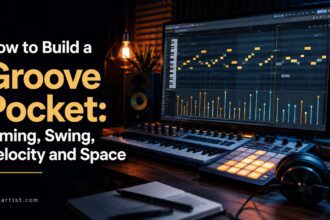
How to Build a Groove Pocket: Timing, Swing, Velocity and Space
A groove can be perfectly quantized and still feel wrong. The drums are on the grid. The bass is locked to the tempo. The hi-hats are technically correct. The kick lands where it should. The snare hits the backbeat. Nothing is late, nothing is early, nothing is broken. And yet, the beat does not move. It has rhythm, but no pocket.This is one of the biggest differences between programming drums and creating a groove. A drum pattern can be accurate without being musical. A bassline can be tight without being alive. A loop can be full of notes and still…
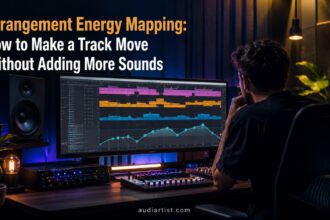
Arrangement Energy Mapping: How to Make a Track Move Without Adding More Sounds
There is a moment in almost every production session when the track feels stuck. The loop is solid. The drums work. The bass has weight. The chords create a mood. The hook is there. But after 45 seconds, something strange happens: the track stops moving. The beginner reaction is predictable. Add another synth. Add a percussion loop. Add a riser. Add a pad. Add a vocal chop. Add a second lead. Add a texture. Add a crash. Add another crash because the first crash looked lonely. Suddenly the session is bigger, the CPU is sweating, and the track still feels…
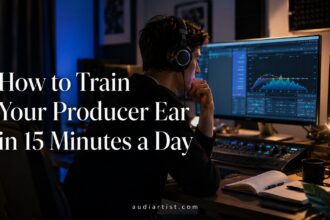
How to Train Your Producer Ear in 15 Minutes a Day
How to Train Your Producer Ear in 15 Minutes a Day Every producer wants better ears, but very few producers train them deliberately. Most beginners train by accident. They make beats, mix tracks, compare references, watch tutorials, adjust EQs, overthink the snare, question their life choices, and eventually improve through repetition. That works, but it is slow. It is also frustrating because the producer often knows something is wrong, but cannot yet identify what it is. Is the vocal too harsh, or is the beat too dull? Is the kick too loud, or is the bass masking it? Is the…